On this page
On 7 November 2026 the BBC reported that in a prolonged blackout it would keep broadcasting on FM radio from an emergency studio, using generator-backed transmitters, with supplies for at least three days. For households, the point is simple: you need a radio that receives FM and runs without mains power to hear it.
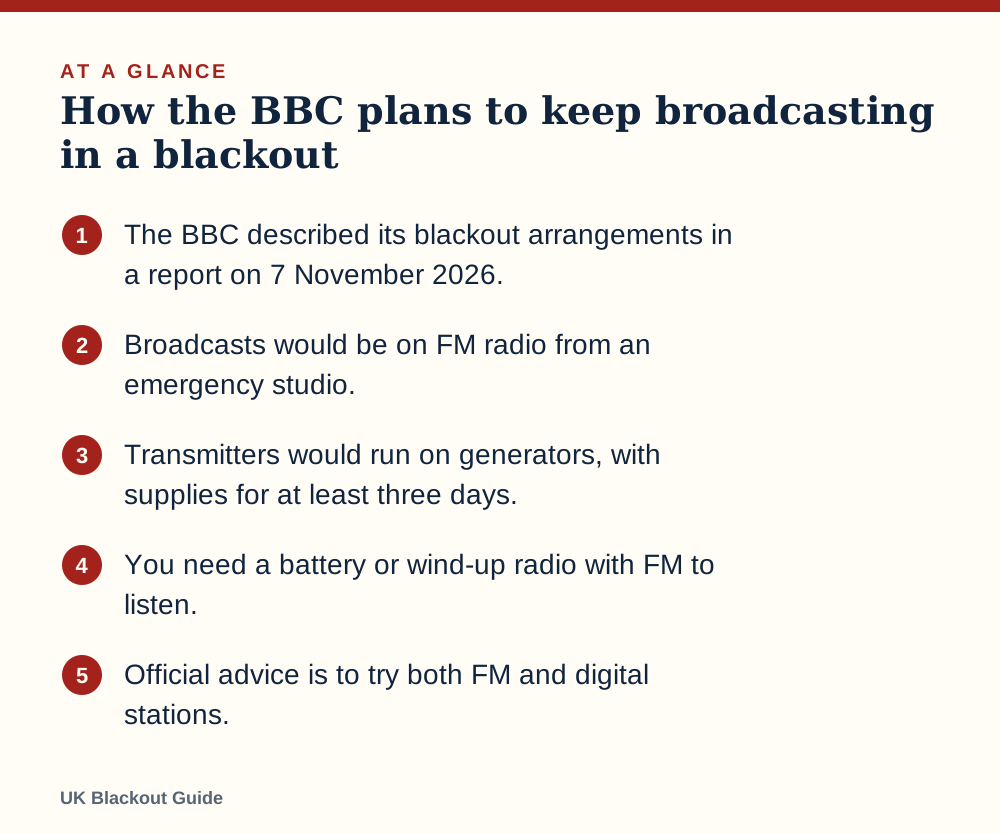
- The BBC described its blackout arrangements in a report on 7 November 2026.
- Broadcasts would be on FM radio from an emergency studio.
- Transmitters would run on generators, with supplies for at least three days.
- You need a battery or wind-up radio with FM to listen.
- Official advice is to try both FM and digital stations.
What the 7 November report described
The BBC's report, published on 7 November 2026, set out how the broadcaster would stay on air in a prolonged, wide-area power failure. Three details stand out.
- The medium is FM radio. Not television, not the website, not an app.
- The source is an emergency studio, feeding transmitters that have generator backup.
- The supplies are planned for at least three days.
The report described contingency arrangements. It did not say that a blackout was expected, and no national blackout has been forecast or announced. It came just over two weeks after the government launched its Be Ready campaign on 22 October 2026, and the two together drove much of the coverage we examine in what the 'Black Sky' reports say.
Why the plan rests on radio
Think about what each way of getting news needs at your end. A television needs mains power. Streaming needs mains power, a router and a working broadband network. A phone needs charge and a live mobile network, and official advice is that mobile networks may only work temporarily in some areas on backup power.
An FM radio needs a couple of batteries. One transmitter can reach a very large number of homes at once, and nothing has to be working in between. That is the practical case for broadcast radio as a fallback. The report's three-day supply figure is the same length as the three days the Be Ready campaign asks households to manage for, though neither source says one was set to match the other.
There is a past UK example on a local scale. When Storm Desmond flooded a substation in Lancaster in December 2015, mobile and internet services failed locally, and the local station The Bay kept broadcasting on a generator.
The radio you need at home
The government's Be Ready kit list asks for a battery or wind-up FM radio. The important words are 'battery or wind-up' and 'FM'. A mains-only kitchen radio, a smart speaker and a radio app on your phone all fail the test.
A wind-up set, such as the wind-up radios we recommend, has the advantage that it cannot run out of power for good. A minute or two of cranking gives a short period of listening, which is enough for a news bulletin.
A conventional battery portable, like the battery radios we recommend, is simpler and usually sounds better. With a spare set of batteries beside it, it will run for many hours.
FM, DAB and the advice to try both
The BBC's report was about FM. That does not make a DAB radio useless. Be Ready's advice is to use a battery or wind-up radio and try both FM and digital, because which transmitters are on air in your area will depend on the event.
The practical answer to whether DAB radio works in a power cut is a radio that has FM, with or without DAB as well. DAB sets also tend to use more power, so batteries do not last as long.
If you have a car, you already own a second radio with a large battery behind it, as explained in whether a car radio works in a blackout. Listen with the car outdoors, never in a closed garage with the engine running, because exhaust fumes contain carbon monoxide.
Ten minutes of preparation
Owning the radio is half the job. In the dark, with no internet to look anything up, you need to know where on the dial to go.
Tune in now, while the power is on. Find the BBC national stations and your BBC local station on FM, check which room gives the best reception, and write the radio frequencies worth keeping on a label stuck to the radio.
We have not seen a published list of which stations would carry emergency broadcasts, so do not rely on a single frequency. Note several, and include a local commercial station as well.
Then put the radio, its spare batteries and the list with your torch. Check them when you check the rest of your kit, every six months.
Common questions
Would BBC television work in a national blackout?
Your television needs mains power, so you could not watch it at home. The arrangements the BBC described on 7 November 2026 are for FM radio.
How long could the BBC keep broadcasting in a blackout?
The BBC's report described supplies for at least three days at its emergency studio and generator-backed transmitters.
Can I listen on my phone instead?
Radio apps stream over the internet, so they need a working network. A separate battery or wind-up FM radio is the reliable option.
Reviewed against these sources on 18 November 2026. If official advice has changed since, follow the official advice.
General information only. This page is not professional, safety, medical, legal or financial advice, and it is not official guidance. No national blackout has been forecast or announced, and nothing here suggests one is expected. We are independent and have no connection to the government or any energy company. Always check the official sources linked on this page. Full disclaimer
Keep reading
 Guide
Could a cyber attack cause a UK blackout?
The government has not said a cyber attack is expected to cause a UK blackout. How grid control systems work in general terms, and what households can do.
Read: Could a cyber attack cause a UK blackout? Question
Do mobile phones work in a power cut?
Your mobile keeps working while its battery lasts, but masts rely on backup power that may only hold temporarily. What to expect and how to stay in touch.
Read: Do mobile phones work in a power cut? Question
Is the UK blackout warning real?
Is the UK blackout warning real? The Be Ready campaign is real, but it is preparedness advice. No official body has warned that a blackout is coming.
Read: Is the UK blackout warning real? Guide
What is a black start, and how is the grid restarted?
A black start is the process of restarting an electricity grid after a total shutdown. How it works, how long it takes and what the 2026 standard requires.
Read: What is a black start, and how is the grid