On this page
A black start is the process of restarting the electricity grid after a total or near-total shutdown. Selected power sources that can start without outside electricity energise small sections of the network, then more generators and customers are added step by step until the whole system is rejoined. Great Britain has never had to do it for the whole grid.
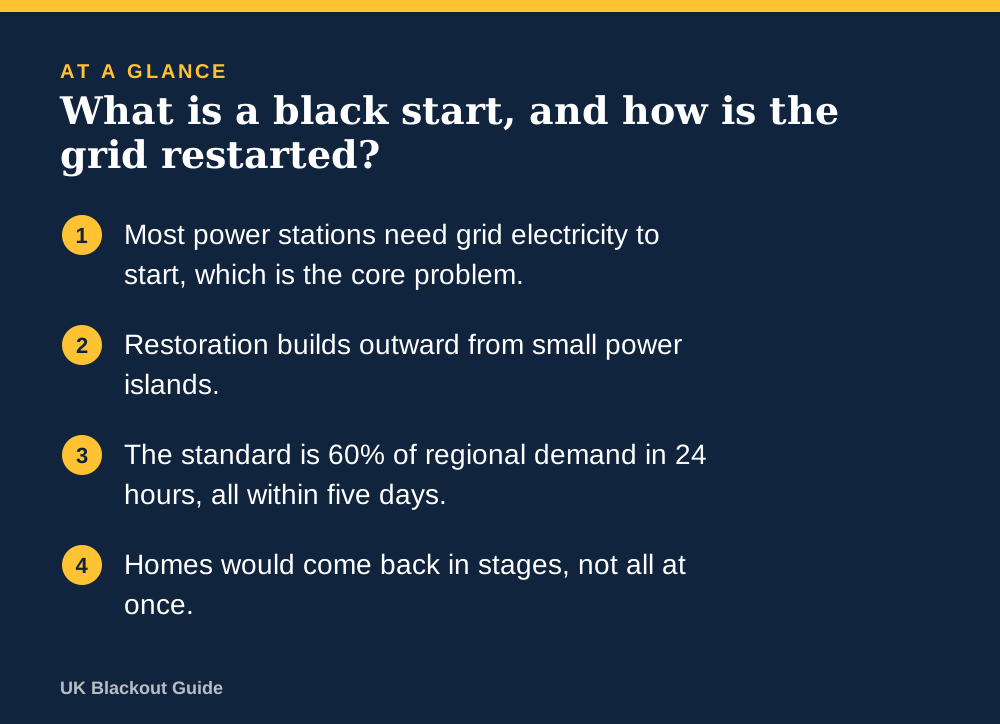
- Most power stations need grid electricity to start, which is the core problem.
- Restoration builds outward from small power islands.
- The standard is 60% of regional demand in 24 hours, all within five days.
- Homes would come back in stages, not all at once.
Why a dead grid is hard to restart
A large power station is a factory that happens to make electricity. It needs pumps, fans, control systems and cooling running before it can generate anything, and those normally take their power from the grid. With the grid dead, most stations cannot start themselves.
The second difficulty is balance. The electricity grid works only while supply and demand match, and in a restart they have to match from the first moment. You cannot switch on a region of a million homes and then go looking for the generation to feed it. Each block of customers has to be added only when there is a generator ready to carry it.
The engineers who do this work now tend to call it electricity system restoration. Black start is the older name and the one that has stuck with the public.
The restart, step by step
- Isolate. The network is broken into sections with every switch open, so nothing is connected by accident.
- Start the starters. A few contracted sites that can start unaided, using their own batteries or small on-site generators, bring themselves up.
- Energise a section. Each one feeds power into a short stretch of the network and on to a nearby larger power station, which uses it to start.
- Add demand in blocks. Local customers are reconnected in measured steps to give the generators a stable load. This forms a power island, a small working grid on its own.
- Grow the islands. More stations and more customers are added to each island.
- Join them up. Neighbouring islands are synchronised so their frequencies match exactly, then linked. This repeats until the country is one system again.
Every step involves people in control rooms and at substations talking to each other, which is why the energy industry keeps its own communications able to run without mains power.
Which power sources can start the grid
Traditionally the job fell to large stations that could self-start, such as hydro plants and some fossil-fuelled stations with their own auxiliary generators. The pool of providers has since widened to other kinds of technology and to sources in more parts of the country.
Home solar panels play no part. Most domestic solar panels shut off automatically in a power cut, for the safety of engineers working on the lines, unless they have battery backup able to run independently of the grid.
How long it would take
The government set an Electricity System Restoration Standard in 2021. By the grid restoration deadline of 31 December 2026, NESO, the National Energy System Operator, must have the capability to restore 60% of demand in each region within 24 hours and 100% of Great Britain's demand within five days.
Two details in that wording matter. The 60% figure applies in each region, so no part of the country should be left far behind the rest. And it is a standard for capability, not a promise about any particular event. The National Risk Register notes that restoring the transmission system could take up to about seven days.
One real event abroad is on record. When Spain and Portugal lost all power on 28 April 2025, most supply was restored by the early hours of the next day. That is what happened there, not a guide to what would happen here or to how long a national blackout might last.
What a restart would look like from your home
Power would return unevenly. Your town might come back hours or days before one fifty miles away, depending on where it sits relative to the starting stations. Do not read anything into a neighbouring area getting power first.
It may also come and go. While islands are small they are fragile, and engineers may need to disconnect an area again to keep the system stable. Treat the first return of power as provisional, and follow the usual steps for when the power comes back: recharge phones and power banks straight away, and hold off running everything at once.
Leave one light switched on so you know when power returns, but keep ovens, heaters and irons off and unplug televisions and computers. A surge can occur when supply is restored, which is the case for unplugging things in a power cut.
Sensitive electronics can be protected with a surge-protected extension lead.
How you would hear what is happening
During a full restart, broadband would be down and mobile networks might work only briefly on backup power. Broadcast radio is the planned fallback for getting news in a blackout. The BBC has described plans to keep broadcasting on FM from an emergency studio, with generator-backed transmitters and supplies for at least three days.
That makes a battery or wind-up radio the one item that connects you to the restoration effort. You would hear which regions are back, what to expect and any safety advice.
How well rehearsed this is
Because a national black start has never been needed in Great Britain, confidence comes from testing and exercises instead of experience. Individual stations and sections of network are tested, and in 2023 the government ran Exercise Mighty Oak, a national power outage exercise that rehearsed the wider response.
None of this is a forecast. The National Risk Register rates a national outage as low likelihood but very high impact, and no national blackout has been forecast or announced. For households, the Be Ready campaign asks for the ability to manage for three days, and the government has not asked for more.
Common questions
Has Great Britain ever carried out a full black start?
No. The whole grid has never shut down, so a national restart has never been needed. Parts of the process are tested regularly.
Why can't all the power stations just be switched back on together?
Most need electricity to start, and supply must match demand at every moment. Adding too much of either at once would trip the system again.
Would my home solar and battery help restart the grid?
No. Home systems are designed to disconnect from the grid in a power cut. A battery able to run independently can power your own home but not the street.
- National Energy System Operator (NESO)
- National Risk Register, Cabinet Office
- Be Ready campaign, UK government
Reviewed against these sources on 18 November 2026. If official advice has changed since, follow the official advice.
General information only. This page is not professional, safety, medical, legal or financial advice, and it is not official guidance. No national blackout has been forecast or announced, and nothing here suggests one is expected. We are independent and have no connection to the government or any energy company. Always check the official sources linked on this page. Full disclaimer
Keep reading
 Explainer
How the BBC plans to keep broadcasting in a blackout
A BBC report on 7 November 2026 set out how it would keep broadcasting on FM radio through a long blackout. What it said and what radio you need to hear it.
Read: How the BBC plans to keep broadcasting in a Explainer
The government's Be Ready campaign: what it asks households to do
The government's Be Ready campaign, launched 22 October 2026, asks every household to be able to manage for three days. The full kit list and what it means.
Read: The government's Be Ready campaign: what it Explainer
'Black Sky' planning: what the reports actually say
What the autumn 2026 'Black Sky' reports are based on: the Be Ready launch, a BBC report on emergency broadcasting, and long-standing national risk planning.
Read: 'Black Sky' planning: what the reports Question
Do mobile phones work in a power cut?
Your mobile keeps working while its battery lasts, but masts rely on backup power that may only hold temporarily. What to expect and how to stay in touch.
Read: Do mobile phones work in a power cut?