On this page
No, not everything. Official advice is to turn off appliances that make heat (irons, ovens, electric fires, fryers) and to unplug sensitive electronics such as the TV and computer, because a surge can follow when power returns. Leave the fridge and freezer plugged in with the doors shut, and leave one light switched on.
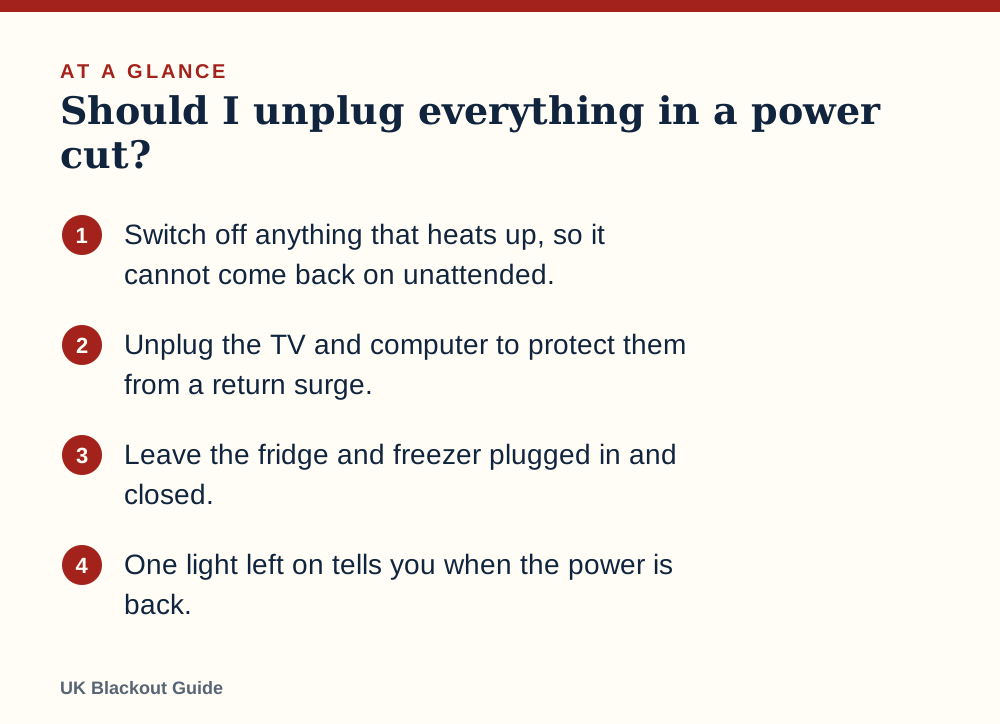
- Switch off anything that heats up, so it cannot come back on unattended.
- Unplug the TV and computer to protect them from a return surge.
- Leave the fridge and freezer plugged in and closed.
- One light left on tells you when the power is back.
What to switch off, unplug or leave alone
The UK government's Be Ready advice gives two specific instructions for a power cut. Turn off irons, ovens, electric fires and fryers, and unplug the TV and PC. Everything else is a judgement call, and this table shows how we would decide what to switch off in a power cut around the house.
| Item | What to do | Why |
|---|---|---|
| Oven, hob, iron, fryer, electric fire, hair straighteners | Switch off at the appliance and the wall | They restart when power returns, possibly while you are out or asleep |
| TV, computer, games console | Unplug | Electronics are the most exposed to a surge |
| Fridge and freezer | Leave plugged in, doors shut | They need to restart on their own as soon as power is back |
| One ceiling light | Leave switched on | It shows you the moment supply returns |
| Boiler | Leave alone | Most restart themselves |
| Medical equipment | Follow the maker's or your clinician's instructions | Advice varies by device |
Heat appliances are the real safety risk
The biggest danger is forgetting what was on. A hob ring or an iron left on when the lights went out will heat up again the second supply returns, whether or not anyone is in the room. Switching these off is about preventing a fire, and it matters more than anything else on the list.
If you leave the house during a power cut, check the cooker, iron and any electric heaters are off before you go.
Why electronics are worth unplugging
Power does not always come back cleanly. Supply can flicker on and off several times as engineers reconnect sections of the network, and there can be a brief voltage spike. Fridges and lamps shrug this off. Televisions, computers and consoles are less tolerant, which is the case for protecting appliances from power surges.
Pulling the plug is free and completely effective. For kit you would rather leave connected, or for cuts that happen while you are out, a surge protected extension lead gives a layer of defence.
When the power returns
When the power comes back, wait a few minutes before you plug everything back in, in case the supply drops again. Then reconnect a few items at a time, reset clocks and timers, and check the freezer if the cut was a long one.
Common questions
Should I turn off the main switch at the fuse box?
It is not part of the official advice for an ordinary power cut. Turning off heat appliances and unplugging electronics does the job, and leaving the main switch on lets the fridge and freezer restart.
Do I need to unplug phone chargers and lamps?
No. They are low risk. Concentrate on heat appliances and expensive electronics.
Does switching off at the wall protect against a surge?
A wall switch helps, but physically unplugging is the certain way to isolate valuable electronics.
Reviewed against these sources on 18 November 2026. If official advice has changed since, follow the official advice.
General information only. This page is not professional, safety, medical, legal or financial advice, and it is not official guidance. No national blackout has been forecast or announced, and nothing here suggests one is expected. We are independent and have no connection to the government or any energy company. Always check the official sources linked on this page. Full disclaimer
Keep reading
 Buying guide
Best surge protectors for power cuts
Surge protectors for power cuts: extension leads that guard a TV, computer or router from the spike when the mains returns, chosen from Amazon UK listings.
Read: Best surge protectors for power cuts Guide
What to switch off and unplug in a power cut
Which appliances to switch off or unplug in a power cut and which to leave alone, with a room-by-room table covering cookers, heaters, TVs and freezers.
Read: What to switch off and unplug in a power cut Guide
What to do when the power comes back on
What to do when the power comes back on after a cut: reconnect appliances safely, check fridge and freezer food, reset the boiler and restock your kit.
Read: What to do when the power comes back on Question
Can a power cut damage appliances?
A power cut rarely harms appliances by itself. The risk comes from surges and flickering when supply returns, and from computers losing power mid-task.
Read: Can a power cut damage appliances?