On this page
Yes, in almost all cases. Battery smoke alarms do not use mains power at all, and mains-wired alarms normally contain a backup battery that takes over during a cut. The exception is an alarm whose battery is flat or missing. Press the test button on each one to check, because fire risk goes up when people use candles and stoves.
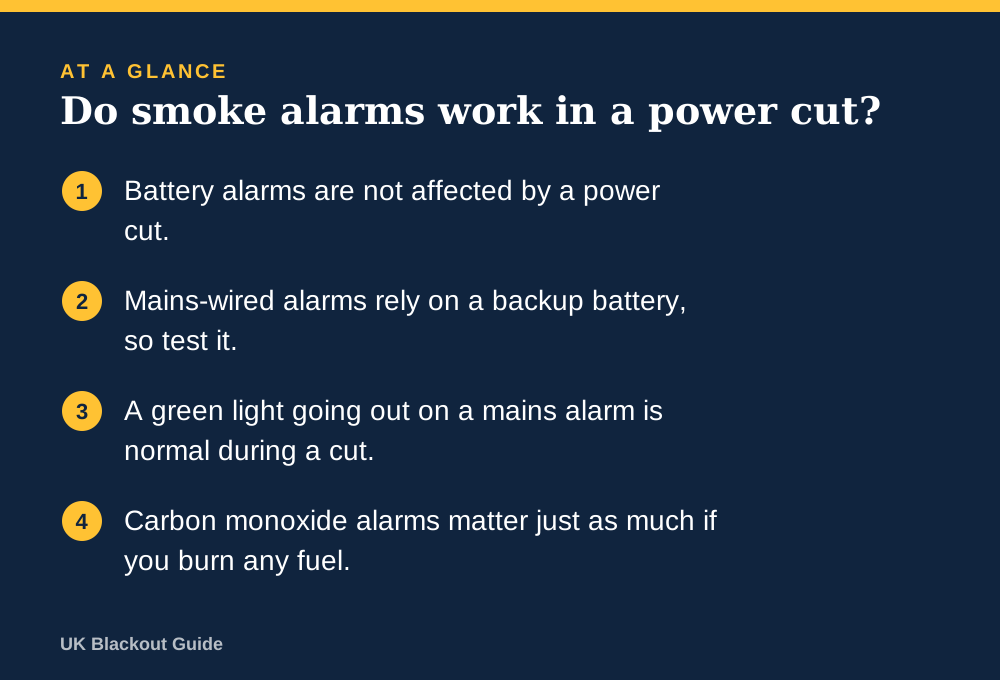
- Battery alarms are not affected by a power cut.
- Mains-wired alarms rely on a backup battery, so test it.
- A green light going out on a mains alarm is normal during a cut.
- Carbon monoxide alarms matter just as much if you burn any fuel.
How each type behaves
| Alarm type | In a power cut | What to check |
|---|---|---|
| Replaceable battery | Works as normal | Test it and change the battery when it chirps |
| Sealed long-life battery | Works as normal | Test it and note the replace-by date on the unit |
| Mains-wired with backup battery | Switches to its battery | The mains light goes out. Test it during the cut |
| Mains-wired with no working backup | Does not work | Rare, usually an old unit or a removed battery. Replace it |
If you are not sure which you have, look for a small green light. A steady green light in normal times means the alarm is on mains power. Mains alarms are also usually linked, so that one sounding sets off the rest.
Test them, because the risk is higher
A power cut is when a working smoke alarm earns its keep. People light candles, cook on camping stoves, run heaters they have not used for years and move about in the dark. Fire and rescue services give the same advice as the government's Be Ready campaign: torches are safer than candles.
Press and hold the test button on every alarm. It should sound loudly within a few seconds. If one stays silent, replace the battery or fit a new battery smoke alarm. A single chirp every minute or so means the battery is low.
If you do use candles, read our candle safety advice first.
Carbon monoxide alarms and heat alarms
Carbon monoxide (CO) alarms work the same way: battery models are unaffected and mains models fall back on a battery. Most homes with a gas boiler, fire or wood burner should already have one.
Never use a generator, barbecue, camping stove or patio heater indoors, in a garage or in a tent. Carbon monoxide has no smell. Headache, dizziness, nausea and breathlessness are warning signs of carbon monoxide poisoning. Get into fresh air and call the gas emergency line on 0800 111 999 if you suspect a leak from a gas appliance.
After the power returns
Mains alarms may give a short beep as supply comes back, then the green light returns and the backup battery tops itself up. If an alarm keeps chirping the next day, its backup battery needs replacing. With the lights back on, it is a good moment to check escape routes and the rest of your fire safety in a power cut.
Common questions
Why did my smoke alarm beep when the power went off?
Many mains-wired alarms give a brief beep when they switch to battery or back to mains. Continued chirping means the backup battery is low.
How often should I test smoke alarms?
Fire and rescue services recommend testing regularly. Once a month is the usual advice, and it is worth an extra test at the start of any power cut.
Do heat alarms in kitchens work in a power cut?
They follow the same rule. Battery models are unaffected and mains models use their backup battery.
Reviewed against these sources on 18 November 2026. If official advice has changed since, follow the official advice.
General information only. This page is not professional, safety, medical, legal or financial advice, and it is not official guidance. No national blackout has been forecast or announced, and nothing here suggests one is expected. We are independent and have no connection to the government or any energy company. Always check the official sources linked on this page. Full disclaimer
Keep reading
 Buying guide
Best power cut essentials: the blackout kit worth buying
The blackout kit worth buying for a UK power cut: a battery torch, a lantern, a power bank, a wind-up radio, an automatic light and a flask, with picks.
Read: Best power cut essentials: the blackout kit Buying guide
Best surge protectors for power cuts
Surge protectors for power cuts: extension leads that guard a TV, computer or router from the spike when the mains returns, chosen from Amazon UK listings.
Read: Best surge protectors for power cuts Guide
Driving during a wide power cut
Driving in a power cut: what to do when traffic lights are out, why fuel pumps and card machines stop, and how to use your car safely for power and news.
Read: Driving during a wide power cut Guide
The first 24 hours without power
An hour-by-hour plan for the first 24 hours without electricity at home: what to do first, when food becomes a risk and how to ration phone battery.
Read: The first 24 hours without power