On this page
Fire risk rises in a power cut because people bring flames, fuel and makeshift heating into the home. Use battery lights in place of candles, cook only on equipment meant for the job with ventilation, store fuel outside the living space, switch off cookers and heaters at the wall, and check your smoke alarms have working batteries. In a fire, get out and call 999.
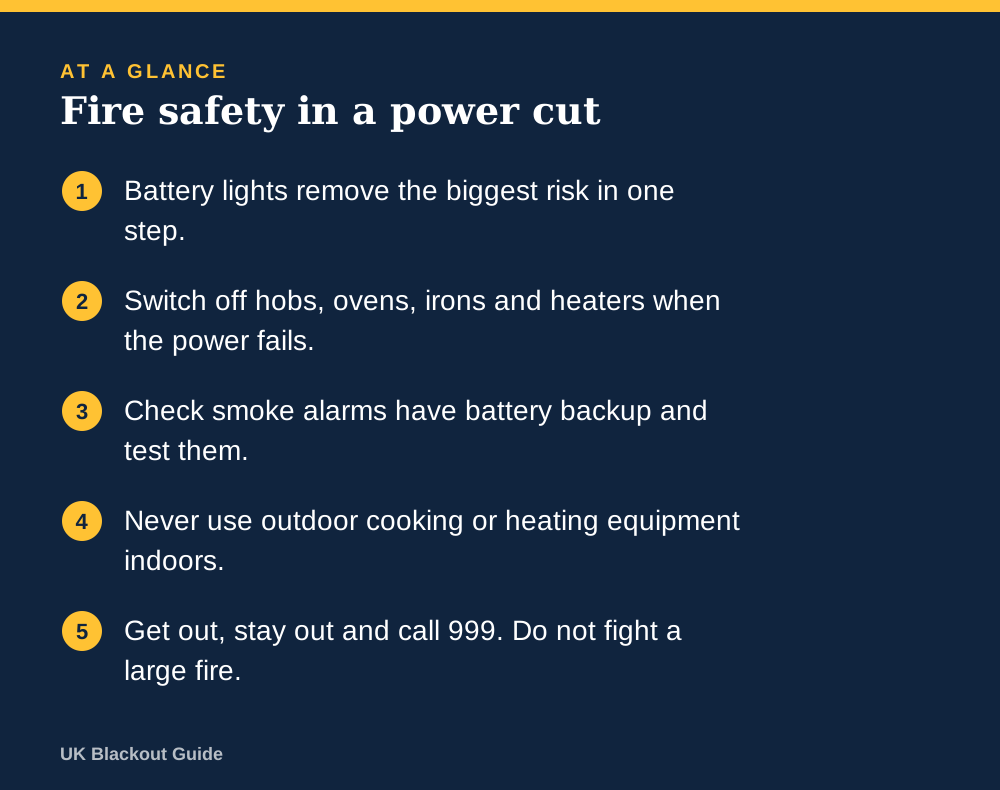
- Battery lights remove the biggest risk in one step.
- Switch off hobs, ovens, irons and heaters when the power fails.
- Check smoke alarms have battery backup and test them.
- Never use outdoor cooking or heating equipment indoors.
- Get out, stay out and call 999. Do not fight a large fire.
Where the extra risk comes from
Electricity is the safest way most homes have ever had of making light and heat. When it stops, people reach for older methods they rarely practise: candles, gas canisters, open fires, petrol. At the same time the house is dark, exits are harder to find and everyone is tired.
Each risk has a simple control. This page goes through them in the order a power cut tends to unfold.
The first minute: switch off what was on
The official Be Ready advice is to turn off irons, ovens, electric fires and fryers when the power fails. The reason is what happens later. Power often returns in the middle of the night or when you have gone out, and a hob ring left on under a pan or an electric fire with washing draped nearby will start up unattended.
Walk round the kitchen and the rooms you were using, and switch these off at the appliance and the wall, along with the rest of what to switch off in a power cut.
Light: choose batteries over flames
Be Ready settles the question of torches versus candles directly: torches are safer. A candle is an open flame that can be knocked over by a child, a pet, a curtain or a sleeve, and people fall asleep with them burning.
LED lanterns and torches give more light for longer and cannot start a fire. If you like the look of candlelight, battery LED candles give the glow without the flame.
If candles are all you have, basic candle safety is to stand them in a proper holder on a flat, heatproof surface, well clear of curtains and shelves. Keep them away from children and pets, never carry them from room to room, and put them out before you leave the room or go to sleep.
Never use candles, matches or any naked flame in a home where medical oxygen is in use. Oxygen makes materials burn far more fiercely.
Smoke alarms must still work
Battery smoke alarms are unaffected by a power cut. Mains-wired alarms normally have a backup battery, but it may be years old, so whether smoke alarms work in a power cut depends on the type you have. Press the test button on every alarm now, and again during a cut if you are unsure.
You should have at least one smoke alarm on every floor. If you will be using any fuel-burning appliance, you also need a carbon monoxide alarm, which is a separate device.
Cooking and heating without mains power
A camping stove is a sensible way to heat food and water, used correctly, which means outdoors, because using a camping stove indoors is not safe. Place it on a stable, level, heatproof surface with clear space above and around it. Never leave it lit and unattended, never change a gas canister near a flame, and let it cool before packing away.
Barbecues, patio heaters and generators must never be used indoors, in a garage or in a tent. They are a fire risk and they produce carbon monoxide, which has no smell and can kill. Fit an audible CO alarm marked EN 50291.
Do not use a gas oven or hob to heat a room. If you light an open fire or wood burner that has not been used for a while, be aware that an unswept chimney can catch fire. Use a fireguard, and keep airing racks and blankets well back.
Keep a fire blanket where you cook. It smothers a pan fire or a small stove fire without the mess and risk of water.
Fuel, generators and batteries
Petrol vapour ignites easily, which is the first thing to know about whether it is safe to store fuel at home. The HSE says you can keep up to 30 litres at home without notifying anyone, in suitable containers, in a garage or shed and never in the living space. Refuel a generator only when it is switched off and cool, a basic rule of generator safety.
Spare gas canisters belong somewhere cool and ventilated, away from the stove you are using.
Lithium batteries in power banks and power stations are safe when used as intended. Charge them on a hard surface, not on a bed or sofa, use the charger supplied, and stop using any battery that is swollen, damaged or hot.
Escape routes in the dark
A fire at night in a house with no lights is disorientating. Keep a torch by every bed. Keep stairs and hallways clear of the blankets, boxes and extension leads that accumulate during a cut. Know where the door keys are, and agree where you would meet outside.
Remember that electric garage doors, gates and some door-entry systems may not open. Find the manual release before you need it.
If a fire starts
Get everyone out, close doors behind you if you can, stay out and call 999. Emergency calls from a mobile can use any network with signal. If you cannot get through, go to a neighbour.
Only tackle a fire if it is very small, you have the right equipment and your way out is behind you. A home fire extinguisher is for the first few seconds of a small fire, nothing more.
Many fire and rescue services offer free home fire safety visits, so ask yours.
Checklist
Fire safety in a power cut
- Test every smoke alarm
- Fit a carbon monoxide alarm if you burn any fuel
- Put a torch by every bed
- Replace candles with battery lanterns or LED candles
- Mount a fire blanket near the kitchen door
- Store fuel and spare gas outside the living space
- Find manual releases for electric doors and gates
- Agree a meeting point outside
Common questions
Are tea lights safer than tall candles?
They are harder to knock over but still an open flame, and they can overheat the surface beneath them. Battery tea lights avoid the risk.
Can I leave a candle burning overnight as a night light?
No. Never sleep with a candle lit. Use a battery or rechargeable night light.
Will my fire extinguisher work on a chip pan fire?
Most general home extinguishers are not suitable for burning oil. Turn off the heat if it is safe, use a fire blanket, and never use water.
Do I need a carbon monoxide alarm as well as a smoke alarm?
Yes, if you burn any fuel in the home. Smoke alarms do not detect carbon monoxide.
Reviewed against these sources on 18 November 2026. If official advice has changed since, follow the official advice.
General information only. This page is not professional, safety, medical, legal or financial advice, and it is not official guidance. No national blackout has been forecast or announced, and nothing here suggests one is expected. We are independent and have no connection to the government or any energy company. Nothing here is medical advice: follow your own clinician, pharmacist or equipment supplier. Always check the official sources linked on this page. Full disclaimer
Keep reading
 Buying guide
Best fire extinguishers and fire blankets for power cuts
Fire extinguishers and fire blankets for power cuts, when candles and stoves raise the risk. Amazon UK listings compared on type, standards and ratings.
Read: Best fire extinguishers and fire blankets for Buying guide
Best battery smoke alarms that work in a power cut
Battery smoke alarms that work in a power cut, chosen from Amazon UK listings on sealed battery life, stated standards, pack size and buyer ratings.
Read: Best battery smoke alarms that work in a Buying guide
Best CPAP battery backups for power cuts
CPAP battery backups for a power cut at night, chosen from Amazon UK listings on stated watt-hours, voltage and machine compatibility, with runtime maths.
Read: Best CPAP battery backups for power cuts Question
Can I get a free backup battery for my landline for power cuts?
Who can get a free battery backup for a digital landline, how to ask your phone provider, how long it lasts and what to do if you do not qualify for one.
Read: Can I get a free backup battery for my