On this page
A mains oxygen concentrator stops when the power does, so home oxygen users are normally given a backup cylinder that needs no electricity. Know where yours is and how to switch to it, keep your oxygen supplier's emergency number written down, and join the Priority Services Register. If you become breathless or unwell and cannot restore your oxygen, call 999.
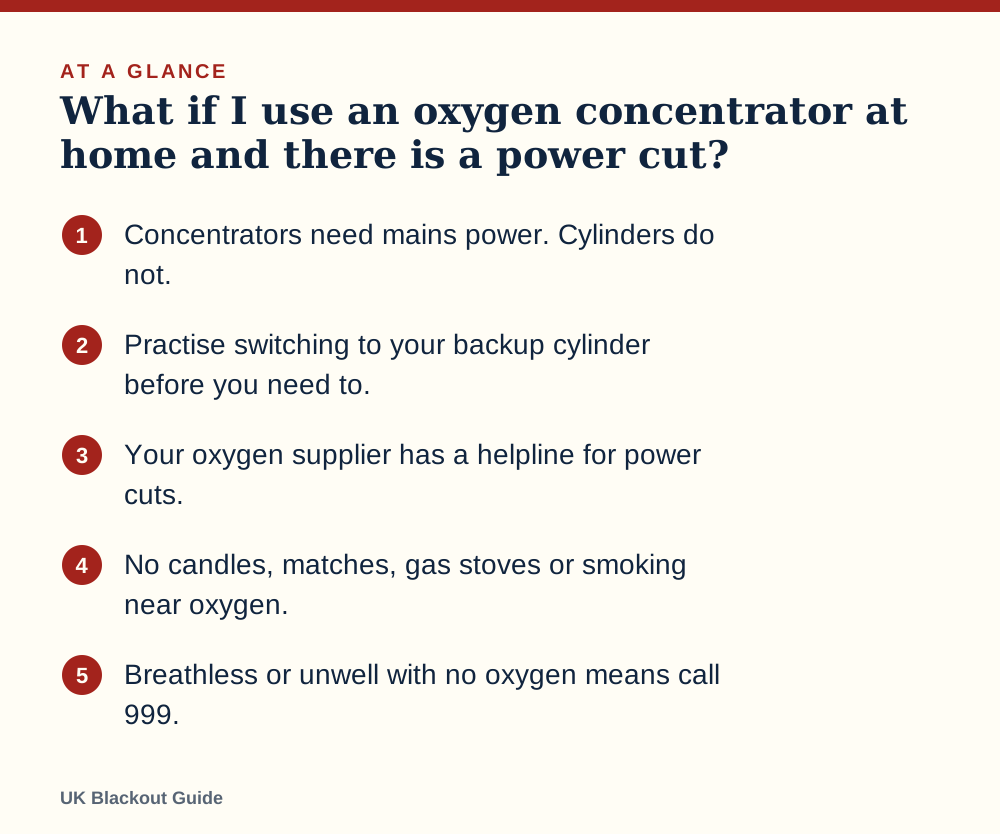
- Concentrators need mains power. Cylinders do not.
- Practise switching to your backup cylinder before you need to.
- Your oxygen supplier has a helpline for power cuts.
- No candles, matches, gas stoves or smoking near oxygen.
- Breathless or unwell with no oxygen means call 999.
What stops and what keeps going
Home oxygen comes in a few forms, and they behave differently when the mains fails.
| Equipment | In a power cut |
|---|---|
| Mains concentrator | Stops. Most sound an alarm |
| Portable concentrator | Runs on its battery until that is flat |
| Oxygen cylinders | Unaffected. No electricity needed |
| Liquid oxygen | Unaffected |
If you use a mains concentrator, your supplier will normally have provided a backup cylinder for exactly this situation. How long it lasts depends on its size and your prescribed flow rate. Ask your supplier for the figure for your setup and write it on the cylinder.
Do these things this week
- Find the backup cylinder and check its gauge. Ask the supplier to show you, or a family member, how to switch over. Practise once in daylight.
- Write down the supplier's emergency number and keep it by the concentrator. Home oxygen suppliers run helplines at all hours and can deliver more cylinders in a long outage.
- Tell the supplier if you have had power cuts before or live somewhere remote. They may leave extra backup.
- Join the Priority Services Register. It is free and tells your network operator that someone at your address depends on powered medical equipment.
- Keep a torch beside the equipment. You will be changing over in the dark.
A plug-in alarm that sounds when the mains fails is a useful second warning, particularly at night. See the power failure alarms round-up.
No naked flames. This matters more than usual
Never use candles, matches, lighters, gas stoves, gas heaters or open fires in a room where oxygen is in use or stored, and never smoke or vape near it. Oxygen makes clothing, bedding and furniture burn far faster and hotter.
Power cuts are exactly when people reach for candles and camping stoves, so plan around this in advance. Use battery torches and lanterns only. If someone else in the home wants to cook on a gas stove, it must be in a different, ventilated room, well away from you and your equipment. The background is in our guide to candle safety.
Follow the fire safety advice your supplier gave you at installation.
Can a battery run a concentrator?
Sometimes, for a limited time. Mains concentrators run continuously and generally draw far more power than a phone charger or a lamp. The wattage is on the machine's rating label. A portable power station may be able to supply it, but the hours are modest. As a rough guide, runtime is the station's watt-hours times 0.85, divided by the concentrator's watts. If a machine drew 300 W, for example, a 1,000 Wh station would give under three hours on paper.
Ask your oxygen supplier before trying it. They can confirm the wattage and whether your model may be run this way.
Our portable power stations list shows capacities and outputs. Never run a petrol generator indoors or near windows. Carbon monoxide has no smell and is especially dangerous for anyone with a lung condition.
When to call, and who
Call your oxygen supplier as soon as a cut looks likely to last, so they can plan a delivery. Report the cut on 105, or 03457 643643 in Northern Ireland, and say that you use oxygen.
Call 999 if you are more breathless than usual, feel confused or drowsy, your lips look blue, or your backup is running low with no replacement on the way. Do not wait. If the phones are unreliable, our guide to reaching 999 in a power cut lists what to try. The wider plan for home devices is in medical equipment in a power cut.
This is general information. Your respiratory team and oxygen supplier know your prescription, and their instructions come first.
Common questions
How long will my backup oxygen cylinder last?
It depends on the cylinder size and your prescribed flow rate. Your oxygen supplier can give you the figure for your equipment.
Will my supplier bring more oxygen in a long power cut?
Home oxygen suppliers run emergency helplines and can deliver extra cylinders. Call early, since roads and phones may be affected in a wide outage.
Can I use a gas camping stove if I have oxygen in the house?
Not in the room where oxygen is used or stored. Any flame must be in a separate, ventilated room well away from the equipment.
Reviewed against these sources on 18 November 2026. If official advice has changed since, follow the official advice.
General information only. This page is not professional, safety, medical, legal or financial advice, and it is not official guidance. No national blackout has been forecast or announced, and nothing here suggests one is expected. We are independent and have no connection to the government or any energy company. Nothing here is medical advice: follow your own clinician, pharmacist or equipment supplier. Always check the official sources linked on this page. Full disclaimer
Keep reading
 Guide
Medical equipment at home in a power cut
How to plan for a power cut if you rely on medical equipment at home: who to tell, what to ask your supplier, backup power options and when to call 999.
Read: Medical equipment at home in a power cut Guide
Pets in a power cut, including fish tanks and reptiles
How to look after dogs, cats, small animals, reptiles, birds and fish in a power cut, including food, water, warmth and which pets need backup power.
Read: Pets in a power cut, including fish tanks and Question
Powered wheelchairs and mobility scooters in a power cut: what to plan for
Whether a powerchair or mobility scooter needs backup power in a power cut, how to stay charged, charging from a power station and what else to plan for.
Read: Powered wheelchairs and mobility scooters in Question
How do I keep a fish tank alive in a power cut?
How to keep aquarium fish alive in a power cut: oxygen, filter bacteria and temperature, what to do hour by hour and how to power a pump from a battery.
Read: How do I keep a fish tank alive in a power