On this page
Dogs and cats cope with a power cut much as you do: keep three days of food and water, a torch for walks and their usual routine. Pets that depend on powered heat, filtration or air, such as reptiles and fish, need a plan made in advance, usually insulation first and a battery power station for the equipment that cannot stop.
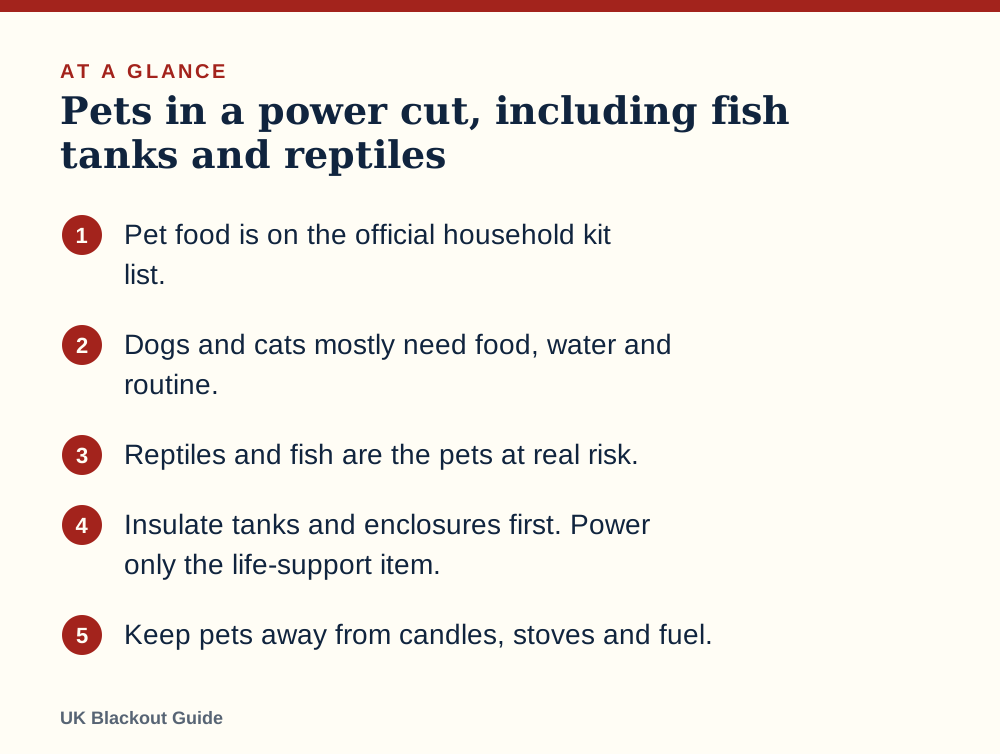
- Pet food is on the official household kit list.
- Dogs and cats mostly need food, water and routine.
- Reptiles and fish are the pets at real risk.
- Insulate tanks and enclosures first. Power only the life-support item.
- Keep pets away from candles, stoves and fuel.
Which pets need a plan, and how urgent it is
How much a power cut matters depends almost entirely on the species. A labrador will sleep through it. A tropical fish tank is on a clock from the first minute.
| Pet | Main concern | How soon |
|---|---|---|
| Dogs and cats | Food, water, getting out in the dark | Days |
| Rabbits, guinea pigs, hamsters | Cold in winter, heat in summer | Many hours |
| Cage birds | Cold, draughts and fumes | Hours |
| Reptiles and amphibians | Loss of heat lamps and mats | Hours, depending on species and season |
| Fish | Loss of filtration, air and heat | A few hours |
The timings are a rough guide only. Your vet, or a specialist keeper's society for exotic species, can tell you what your animal tolerates.
Food and water for three days
The government's Be Ready campaign includes pet food in its household kit, alongside your own three days of supplies. Keep at least that much dry or tinned food beyond the open bag. If it is tinned, it needs a manual tin opener.
Pets need water too, and mains supply can be disrupted in and after a power cut. Add your animals to the household sum when you work out how much water to store. Measure what your animals drink on a normal day and multiply by three, allowing more in hot weather.
Keep a week of any regular medication, with the vet's number written down. If a medicine lives in the fridge, ask the vet now what to do if it warms up.
Dogs and cats
Keep to normal feeding and walk times. Animals read your mood, and routine settles them. For evening walks you need a torch or head torch and something reflective on the dog, because streetlights will be off and drivers will not see either of you.
Keep cats indoors after dark if they will tolerate it. Electric cat flaps with microchip readers usually run on batteries and keep working, but check yours. Electric garage doors and gates may not open, so know where the manual release is before a pet is shut behind one.
In a cold house, dogs and cats will find the warm spot themselves. That is usually your lap. Elderly, very young or thin-coated animals appreciate a blanket and a raised bed off a cold floor.
Small animals and birds
Bring outdoor hutches into the house or a sheltered spot if it is cold, add extra bedding and cover part of the cage with a blanket, leaving ventilation. In a heatwave the worry reverses: move cages to the coolest room and out of the sun.
A reusable hand warmer or heat pack wrapped in a towel, placed in one corner so the animal can move away from it, adds gentle warmth for a few hours.
Birds are extremely sensitive to fumes. Never use a camping stove, gas heater or generator in a room with them. Carbon monoxide in a power cut harms pets as well as people, and they often show effects first.
Reptiles, amphibians and fish
These animals rely on equipment, so think like an engineer. Step one is always to slow the heat loss. Wrap the vivarium or tank in blankets, duvets or sheets of polystyrene, leaving a little ventilation, and keep the lid on. Do not feed, since digestion needs warmth and uneaten food fouls water.
Step two is to power only what matters. A heat mat or a small aquarium air pump draws a few watts and can run for many hours from a modest battery. A basking lamp or a large aquarium heater draws far more, for the same reason that settles whether a power station can run a heater. Check the label on each item and add up the watts.
Runtime in hours is roughly the power station's watt-hours times 0.85, divided by the load in watts. A 300 Wh station running a 15 W heat mat gives about 17 hours on paper. Run the same sum for your own equipment before picking from the portable power stations on sale.
Fishkeepers have more to manage, because keeping a fish tank alive in a power cut means looking after air, filters and temperature together.
Flames, fuel and curious animals
A wagging tail and a candle on a coffee table are a classic cause of house fires. Use battery lanterns, and follow the rules of candle safety if you light any at all. Keep camping stoves off the floor, flasks out of reach and generator fuel shut away.
If you have to leave
In a long outage, weighing up whether to stay or leave may end with a move to family who have power. Take the pets. Keep carriers where you can reach them, with a lead, food, bowl, medication and vaccination record in a bag beside them. Check that microchip details are current.
If an animal becomes very lethargic, struggles to breathe or collapses, ring your vet's emergency number. Keep it written down, since you may not be able to search for it.
Common questions
Do I need a generator for my pets?
Almost never. Insulation plus a small battery power station covers the low-wattage equipment that most pets need. Generators must stay outdoors and produce fumes that are dangerous to animals.
Can I use a hot water bottle for a pet?
A warm, not boiling, bottle wrapped in a towel can help dogs, cats and small mammals if they can move away from it. Avoid it with animals that chew rubber.
Will my pet's microchip cat flap work?
Most run on their own batteries and carry on working. Mains-powered models will not, so check the manual.
How cold is too cold for a reptile?
It depends entirely on the species. Ask your vet or a specialist society for the safe range and how long your animal can tolerate a drop.
Reviewed against these sources on 18 November 2026. If official advice has changed since, follow the official advice.
General information only. This page is not professional, safety, medical, legal or financial advice, and it is not official guidance. No national blackout has been forecast or announced, and nothing here suggests one is expected. We are independent and have no connection to the government or any energy company. Nothing here is medical advice: follow your own clinician, pharmacist or equipment supplier. Always check the official sources linked on this page. Full disclaimer
Keep reading
 Question
Powered wheelchairs and mobility scooters in a power cut: what to plan for
Whether a powerchair or mobility scooter needs backup power in a power cut, how to stay charged, charging from a power station and what else to plan for.
Read: Powered wheelchairs and mobility scooters in Question
How do I keep a fish tank alive in a power cut?
How to keep aquarium fish alive in a power cut: oxygen, filter bacteria and temperature, what to do hour by hour and how to power a pump from a battery.
Read: How do I keep a fish tank alive in a power Question
How do I run a CPAP machine in a power cut?
How to keep a CPAP machine running in a power cut using a dedicated battery or portable power station, how to estimate runtime and what to ask your clinic.
Read: How do I run a CPAP machine in a power cut? Guide
Medical equipment at home in a power cut
How to plan for a power cut if you rely on medical equipment at home: who to tell, what to ask your supplier, backup power options and when to call 999.
Read: Medical equipment at home in a power cut