On this page

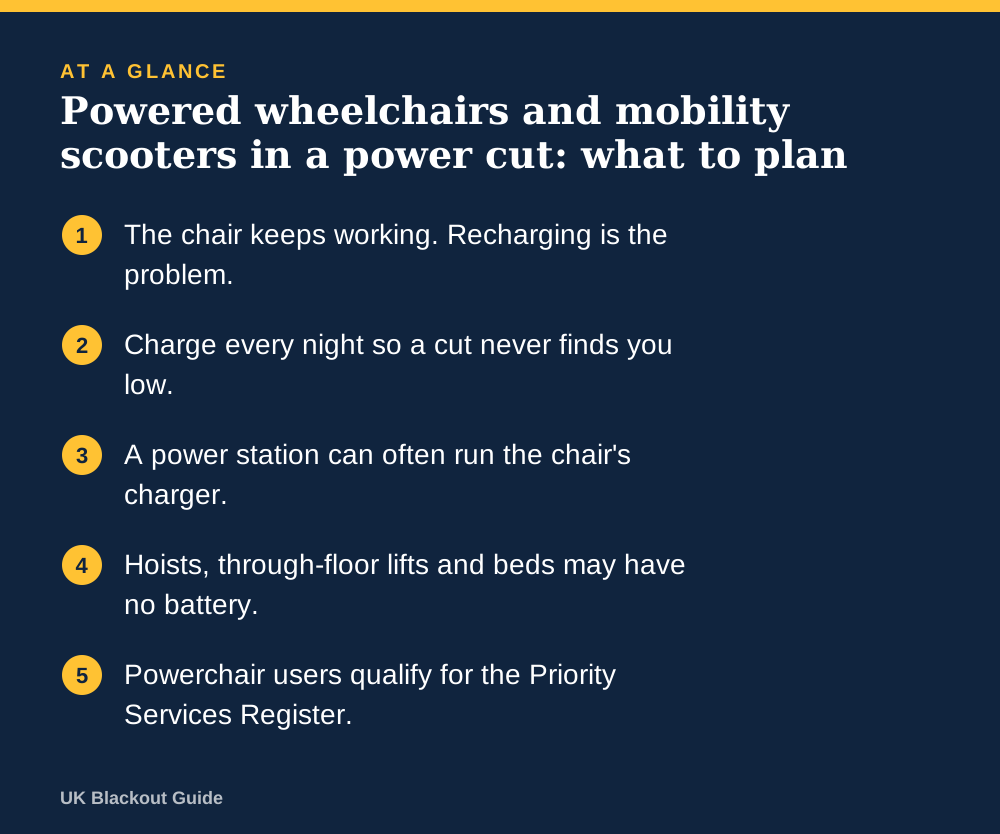
An electric wheelchair runs on its own batteries, so a power cut does not stop it. What you lose is the ability to recharge. Keep it topped up as a habit, and for longer cuts a portable power station can usually run the charger. Plan as well for the mains-powered equipment around it, such as hoists, lifts and adjustable beds.
- The chair keeps working. Recharging is the problem.
- Charge every night so a cut never finds you low.
- A power station can often run the chair's charger.
- Hoists, through-floor lifts and beds may have no battery.
- Powerchair users qualify for the Priority Services Register.
The chair is already a battery device
Powerchairs and mobility scooters carry large rechargeable batteries and only need the mains to refill them. If the power fails at midday and your chair was charged overnight, you have the rest of that charge to use. How far that takes you depends on the chair, the batteries' age, the terrain and the weather. Your manual or wheelchair service can give a realistic figure for yours.
For a cut of a few hours, good charging habits are enough. Backup starts to matter when a cut runs past a day.
Habits that cost nothing
- Charge every night, or as your manual advises, not only when the gauge is low.
- Charge early before forecast storms. Most long cuts in the UK follow severe weather.
- Ration in a cut. Use the chair for what matters, lower the speed setting and avoid tilt and recline functions you can manage without.
- Keep a manual wheelchair if you have one, and make sure someone knows how to disengage the motors so the powerchair can be pushed.
- Tell people. Join the free Priority Services Register, and give a neighbour your number.
Charging from a portable power station
A wheelchair charger is an ordinary mains appliance, so it can usually be plugged into a power station with a three-pin socket. Two numbers decide whether it works: the charger's wattage, printed on its label, and the power station's capacity in watt-hours.
The power station must hold noticeably more energy than you want to put into the chair, because some is lost on the way. As a rule of thumb, about 85% of the stated watt-hours is usable.
Check with the chair's manufacturer or your wheelchair service before relying on this. They can confirm the charger's power draw and whether it needs a pure sine wave supply. Our guide to sizing a power station explains the sums.
The portable power stations round-up lists capacities.
Never run a petrol generator indoors or in a garage to charge a chair. Carbon monoxide has no smell and can kill. Charge mobility batteries on a hard floor, clear of exits, with the charger supplied.
The equipment around the chair
For many wheelchair users, the chair is the least of it. Go through the house and check what else depends on the mains.
| Equipment | What to find out |
|---|---|
| Ceiling or mobile hoist | Many run on rechargeable batteries. Is there an emergency lowering function? |
| Through-floor lift | Is there a battery or manual lowering? Which floor would you be stuck on? |
| Stairlift | Usually battery-backed for a few trips. See whether stairlifts work in a power cut |
| Profiling bed, riser recliner | Is there a backup battery or manual release? |
| Airflow pressure mattress | How long does it hold air, and what does the supplier advise? |
| Door openers, entry systems | How do they open by hand? |
Ask the supplier of each item and write the answers down. If a cut could leave you unable to get out of bed, off a floor or out of the building, that needs a plan agreed with your care team or occupational therapist. The fuller approach is in our guide to medical equipment in a power cut. Oxygen users have a separate answer in using an oxygen concentrator at home in a power cut.
If you get stuck
Call 105 to report the cut, or 03457 643643 in Northern Ireland, and say that you use powered mobility equipment. If you are trapped, have fallen or are in any danger, call 999. Keep a charged mobile within reach of the chair and the bed, and consider a power bank that lives in the chair's bag.
Common questions
How long will my powerchair last in a power cut?
As long as its current charge allows. That depends on the chair, battery condition and how you use it, so check your manual or ask your wheelchair service.
Can I charge a mobility scooter from my car?
Possibly, through a suitable inverter with the engine running outdoors, but check the charger's wattage and the manufacturer's advice first. A power station is the simpler indoor option.
Does the NHS wheelchair service help in a power cut?
They can advise on your equipment and its batteries in advance. During a cut, report it on 105 and call 999 if you are in danger.
Reviewed against these sources on 18 November 2026. If official advice has changed since, follow the official advice.
General information only. This page is not professional, safety, medical, legal or financial advice, and it is not official guidance. No national blackout has been forecast or announced, and nothing here suggests one is expected. We are independent and have no connection to the government or any energy company. Nothing here is medical advice: follow your own clinician, pharmacist or equipment supplier. Always check the official sources linked on this page. Full disclaimer
Keep reading
 Guide
Medical equipment at home in a power cut
How to plan for a power cut if you rely on medical equipment at home: who to tell, what to ask your supplier, backup power options and when to call 999.
Read: Medical equipment at home in a power cut Guide
Pets in a power cut, including fish tanks and reptiles
How to look after dogs, cats, small animals, reptiles, birds and fish in a power cut, including food, water, warmth and which pets need backup power.
Read: Pets in a power cut, including fish tanks and Question
How do I keep a fish tank alive in a power cut?
How to keep aquarium fish alive in a power cut: oxygen, filter bacteria and temperature, what to do hour by hour and how to power a pump from a battery.
Read: How do I keep a fish tank alive in a power Question
How do I run a CPAP machine in a power cut?
How to keep a CPAP machine running in a power cut using a dedicated battery or portable power station, how to estimate runtime and what to ask your clinic.
Read: How do I run a CPAP machine in a power cut?