On this page
The Priority Services Register is a free list kept by energy networks and suppliers of households that need extra help in a power cut. In England, Scotland and Wales you join at thepsr.co.uk or through your supplier or network operator. Northern Ireland has Customer Care Registers. It gives you support and information, not a guaranteed supply.
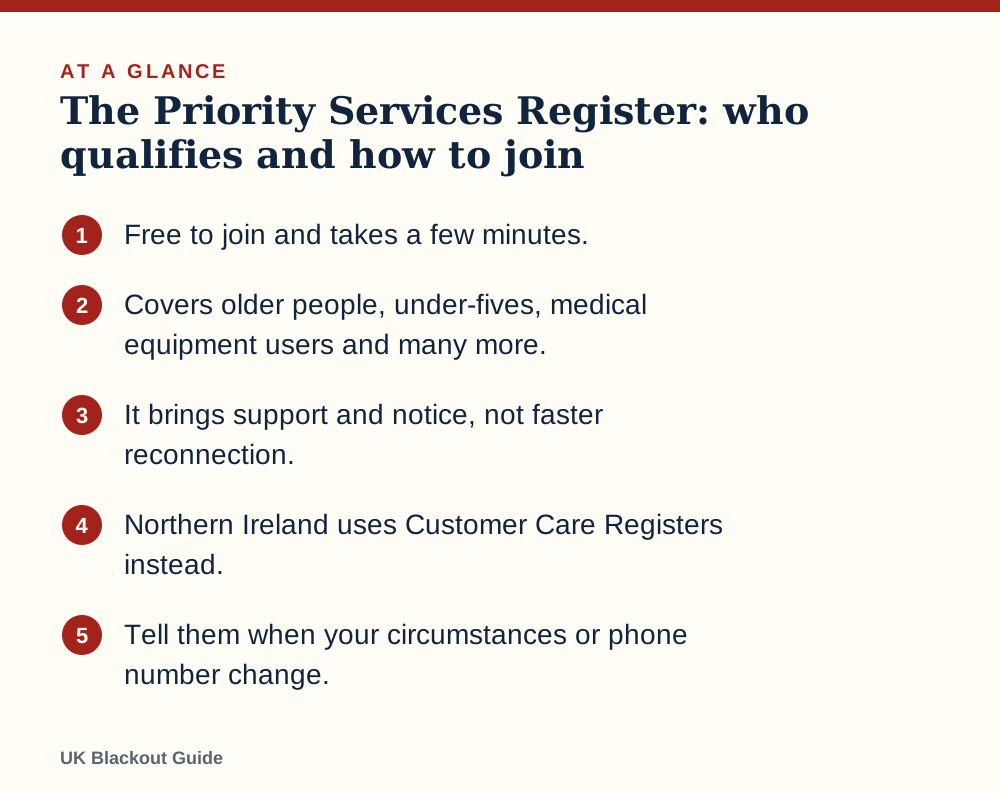
- Free to join and takes a few minutes.
- Covers older people, under-fives, medical equipment users and many more.
- It brings support and notice, not faster reconnection.
- Northern Ireland uses Customer Care Registers instead.
- Tell them when your circumstances or phone number change.
What the register is for
When the power goes off across thousands of homes, the network operator cannot tell which of them contains a newborn, a 90-year-old living alone or someone on a ventilator. The Priority Services Register (PSR) tells them. It is a simple record of who lives at an address and what kind of help they might need.
It costs nothing, and joining does not affect your tariff or your bills. The government's Be Ready campaign points households to it as part of ordinary preparation.
Who can join
Far more people qualify than realise it. The register is open to households that include:
- children under five
- older people
- anyone who relies on powered medical equipment
- people with a disability or long-term health condition
- people with sight, hearing or communication needs
Many networks also accept temporary situations, such as recovering from an operation or late pregnancy. If you think a power cut would be harder for your household than for most, apply and let the operator decide. You do not normally need medical proof.
If you are signing up because of a home device, registration is only one part of planning for medical equipment in a power cut.
How to sign up
In England, Scotland and Wales there are three routes, and you only need one:
- Fill in the form at thepsr.co.uk.
- Contact your electricity network operator. If you do not know who your network operator is, you can look it up by postcode at powercut105.com.
- Ask your energy supplier, the company that sends your bill.
In Northern Ireland, ask your network company and supplier about their Customer Care Registers.
You will be asked for your address, a contact number and the reasons you are registering. Give a mobile number and, if you can, a second contact such as a relative. You can register on someone else's behalf with their agreement, which is often the most useful ten minutes you can spend for an older relative.
Water companies and gas networks keep priority registers too. Ask whether your details will be shared with them. If not, register with each one separately.
What you get
Services vary between companies, but these are typical:
- Notice of planned cuts. You should hear in advance of planned power cuts, when engineers need to switch off your street for maintenance.
- Contact during long faults. In a widespread outage, operators use the register to decide who to phone, text or visit first.
- A password scheme. You agree a word that genuine staff will quote on the doorstep or phone.
- Accessible communication. Large print, braille, a textphone number or a nominated person who receives messages for you.
- Practical help in a long cut. In prolonged faults some networks arrange hot food, hot drinks or other welfare support for registered customers.
The password scheme is worth setting up. Fraudsters use power cuts as cover, which makes it a simple defence against scams during power cuts.
What the register does not do
It does not keep your electricity on, and it does not move your home to the front of the repair queue. Engineers fix faults in the order the network allows, and one damaged cable can supply a whole village.
The same applies to a national shortage. If rota power cuts were ever used, they would be applied by load block for about three hours at a time. Being on the register does not mean your home is skipped, so anyone with equipment that cannot stop still needs a backup of their own.
It also does not replace calling for help. If someone is in danger, call 999. To report a power cut, call 105, or 03457 643643 in Northern Ireland, and say you are on the register.
Keep your entry useful
A register entry is only as good as the phone number on it. Update it when you move house, change supplier, change number or when your needs change. When you switch supplier, check that the new one has carried your registration across.
Think about how the call will reach you. A digital landline stops when the mains does unless it has a battery, so ask whether you can get a free backup battery for your landline. Where you still have an older copper line, a simple corded phone plugged straight into the wall socket needs no mains power at all, which is why it is still worth keeping one in a drawer.
A plug-in power cut alarm that sounds when the mains fails is a useful partner to the register, particularly at night.
A two-minute job to do today
Write the following on a card and keep it by the phone or in your emergency kit: 105 for power cuts, your network operator's name, your PSR password and the number of the person you have nominated. In a real cut you will not be able to look any of it up online.
Common questions
Is the Priority Services Register free?
Yes. There is no charge to join and it has no effect on your energy bills or tariff.
Do I need to register with both my supplier and my network operator?
One registration is normally shared between them, but it is worth confirming with each company. Water and gas companies may need a separate registration.
Does being on the register mean my power comes back first?
No. It means your network operator knows you may need support and can contact you, but repairs follow the layout of the network.
Can I register a relative?
Yes, with their agreement. You can also be listed as their nominated contact so that messages come to you.
Reviewed against these sources on 18 November 2026. If official advice has changed since, follow the official advice.
General information only. This page is not professional, safety, medical, legal or financial advice, and it is not official guidance. No national blackout has been forecast or announced, and nothing here suggests one is expected. We are independent and have no connection to the government or any energy company. Nothing here is medical advice: follow your own clinician, pharmacist or equipment supplier. Always check the official sources linked on this page. Full disclaimer
Keep reading
 Buying guide
Best battery smoke alarms that work in a power cut
Battery smoke alarms that work in a power cut, chosen from Amazon UK listings on sealed battery life, stated standards, pack size and buyer ratings.
Read: Best battery smoke alarms that work in a Buying guide
Best CPAP battery backups for power cuts
CPAP battery backups for a power cut at night, chosen from Amazon UK listings on stated watt-hours, voltage and machine compatibility, with runtime maths.
Read: Best CPAP battery backups for power cuts Buying guide
Best rechargeable fans for a summer power cut
Rechargeable fans that run from their own battery in a summer power cut and top up from a power bank. Seven Amazon UK listings compared on stated runtime.
Read: Best rechargeable fans for a summer power cut Question
Can I get a free backup battery for my landline for power cuts?
Who can get a free battery backup for a digital landline, how to ask your phone provider, how long it lasts and what to do if you do not qualify for one.
Read: Can I get a free backup battery for my