On this page
Prepare their home on a normal visit, not during a cut. Register them on the Priority Services Register, put automatic lights on the route to the bathroom, leave a battery radio and warm bedding within reach, and agree how you will make contact if the phones fail. In a cold house, check for signs of hypothermia and call 999 if you see them.
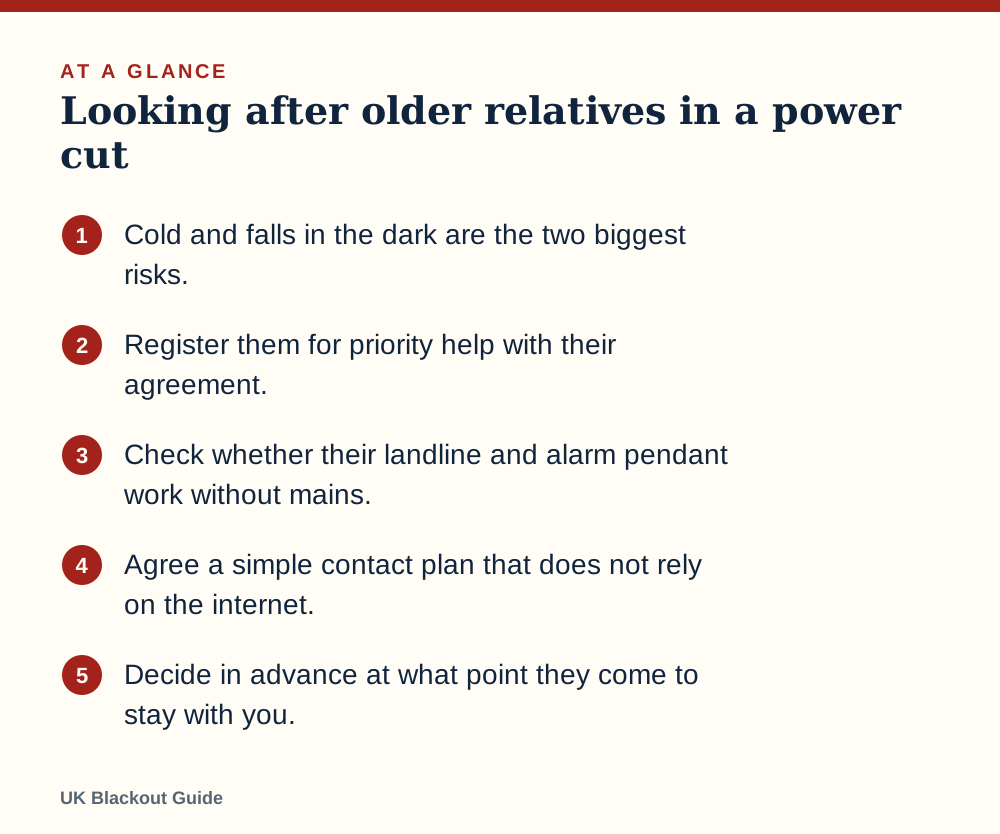
- Cold and falls in the dark are the two biggest risks.
- Register them for priority help with their agreement.
- Check whether their landline and alarm pendant work without mains.
- Agree a simple contact plan that does not rely on the internet.
- Decide in advance at what point they come to stay with you.
The two risks that matter most
For a fit adult a power cut is an inconvenience. For someone in their eighties it brings two specific dangers: getting cold, and falling in the dark. Almost everything worth doing for an older relative reduces one or the other.
Older people can lose body heat without feeling how cold they have become. The NHS advises heating the rooms you use to at least 18°C, and a house with no heating in January drops below that within hours. Hypothermia starts when body temperature falls below 35°C. Our page on spotting hypothermia at home lists what to look for.
One visit, six jobs
Pick an ordinary weekend and work through this list in their home. Do it with them, not for them. People use things they chose and understand.
- Register for priority help. The Priority Services Register is free, and you can be named as their contact.
- Test the phone. Unplug the router and see whether the landline still gives a dial tone. Many do not. See whether landlines work in a power cut.
- Check the alarm pendant. If they wear one, ask the provider what happens in a cut. Our guide to telecare and personal alarms explains the questions.
- Light the night route. Bed to bathroom, and the top and bottom of the stairs.
- Put warmth within reach. A blanket on the chair, and a hat and thick socks by the bed.
- Write the numbers down. 105 for power cuts, your number, a neighbour's and the GP's, in large print by the phone.
Light that comes on by itself
A torch in a drawer is no use to someone who cannot find the drawer. The best light for an older person is one they never have to look for.
Plug-in power cut lights sit in a socket, charge quietly and switch on the moment the mains fails. Most lift out to become a hand torch. One on the landing and one by the bed covers the walk most likely to end in a fall. The automatic power cut lights round-up compares them.
Leave candles out of the plan entirely. The official advice is that torches are safer, and an unsteady hand or a dozing owner makes a naked flame a real hazard.
Warmth without heating
Gas central heating stops in a power cut because the boiler's pump and controls need electricity. The answer is to warm the person, not the house. Layers, a hat, a blanket over the knees and another round the shoulders do more than people expect.
Choose one room, close the door and curtains and live in it. Our guide to setting up one warm room shows how. Warm food and drinks help, so a flask filled each evening in winter is a sensible habit.
There is a wider choice in our list of the best blankets for power cuts.
Never bring a barbecue, camping stove or patio heater indoors for warmth. Carbon monoxide has no smell and older people are especially vulnerable to it. If there is any gas appliance or fire in the home, fit an audible alarm marked EN 50291.
News and company
Silence and darkness are frightening when you live alone. A battery radio provides news and a human voice, and local stations carry practical updates in a real emergency. In Lancaster in 2015 a local station kept broadcasting on a generator when mobile, internet and cash machines had all failed.
The battery radios list includes models with large controls.
Stairlifts, medicines and mobility
Many stairlifts run on a battery that charges from the mains, so they keep going for a few trips. Check the manual for theirs, and read whether stairlifts work in a power cut. If it is mains-only, they may need to sleep downstairs.
Keep a week's medicines where they can be found by torchlight and a written list of what is taken when. Riser recliner chairs and electric beds can stick in position, so ask the supplier about a battery backup or manual release.
Your plan for staying in touch
Agree a simple rule. For example: if the power goes off, I ring you within the hour, and if I cannot get through, I come round or ask the neighbour to knock. Swap numbers with that neighbour now.
Tell your relative that genuine energy staff will never ask for bank details or cash at the door. Doorstep callers sometimes exploit outages, as our guide to power cut scams explains.
Finally, set a trigger for bringing them to you. A sensible one is any cut that will run overnight in cold weather, or any cut at all if they depend on powered equipment. The kit to leave ready at their home is listed in our emergency kit for older people.
Checklist
Looking after older relatives in a power cut
- Priority Services Register entry made, with you as contact
- Landline tested with the router unplugged
- Alarm pendant provider asked about power cuts
- Automatic lights on the bed to bathroom route
- Blanket, hat and socks within reach of chair and bed
- Battery radio tuned to a local station
- Large-print number list by the phone
- Neighbour's number swapped
Common questions
Should an older person stay at home in a power cut?
For a short cut, usually yes, if they are warm and have light. For a long cut in cold weather, or if they rely on powered equipment, it is safer to move them to a home with power.
Are electric blankets usable in a power cut?
Not from the mains. Some low-wattage heated throws can run from a portable power station, but ordinary blankets and layers are the reliable option.
Who can check on my relative if I live far away?
Ask a neighbour in advance and swap numbers. If you are seriously worried and cannot reach anyone, call the police on 101, or 999 if you believe they are in danger.
Can I register my parent for priority services myself?
Yes, with their agreement. You can also be listed as the nominated contact.
Reviewed against these sources on 18 November 2026. If official advice has changed since, follow the official advice.
General information only. This page is not professional, safety, medical, legal or financial advice, and it is not official guidance. No national blackout has been forecast or announced, and nothing here suggests one is expected. We are independent and have no connection to the government or any energy company. Nothing here is medical advice: follow your own clinician, pharmacist or equipment supplier. Always check the official sources linked on this page. Full disclaimer
Keep reading
 Guide
Emergency kit for older people
An emergency kit for older people: easy-to-use lights and radio, staying warm, medication, landline and telecare backup, and free priority support.
Read: Emergency kit for older people Buying guide
Best battery smoke alarms that work in a power cut
Battery smoke alarms that work in a power cut, chosen from Amazon UK listings on sealed battery life, stated standards, pack size and buyer ratings.
Read: Best battery smoke alarms that work in a Buying guide
Best CPAP battery backups for power cuts
CPAP battery backups for a power cut at night, chosen from Amazon UK listings on stated watt-hours, voltage and machine compatibility, with runtime maths.
Read: Best CPAP battery backups for power cuts Buying guide
Best rechargeable fans for a summer power cut
Rechargeable fans that run from their own battery in a summer power cut and top up from a power bank. Seven Amazon UK listings compared on stated runtime.
Read: Best rechargeable fans for a summer power cut