On this page
Stop feeding, keep the lid on, wrap the tank in blankets to hold the heat and add oxygen with a battery air pump or by gently stirring the surface every so often. Keep the filter media wet so its bacteria survive. A healthy, lightly stocked tank usually copes with a few hours. For longer cuts, run the air pump or filter from a power station.
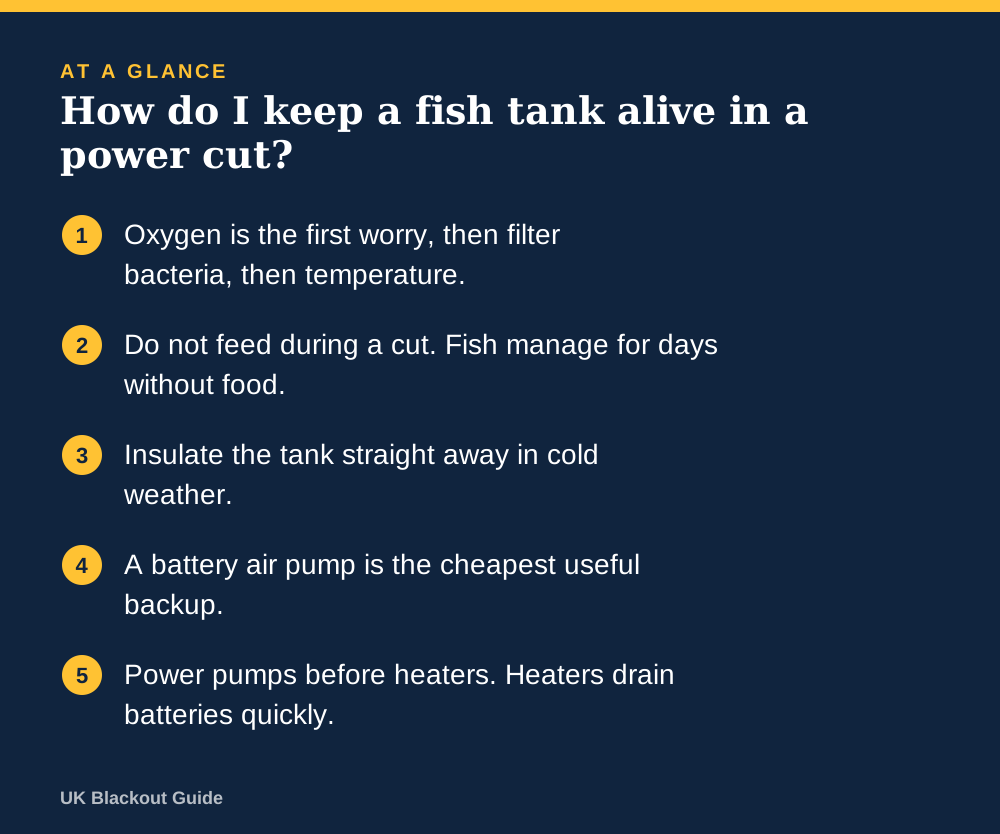
- Oxygen is the first worry, then filter bacteria, then temperature.
- Do not feed during a cut. Fish manage for days without food.
- Insulate the tank straight away in cold weather.
- A battery air pump is the cheapest useful backup.
- Power pumps before heaters. Heaters drain batteries quickly.
What goes wrong, in order
Three things stop at once when the power fails, and they become a problem at different speeds.
Oxygen. The filter and air pump keep the surface moving, which is how oxygen gets into the water. Still water holds less. Fish gasping at the surface is the sign.
The filter. The bacteria living in the filter media clean the water, and they need a flow of oxygenated water to survive. In a sealed canister filter that has stopped, they start to die off after a few hours. If that stale water is then pumped back into the tank, it can harm the fish.
Temperature. A tropical tank cools slowly, and a large one more slowly than a small one. Most common tropical fish tolerate a gradual drop of a few degrees.
What to do from the first minute
- Stop feeding. Uneaten food and waste foul water that is no longer being filtered. Healthy fish can go without food for several days.
- Keep the lid on and wrap the tank. Blankets, towels, a duvet or sheets of polystyrene round the sides and top hold the heat in. Leave a small gap for air.
- Add oxygen. Switch on a battery air pump if you have one. If not, every half hour or so scoop out a jug of tank water and pour it back from a height, or gently stir the surface.
- Look after the filter. After an hour or two, take the media out of a canister filter and sit it in a shallow tray of tank water, or hang it in the tank in a net bag. It needs to stay wet and in contact with air.
- Leave the lights off and disturb the fish as little as possible. Calm fish use less oxygen.
Do not heat the room with a camping stove, barbecue or gas heater not designed for indoor use. Carbon monoxide has no smell and is dangerous to you and your pets. Keep candles away from the blankets round the tank.
Backup power for a longer cut
A battery air pump costs little and runs for many hours on ordinary cells.
For more than that, a portable power station can run the tank's own equipment. The trick is to choose what to power. An air pump or small filter draws only a few watts. A heater draws far more, though it cycles on and off. Check the label on each item, or see how many watts common appliances use.
Runtime in hours is roughly watt-hours times 0.85, divided by watts, the same sum used in the power station sizing guide. A 300 Wh power station running a 10 W filter gives about 25 hours on paper. Add a 100 W heater running half the time and that falls to around four hours. Insulation is doing the work of the heater for free, so wrap first and power the pump.
Our portable power stations round-up lists capacities.
When the power comes back
If a canister filter sat sealed and stagnant for several hours, empty and rinse it in a bucket of tank water before restarting, so the stale water does not go into the tank. Never rinse media under the tap, since chlorine kills the bacteria.
Let the heater bring the temperature back gradually. Feed lightly for a day or two.
Coldwater fish, reptiles and other animals have their own needs, covered in our guide to pets in a power cut. For anything unusual or valuable, ask your aquatics shop or a vet who sees fish.
Common questions
How long can fish survive without a filter?
It depends on the size of the tank, how many fish are in it and the temperature. A lightly stocked tank usually manages for some hours if you keep the surface moving and stop feeding.
Should I do a water change during a power cut?
Only if the fish are clearly struggling and you have water at a similar temperature. A large change with cold water can shock them.
Can I warm the tank with hot water bottles?
A sealed bottle of warm water floated in the tank raises the temperature gently. Use warm, not boiling, water and change it gradually to avoid a sudden swing.
Reviewed against these sources on 18 November 2026. If official advice has changed since, follow the official advice.
General information only. This page is not professional, safety, medical, legal or financial advice, and it is not official guidance. No national blackout has been forecast or announced, and nothing here suggests one is expected. We are independent and have no connection to the government or any energy company. Nothing here is medical advice: follow your own clinician, pharmacist or equipment supplier. Always check the official sources linked on this page. Full disclaimer
Keep reading
 Guide
Medical equipment at home in a power cut
How to plan for a power cut if you rely on medical equipment at home: who to tell, what to ask your supplier, backup power options and when to call 999.
Read: Medical equipment at home in a power cut Guide
Pets in a power cut, including fish tanks and reptiles
How to look after dogs, cats, small animals, reptiles, birds and fish in a power cut, including food, water, warmth and which pets need backup power.
Read: Pets in a power cut, including fish tanks and Question
Powered wheelchairs and mobility scooters in a power cut: what to plan for
Whether a powerchair or mobility scooter needs backup power in a power cut, how to stay charged, charging from a power station and what else to plan for.
Read: Powered wheelchairs and mobility scooters in Question
How do I run a CPAP machine in a power cut?
How to keep a CPAP machine running in a power cut using a dedicated battery or portable power station, how to estimate runtime and what to ask your clinic.
Read: How do I run a CPAP machine in a power cut?