On this page
Tell the truth in a sentence they can hold on to: the electricity has stopped for a while, people are fixing it, and we have what we need. Stay calm yourself, give them a light of their own and a small job to do, and keep meals and bedtime as normal as you can. Children take their cue from the adults around them.
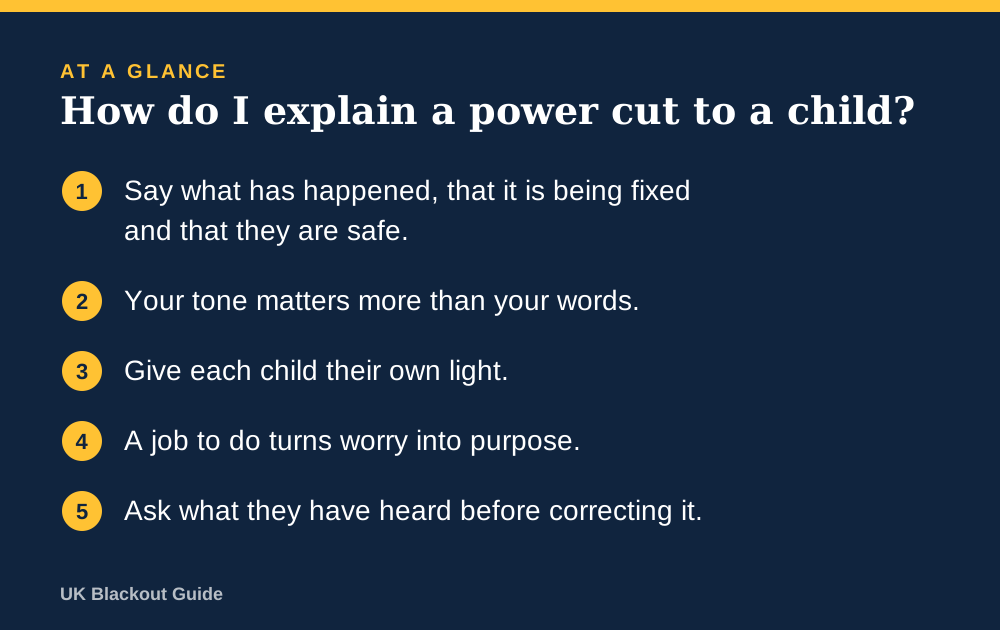
- Say what has happened, that it is being fixed and that they are safe.
- Your tone matters more than your words.
- Give each child their own light.
- A job to do turns worry into purpose.
- Ask what they have heard before correcting it.
Three things every child needs to hear
Whatever their age, a good explanation has the same three parts: what has happened, who is sorting it out, and what we are going to do. Keep each part short.
Children are quick to spot a worried adult. If you are tense about the freezer or the phone battery, say so in a matter-of-fact way: 'I am a bit annoyed about the telly, but we are fine.' That is more reassuring than a bright voice that does not match your face.
Words that work at different ages
| Age | What you might say |
|---|---|
| Under 4 | 'The lights are having a rest. We have torches. Come and help me find teddy.' |
| 4 to 7 | 'Electricity comes to our house along wires. Something has stopped it for a bit, and the engineers are mending it. Until then we use torches.' |
| 8 to 11 | 'There is a fault on the network, maybe from the weather. It usually takes a few hours to fix. Here is what works and what does not, and here is the plan.' |
| 12 and over | The same facts you would give an adult, including what you do not know yet. Ask for their help with younger ones. |
Avoid promises you cannot keep, such as 'it will be back in ten minutes'. 'I do not know exactly when, but most power cuts are fixed within a few hours' is honest and still comforting.
Give them a light and a job
Darkness is the frightening part for most small children. A light that belongs to them fixes that at once, and the best night lights for children come in options by age. A night light they already know is best of all, so think about using a rechargeable one every night. Then a power cut changes nothing in their bedroom.
Glow sticks are a cheap extra that children love. They give a gentle light for hours with no heat and no batteries, and work well hung on a door handle to mark the way to the toilet.
Then hand out jobs. Torch monitor, snack chooser and blanket collector are all real roles to a five-year-old. Feeling useful crowds out feeling scared.
Use battery lights, not candles, around children. If any torch takes button batteries, check the compartment is screwed shut. Swallowed button batteries are a medical emergency.
Fill the evening, then keep bedtime normal
With screens off, you need something to do. Cards, board games, drawing by lantern light, shadow puppets on the wall and stories under a blanket den all work. There are family favourites in our list of the best games for power cuts.
Then do bedtime in the usual order at the usual time. In a power cut with children, routine tells them that the world is still working. An extra layer and a familiar toy cover the lack of heating and night light.
If they ask about blackouts in the news
Older children may have heard about national blackouts at school or online. Ask what they have heard first, then correct it gently. The plain facts help: no national blackout is planned or predicted, the government's Be Ready advice is general preparation in the same way a fire drill is, and ordinary power cuts are usually short.
Showing them the family's torch, radio and kit is reassuring in a way words are not. If a child's worry does not settle, or if it is really your own, our page on coping with anxiety about blackouts may help.
Common questions
Should I tell my child about a planned power cut in advance?
Yes. A day's notice, with a simple explanation and a plan for what you will do, makes it feel like an event and not a shock.
My child is scared of the dark. What helps most?
A familiar light of their own that works without mains, an adult staying nearby until they settle and the normal bedtime routine.
Is it all right to make a power cut fun?
Yes. Games, dens and torchlit stories are a good way to keep children calm, as long as you also answer their questions honestly.
Reviewed against these sources on 18 November 2026. If official advice has changed since, follow the official advice.
General information only. This page is not professional, safety, medical, legal or financial advice, and it is not official guidance. No national blackout has been forecast or announced, and nothing here suggests one is expected. We are independent and have no connection to the government or any energy company. Nothing here is medical advice: follow your own clinician, pharmacist or equipment supplier. Always check the official sources linked on this page. Full disclaimer
Keep reading
 Guide
Babies and toddlers in a power cut
A practical plan for a power cut with a baby or toddler: feeds, safe warmth, sleep, night light, nappies and the baby items to add to your household kit.
Read: Babies and toddlers in a power cut Guide
Power cuts with children: keeping them calm and busy
How to get through a power cut with children: explaining it calmly, giving each child a light, keeping routines, feeding them and filling the evening.
Read: Power cuts with children: keeping them calm Buying guide
Best battery smoke alarms that work in a power cut
Battery smoke alarms that work in a power cut, chosen from Amazon UK listings on sealed battery life, stated standards, pack size and buyer ratings.
Read: Best battery smoke alarms that work in a Buying guide
Best CPAP battery backups for power cuts
CPAP battery backups for a power cut at night, chosen from Amazon UK listings on stated watt-hours, voltage and machine compatibility, with runtime maths.
Read: Best CPAP battery backups for power cuts