On this page
No national blackout is planned or predicted. The government's Be Ready campaign is general preparedness advice, and official assessments describe a national outage as low likelihood. If the headlines are worrying you, check the facts once, do a small amount of practical preparation, limit how much news you take in, and speak to your GP or NHS talking therapies if the worry persists.
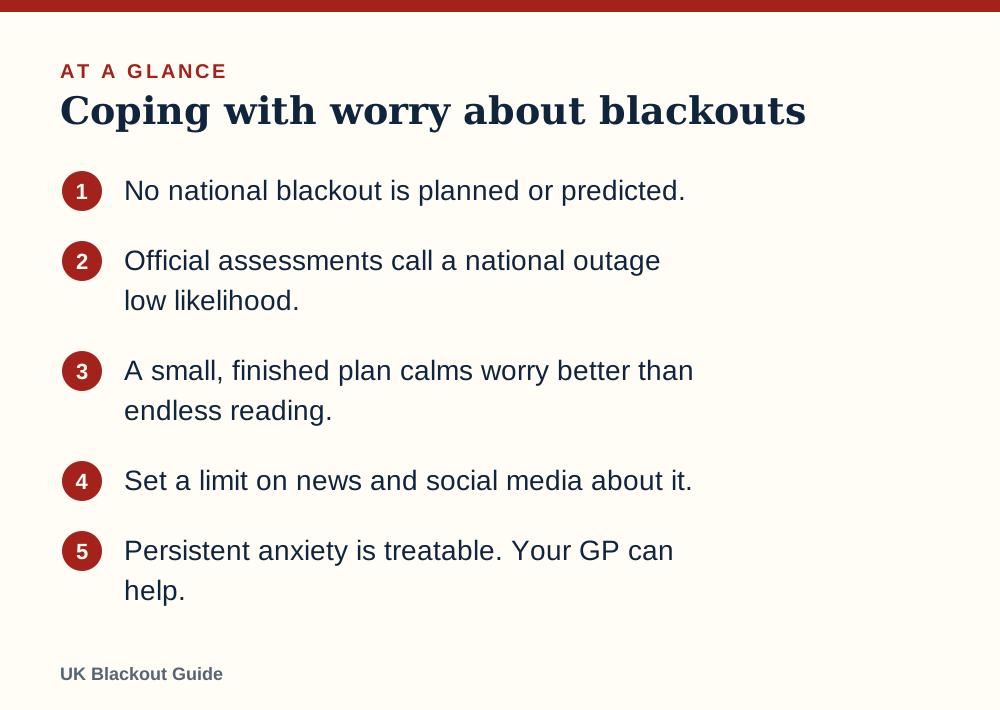
- No national blackout is planned or predicted.
- Official assessments call a national outage low likelihood.
- A small, finished plan calms worry better than endless reading.
- Set a limit on news and social media about it.
- Persistent anxiety is treatable. Your GP can help.
What is known, stated plainly
Worry feeds on vagueness, so the honest answer to whether you should be worried about a UK blackout starts with what is actually on the record.
The government launched its Be Ready campaign on 22 October 2026. It asks households to be able to manage for three days. It is presented as general preparedness, in the same spirit as owning a smoke alarm, and not as a forecast of anything.
The National Risk Register describes a national power outage as low likelihood but very high impact. Both halves of that sentence matter, and our guide to how likely a national blackout is takes each in turn. Planners prepare for it because the effects would be serious, not because they expect it. The grid operator, NESO, is required to be able to restore 60% of demand in each region within 24 hours and all of Great Britain's demand within five days.
Ordinary power cuts are a different thing. They happen every year, mostly from storms and faults, and most are fixed within hours.
Why it feels worse than the facts suggest
Coverage rose sharply after the campaign launch and a BBC report on 7 November 2026 about its emergency broadcasting arrangements. A burst of stories on one subject makes a risk feel as if it has grown, when what has grown is the attention. Our explainer on why blackouts are in the news traces how that happened.
Headlines also favour the dramatic phrase. 'Black Sky' is a planning term for a prolonged, wide-area outage. It describes a scenario that officials rehearse, and its use in a headline does not mean one is on the way. If a specific claim is bothering you, check it against is the UK blackout warning real.
Anxiety is not a failure of logic, though. It is your mind trying to protect you from something it cannot control. Telling yourself to stop worrying rarely works. Giving the worry a small job to do often does.
Turn the worry into one small, finished task
Open-ended worry has no finish line. A short list does. The official advice is to build a kit gradually, and building a kit on a budget, a little at a time, suits an anxious mind well, because each item is a completed step.
Try this over a fortnight, with nothing bought in a rush:
- Find a torch and check it works.
- Put a few bottles of water and some tins you already eat in one cupboard.
- Write down five phone numbers on paper, including 105 for power cuts.
- Charge a power bank and leave it in a drawer.
- Put a small amount of cash with it.
Then stop. You are now better prepared than most households, and you can say so to yourself when the next headline appears. If you would prefer to buy one box and be done, the emergency kits round-up is there for that.
If you notice the list growing every time you read something new, that is the anxiety talking. Three days is the official ask. Our piece on preparing without panic buying helps you decide where to stop.
Put a fence round the news
Checking for updates feels like taking control, but each check tops up the worry. A few habits help:
- Choose one or two reliable sources and ignore the rest. The Be Ready site and your network operator are enough.
- Check at a set time, once a day at most, and not in bed.
- Mute or unfollow accounts that post alarming predictions without sources.
- Notice the difference between 'officials are planning for' and 'officials expect'. Most stories are the first kind.
If you find yourself reading about people stockpiling for months, it is worth knowing that there is a calm, ordinary middle ground, which is our answer to whether prepping is sensible or paranoid.
Calming your body when the worry spikes
Anxiety is physical as well as mental: a tight chest, a racing heart, restless sleep. Simple techniques can take the edge off. Slow your breathing, in through the nose and out for longer through the mouth, for a few minutes. Go for a walk. Keep to regular meals and bedtimes, and go easy on caffeine and alcohol.
Talk to someone you trust. Saying a fear aloud often shrinks it, and you may find they have been thinking the same thing.
The NHS website has free guidance on anxiety, including breathing exercises and self-help based on cognitive behavioural therapy.
If a child has picked up on it
Children hear more than adults assume, from school, from television and from you. Ask what they have heard before you explain a power cut to a child, correct what is wrong in simple words and tell them what the family would do. A torch of their own and one of the best games for power cuts, played by candle-free lantern light, can turn the idea of a power cut into something close to fun.
When to ask for help
Speak to your GP if worry about this, or anything else, is there most days, is affecting your sleep, work or relationships, or is causing panic attacks. Anxiety is common and treatable.
In England you can refer yourself to NHS talking therapies without seeing a GP first. Elsewhere in the UK, your GP is the route. For urgent mental health help, call NHS 111. Samaritans are available on 116 123, free, at any hour, if you need to talk to someone now. If you or someone else is in immediate danger, call 999.
This page is general information and not medical advice. Your own doctor's guidance comes first.
Common questions
Is the government expecting a blackout?
No. The Be Ready campaign is presented as general preparedness, not a forecast, and no national blackout is planned or predicted.
Will preparing make my anxiety worse?
A small, finished plan usually helps. If you find you cannot stop adding to it, or it takes over your thoughts, speak to your GP.
How do I stop reading about it?
Pick one reliable source, check it once a day at a set time and mute accounts that post frightening predictions without evidence.
Who can I talk to right now?
Samaritans answer on 116 123 at any time, free. NHS 111 can help with urgent mental health concerns.
- Be Ready, UK government
- NHS
- NESO, National Energy System Operator
- National Risk Register, Cabinet Office
Reviewed against these sources on 18 November 2026. If official advice has changed since, follow the official advice.
General information only. This page is not professional, safety, medical, legal or financial advice, and it is not official guidance. No national blackout has been forecast or announced, and nothing here suggests one is expected. We are independent and have no connection to the government or any energy company. Nothing here is medical advice: follow your own clinician, pharmacist or equipment supplier. Always check the official sources linked on this page. Full disclaimer
Keep reading
 Buying guide
Best battery smoke alarms that work in a power cut
Battery smoke alarms that work in a power cut, chosen from Amazon UK listings on sealed battery life, stated standards, pack size and buyer ratings.
Read: Best battery smoke alarms that work in a Buying guide
Best CPAP battery backups for power cuts
CPAP battery backups for a power cut at night, chosen from Amazon UK listings on stated watt-hours, voltage and machine compatibility, with runtime maths.
Read: Best CPAP battery backups for power cuts Buying guide
Best rechargeable fans for a summer power cut
Rechargeable fans that run from their own battery in a summer power cut and top up from a power bank. Seven Amazon UK listings compared on stated runtime.
Read: Best rechargeable fans for a summer power cut Question
Can I get a free backup battery for my landline for power cuts?
Who can get a free battery backup for a digital landline, how to ask your phone provider, how long it lasts and what to do if you do not qualify for one.
Read: Can I get a free backup battery for my