On this page
Add one or two items to your normal weekly shop until you have three days of supplies. The government's Be Ready campaign advises building a kit gradually, and there is no deadline, because no blackout is planned or predicted. Buying slowly costs less, wastes less and leaves shelves stocked for everyone else.
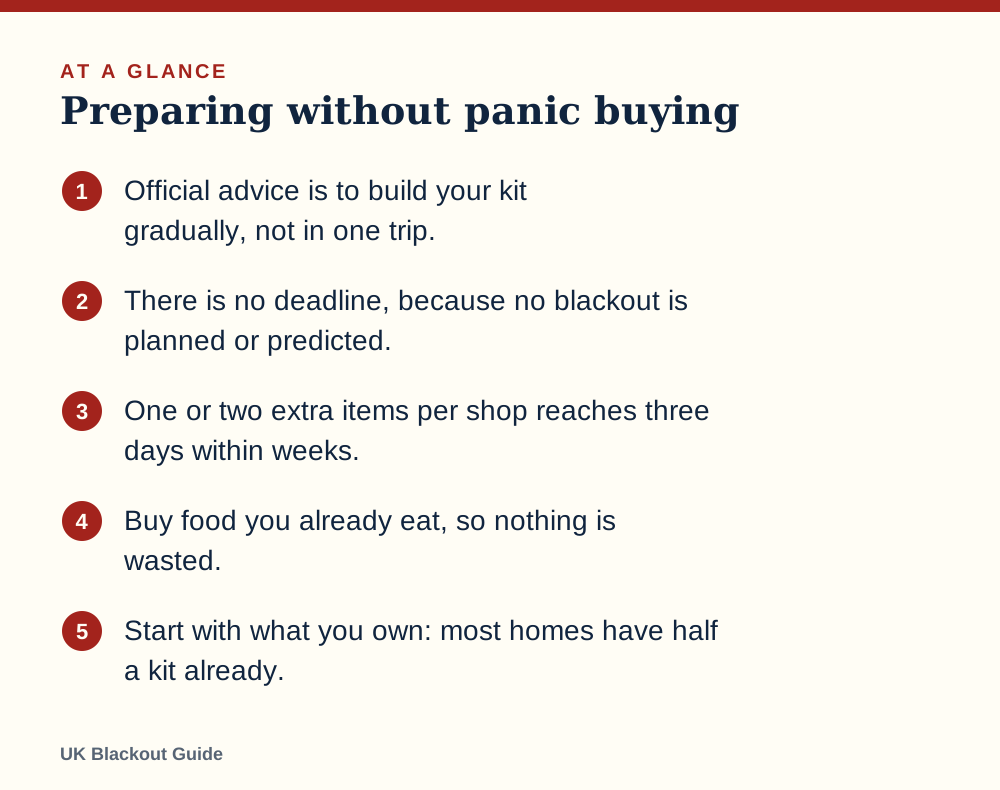
- Official advice is to build your kit gradually, not in one trip.
- There is no deadline, because no blackout is planned or predicted.
- One or two extra items per shop reaches three days within weeks.
- Buy food you already eat, so nothing is wasted.
- Start with what you own: most homes have half a kit already.
Preparing and panic buying are opposites
Preparing means buying a little, early, when nothing is happening. Panic buying means buying a lot, late, because everyone else is. The first takes pressure off shops and services in an emergency, since prepared households do not need to queue. The second creates shortages that would not otherwise exist.
The government's Be Ready campaign, launched on 22 October 2026, is explicit that a kit should be built gradually. It presents the three-day target as general preparedness and not as a forecast, which is the context for why blackouts are in the news.
Start with a walk round your own home
Before buying anything, see what you already have, which is also the first step in getting blackout-ready in one evening. Most households own a torch somewhere, blankets, a first aid kit of sorts, tins in the cupboard and a tin opener. Many have a camping lantern, a power bank from a holiday or a radio in the garage.
Gather these in one place, test them and replace dead batteries. Then compare the pile with the official list of what should be in an emergency kit. The gap is your shopping list, and it is usually shorter than people expect.
A six-week plan using your normal shop
| Week | Add to the trolley | Do at home |
|---|---|---|
| 1 | Bottled water, a few litres per person | Write 105 and key contacts on paper |
| 2 | Three tins per person that can be eaten cold | Find and test your torches |
| 3 | Spare batteries, more water | Check whether you qualify for the Priority Services Register |
| 4 | Long-life milk, cereal bars, crackers | Charge the power bank and note the date |
| 5 | Hand sanitiser, wet wipes, first aid top-ups | Photocopy key documents |
| 6 | The last of the water and any pet or baby items | Put a little cash aside in notes and coins |
By the end you have the three days the campaign asks for: 9 litres of drinking water per person, food, light, hygiene and the paperwork. Nobody at the checkout would have noticed. If money is tight, stretch it over three months instead, starting with what to buy first on a budget.
The few things that are not in the supermarket
Three items on the official list may need a separate purchase: a battery or wind-up radio, a power bank and a decent torch if yours is unreliable. Buy them one at a time. Prices and stock of these items can tighten after a storm or a news story, which is another reason to buy in a quiet week. A power bank for power cuts is the one many people already half-own, so check the drawer first.
If you would prefer to buy the non-food basics in one go, a ready-made kit is a tidy way to do it, and the choice between ready-made kits and building your own comes down to time against control.
Why buying slowly is better for you as well
Gradual buying is the considerate choice, and it also gives you a better kit. You can buy food on offer and choose things your household likes. You spread the cost across several pay days. You have time to notice what you forgot, such as the tin opener or the spare cable.
Food bought in a rush is often the wrong food: whatever was left on the shelf, in quantities you cannot store, with dates that all expire together. Food bought steadily can be rotated through your normal meals so that it never goes out of date, the routine known as food storage and rotation.
What to do when the shelves are already emptying
If a storm forecast or a news story sends people to the shops, a household that prepared earlier can simply stay home. That is the point of doing it in advance.
If you have been caught short, buy what you need for three days and no more. Choose plain alternatives that are still in stock: tap water in clean bottles in place of bottled, oats and tinned beans in place of specialist rations. Check on neighbours who cannot get out, and share where you can. Be wary of inflated prices and doorstep sellers, a staple of scams during power cuts.
Where to stop
Three days is the official ask, and reaching it is a complete job. Some households choose to go on to a week or two. That is a personal choice beyond official guidance, and the government has not asked for it. There is no need to feel that more is always better.
If you find the subject starts to take up more of your thoughts than it deserves, that is common and worth noticing, and it is fair to ask at that point whether preparing is sensible or paranoid. Once the kit is done, put a reminder in your calendar for six months' time and get on with other things.
Common questions
Is the government telling people to stockpile?
No. Be Ready asks households to be able to manage for three days and to build supplies gradually. It is general preparedness, not a forecast of shortages.
How long does it take to build a three-day kit gradually?
Four to six weekly shops is typical for the food, water and hygiene items. The radio, torch and power bank can be bought whenever suits your budget.
Will supermarkets run out if everyone prepares?
Not if people add an item or two per shop over several weeks. Shortages come from sudden bulk buying, which gradual preparation avoids.
Reviewed against these sources on 18 November 2026. If official advice has changed since, follow the official advice.
General information only. This page is not professional, safety, medical, legal or financial advice, and it is not official guidance. No national blackout has been forecast or announced, and nothing here suggests one is expected. We are independent and have no connection to the government or any energy company. Always check the official sources linked on this page. Full disclaimer
Keep reading
 Question
How long could a national blackout last?
How long a national blackout in Great Britain could last, based on NESO's restoration standard, the National Risk Register and what happened in past events.
Read: How long could a national blackout last? Question
Is preparing for a blackout sensible or paranoid?
Whether preparing for power cuts is sensible or over the top: what the UK government asks for, where reasonable preparation ends and how to tell.
Read: Is preparing for a blackout sensible or Guide
Three days without power: the plan the government asks for
A day-by-day plan for three days without mains power, built on the UK government's Be Ready advice: water, food, light, radio, warmth and phone charge.
Read: Three days without power: the plan the Question
Can portable solar keep a household going in a long power cut?
What portable solar panels can and cannot power in a UK home during a long outage, with realistic summer and winter output and example daily loads.
Read: Can portable solar keep a household going in