On this page
Do the free things first: write down 105, join the Priority Services Register if you qualify, and store tap water in clean bottles. Then buy in this order: a torch and batteries, a few days of tinned food, a power bank, a battery radio. Everything else can wait, and much of it you already own.
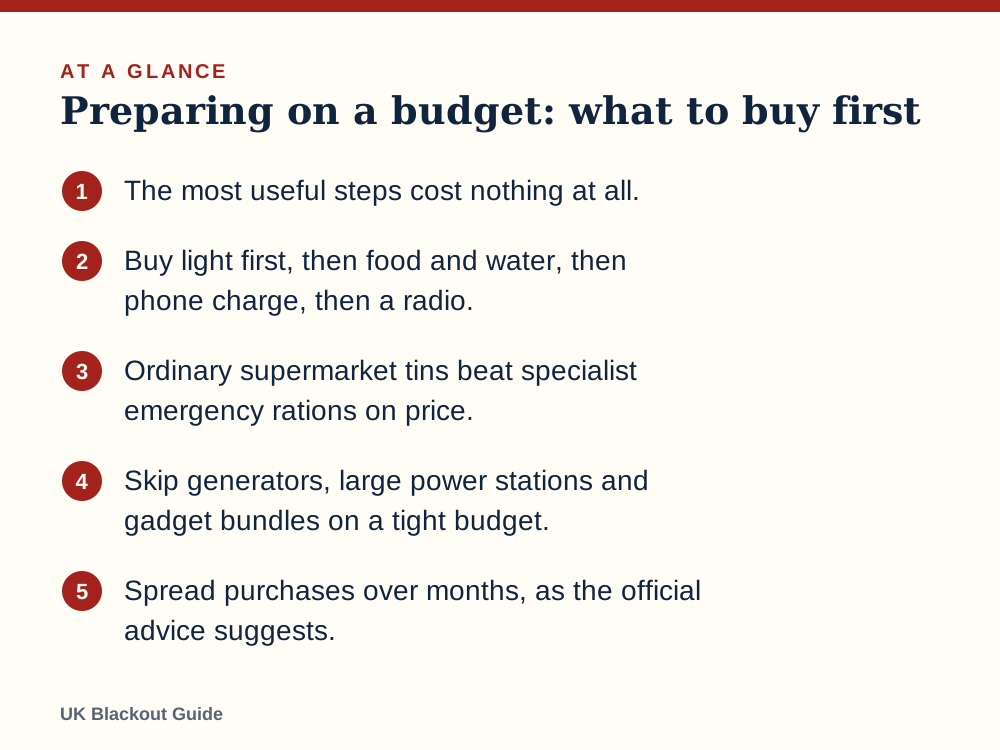
- The most useful steps cost nothing at all.
- Buy light first, then food and water, then phone charge, then a radio.
- Ordinary supermarket tins beat specialist emergency rations on price.
- Skip generators, large power stations and gadget bundles on a tight budget.
- Spread purchases over months, as the official advice suggests.
Step zero costs nothing
Before spending a penny, do the things that are free. They cover a surprising share of what matters in a real power cut.
- Write 105 (03457 643643 in Northern Ireland) on paper and stick it inside a cupboard door, with phone numbers for family and neighbours.
- Check whether you qualify for the Priority Services Register. It is free, and many households do, including those with children under 5, older people and anyone who relies on powered medical equipment.
- Fill clean, food-grade bottles with tap water. Aim for 3 litres per person per day for three days, and refresh them regularly.
- Find the torches, blankets, tin opener and first aid kit you already own, and put them where you can reach them in the dark.
- If a digital landline is your lifeline, ask your provider whether you are eligible for a free battery backup unit.
- Look up your load block letter at powercut105.com and write it down.
First purchase: light
Moving around a dark house invites falls on stairs, burns and cuts. A reliable torch is the first thing to buy if you do not have one. Official advice is that torches are safer than candles, and a basic LED torch lasts for years.
One torch per adult is the aim, built up over time. If you can only afford one, make it a lantern or a torch that stands on end to light a room. That is the budget view of the best type of light for a power cut.
Second: food you would eat anyway
Three days of food does not mean special food. Supermarket own-brand tins of beans, soup, fish, fruit and rice pudding, plus crackers and cereal bars, meet the official advice of non-perishable food that needs no cooking or fridge. Buy two or three extra each week and you will hardly see it in the bill.
Because you eat it and replace it, this food is not an extra cost over the year. It is a shop brought forward, and it turns into no-cook meals without any special ingredients.
Third: keeping a phone alive
Your phone is your torch of last resort, your contact with family and your route to 105 and 999. A basic power bank protects all three. You do not need a large one. A 10,000 mAh model gives about one and a half charges of a typical phone, using the rule that usable charges are roughly the capacity times 0.65, divided by your phone's battery size.
Free habits for making your phone battery last stretch it further: low power mode, a dim screen and aeroplane mode when signal is poor. If you own a car, a cheap adaptor lets you charge a phone from it as well.
Fourth: a radio for news
If the internet and mobile networks are down, radio still carries the news. The BBC has described how it would keep broadcasting on FM from an emergency studio with generator-backed transmitters. A basic battery FM radio is among the cheapest items on the official list.
If you have a car, the car radio in a blackout does the same job at no cost. Wind-up models cost a little more and never need batteries.
What you can leave out
A tight budget is a good filter, because most of what is marketed for emergencies is optional. From the longer list of what not to buy for power cuts, you can skip:
- Generators and large power stations. Useful for some, but far beyond what three days requires.
- Freeze-dried ration buckets. Tins do the same job for much less.
- Survival gadget bundles. Multi-function tools with a weak torch, weak radio and tiny solar panel tend to do each job poorly.
- Bottled water in bulk. Tap water in clean containers is fine if you refresh it.
Cheap ways to stay warm
Heat is the costly part of any plan, so warm people and not rooms. Layers, hats, a blanket each and a hot water bottle filled from a flask do most of what a heater would. Charity shops are a good source of wool jumpers and blankets.
Pick one small room, close the door and block draughts with rolled towels, the method known as keeping one warm room.
Do not save money by heating with a barbecue, camping stove or gas hob. They produce carbon monoxide, which has no smell. If you use candles, never leave them unattended.
A sensible order if you have a little more
Once the four basics are in place, the next most useful power cut essentials are an audible carbon monoxide alarm if you have any fuel-burning appliance, a small first aid kit, a second torch and some cash in notes and coins kept at home.
Spread it out. The official advice is to build a kit gradually, and building an emergency kit on a budget with a small amount each month gets there.
Common questions
What is the single most useful thing to buy first?
A reliable LED torch with spare batteries, if you do not already have one. It lets you move around the house safely in the dark.
Is tap water safe to store?
Yes, in clean food-grade containers with tight lids, kept cool and dark and refreshed regularly. It is the cheapest way to meet the official 3 litres per person per day.
Are cheap power banks safe?
Buy from a recognised brand or retailer and look for safety certification marks. Avoid unbranded units with implausibly high capacity claims.
Can I get help with the cost of preparing?
There is no specific grant for kits, but the Priority Services Register is free, and landline providers may give a free battery backup unit to people who depend on their landline.
Reviewed against these sources on 18 November 2026. If official advice has changed since, follow the official advice.
General information only. This page is not professional, safety, medical, legal or financial advice, and it is not official guidance. No national blackout has been forecast or announced, and nothing here suggests one is expected. We are independent and have no connection to the government or any energy company. Always check the official sources linked on this page. Full disclaimer
Keep reading
 Question
What does the government say to keep at home for a power cut?
What to buy for the blackout, according to the government: the Be Ready list of water, food, a torch, an FM radio, a power bank, medication and cash.
Read: What does the government say to keep at home Guide
Blackout shopping list: what to buy first, and what can wait
What to buy for the blackout, in order: a shopping list based on the government's Be Ready kit, with what to buy first, what can wait and what to skip.
Read: Blackout shopping list: what to buy first, Guide
Build an emergency kit for under £50
How to build a three-day UK emergency kit cheaply: what you already own, what to buy first, what can wait, and the few items where cheap is a false saving.
Read: Build an emergency kit for under £50 Guide
How to prepare for a blackout in the UK
How to prepare for a blackout in the UK: the official Be Ready three-day list, the numbers to save, and the home checks to do. No blackout is forecast.
Read: How to prepare for a blackout in the UK