On this page
If you buy one light, make it a rechargeable LED lantern with a low setting, because it lights a whole room for everyone at once. If you buy two, add a head torch for hands-free jobs. Both meet the official Be Ready advice to keep a battery or wind-up torch, and both are safer than candles.
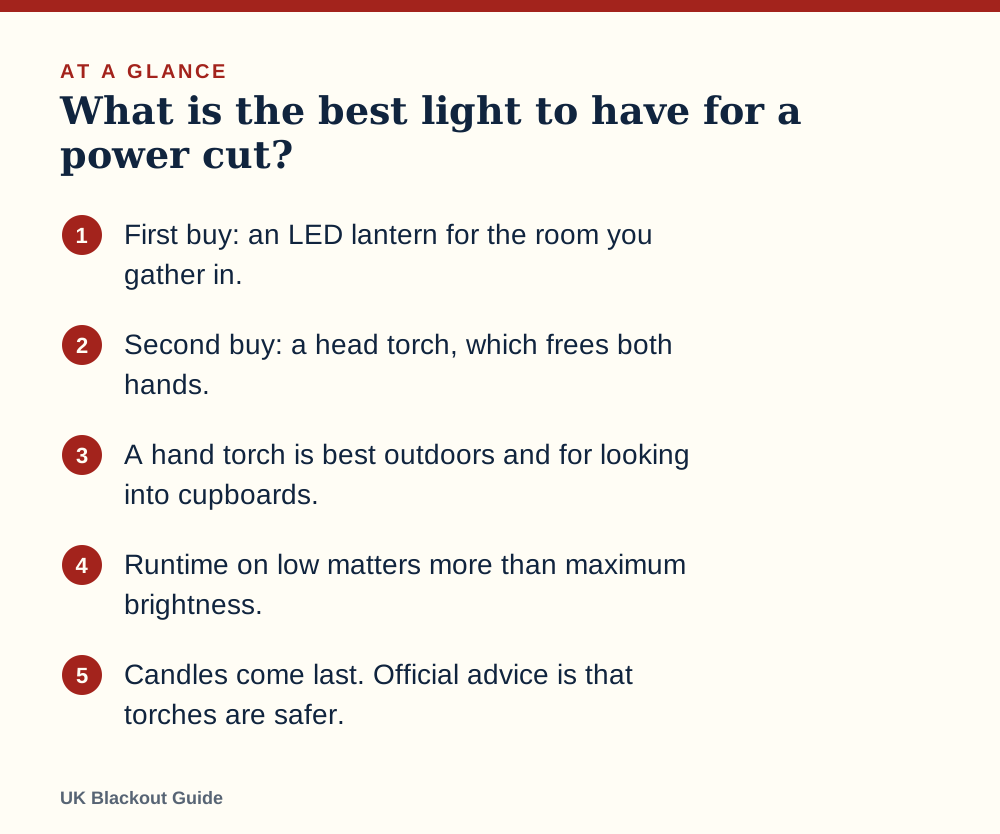
- First buy: an LED lantern for the room you gather in.
- Second buy: a head torch, which frees both hands.
- A hand torch is best outdoors and for looking into cupboards.
- Runtime on low matters more than maximum brightness.
- Candles come last. Official advice is that torches are safer.
A lantern, because power cuts are mostly spent sitting down
Picture a power cut on a January evening. After the first few minutes, most of it is spent in one room: eating, talking, keeping children occupied, listening to the radio. The light that serves those hours best is one that fills the room and lets everyone see each other.
A lantern does that. It shines in all directions, stands on a table or hangs from a hook, and can be left running on low for the whole evening. A hand torch in the same room lights one patch of wall.
Our list of lanterns for power cuts compares runtimes and battery types.
A head torch for everything else
The lantern stays in the room. For the trip to the fuse box, the loo, the kitchen or the car, you want a light that goes with you and leaves your hands free for bannisters, pans and children.
A head torch is better at this than a hand torch for the plain reason that it points where you look. It is also the right light for cooking on a camping stove, for first aid and for reading in bed.
See our head torch picks for options at different budgets.
How the other options rank
- Hand torch: the best tool for outdoors and for peering into a loft or meter cupboard. Worth owning, and ideal by the bed, but third on the list for indoor living.
- Automatic plug-in light: excellent for the first minute of a cut, since it comes on unaided in the hall or on the landing. A supplement to the two above.
- Phone torch: fine for finding a real torch. It spends the battery you need for calls, as the answer on phone torches explains.
- Wind-up torch: never runs out, which is why Be Ready names it, but dim and tiring to keep going. A good backup.
- Candles: a naked flame that cannot be carried or left. Use only if nothing else is available, and follow the candle safety rules.
What makes any light a good one
Whichever type you choose, three features separate a useful emergency light from a drawer ornament. It should have a true low setting, because that is what makes the battery last. It should state its runtime in hours. And it should run on something you can replenish in a cut, meaning standard cells you keep spares of or USB charging from a power bank.
Very high brightness is not on the list. Indoors, a few hundred lumens is ample. Once you have the first two lights, the full guide to lighting a home without power shows how to cover the rest of the house. If you are wondering about the lights you already own outside, see using solar garden lights indoors in a power cut.
Common questions
Is a lantern or a torch better for a power cut?
A lantern is better for lighting a room and a torch is better for moving around or going outside. Most homes are best served by one of each, starting with the lantern.
What is the best light for someone living alone?
A head torch is a strong first choice for one person, since it lights whatever you are doing in any room. Add a plug-in automatic light near the stairs.
Are solar lanterns a good idea?
A solar panel is a useful extra on a lantern that also charges by USB. In a UK winter the panel alone will not keep up with nightly use.
Reviewed against these sources on 18 November 2026. If official advice has changed since, follow the official advice.
General information only. This page is not professional, safety, medical, legal or financial advice, and it is not official guidance. No national blackout has been forecast or announced, and nothing here suggests one is expected. We are independent and have no connection to the government or any energy company. Always check the official sources linked on this page. Full disclaimer
Keep reading
 Guide
Lighting your home without power
How to light a UK home safely in a power cut: which lights to own, what each one is for, how to keep them powered and where to store them all.
Read: Lighting your home without power Buying guide
Best head torches for power cuts
Seven head torches from Amazon UK for power cuts, including long-runtime and AAA battery models, chosen on listed features, price and buyer ratings.
Read: Best head torches for power cuts Buying guide
Best lanterns for power cuts
Seven LED lanterns from Amazon UK for lighting a room in a power cut, including long-runtime, solar, wind-up and battery models, chosen on listings.
Read: Best lanterns for power cuts Guide
A room-by-room lighting plan for power cuts
A room-by-room plan for lighting your home in a power cut: which light goes in the hall, kitchen, living room, bathroom and bedrooms, and why.
Read: A room-by-room lighting plan for power cuts