On this page
Light a home in a power cut with three kinds of battery light: a lantern to fill the room you are sitting in, a head torch for jobs that need both hands, and small lights that mark the hall, stairs and bathroom. The government's Be Ready advice is that torches are safer than candles.
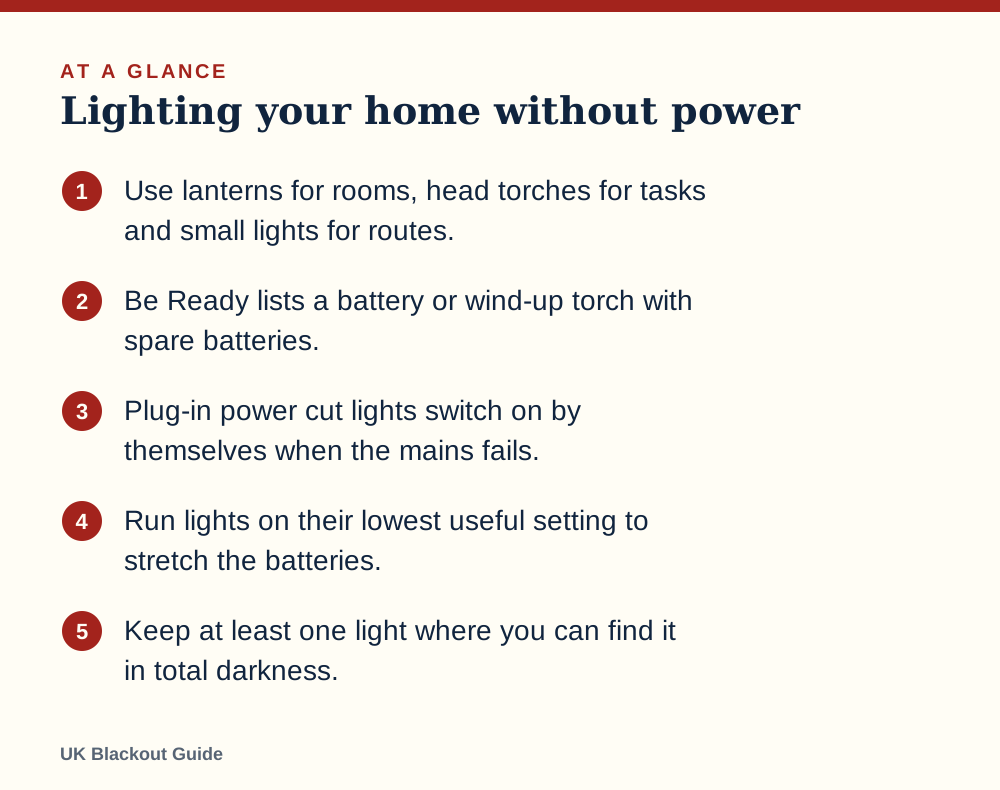
- Use lanterns for rooms, head torches for tasks and small lights for routes.
- Be Ready lists a battery or wind-up torch with spare batteries.
- Plug-in power cut lights switch on by themselves when the mains fails.
- Run lights on their lowest useful setting to stretch the batteries.
- Keep at least one light where you can find it in total darkness.
Three jobs, three kinds of light
Most homes own one torch, and one torch does a poor job of lighting a home. It throws a narrow beam at whatever you point it at and leaves the rest of the room black. It also ties up a hand.
It helps to think about what you need light for. There are three jobs: filling a room so people can eat, talk and play cards; lighting a task right in front of you, such as cooking or finding the fuse box; and marking the route between rooms so nobody falls on the stairs. A lantern does the first, a head torch the second and small low-power lights the third.
The official Be Ready kit list asks for a battery or wind-up torch with spare batteries. If you are deciding which single light to buy first for a power cut, that is the right place to start. Everything below builds on it.
A lantern for the room you are living in
A lantern shines in every direction at once, so one on a table lights faces, food and the floor around it. In a longer cut most households end up gathered in a single room in the evening, and that room is where your lantern belongs.
You do not need a searchlight. A lantern giving a few hundred lumens on its top setting, with a lower setting for most of the evening, suits an ordinary living room. Place the lantern high, on a shelf or hung from a hook, and the light spreads further with less glare.
Runtime matters more than peak brightness, and it is the figure to compare across lanterns suited to power cuts. The gap between the top and bottom settings can be the difference between one evening and a week.
A head torch for anything that needs two hands
Cooking on a camping stove, changing a nappy, carrying a child upstairs, checking the fuse box: all of these need both hands. A head torch points wherever you look and leaves your hands free, which makes it the most useful personal light in the house.
Choose a head torch for home use with a low setting and a beam you can tilt down, so you are not dazzling everyone you speak to. A red light mode is a bonus at night because it keeps your eyes adjusted to the dark.
One per adult is a sensible target when you are working out how many torches a household should have.
Lights that switch themselves on
The worst moment of a power cut is the first one, when the house goes dark and your torch is in a drawer two rooms away. An automatic power cut light solves that. It sits in a socket charging, and when the mains fails it lights up by itself. Most can then be lifted out and carried as a torch.
Put one in the hall or on the landing, and one near the fuse box if there is a socket close by. They are especially useful for a power cut that starts at night, and for anyone unsteady on their feet.
Keeping the lights going for three days
Be Ready asks households to be able to manage for three days. For lighting, that means enough stored energy for three evenings and the dark mornings either side of them in winter.
LED lights use very little power. A typical LED lamp draws 5 to 10 watts at full brightness and far less when dimmed, so lighting is the cheapest thing in the house to keep running. A lantern that charges by USB can be topped up from a power bank during the day. Lights that take AA or AAA cells can be fed from a box of spares, which makes those sizes the batteries worth keeping at home.
Use the lowest setting that lets you do what you are doing. Your eyes adjust within a few minutes, and halving the brightness usually more than doubles the runtime.
Standardise where you can. If every light in the house takes the same size of battery, or charges from the same cable, you are never left with the wrong spares.
Where candles fit in
Candles are a last resort. The official advice is plain that torches are safer than candles, and a naked flame in a dark, unfamiliar-feeling house with tired people in it is how fires start.
If you do light a candle, keep it in a stable holder away from curtains and anything else that burns, never leave it in an empty room, and put it out before you sleep. Smoke alarms that run on batteries keep working in a cut, so test yours now.
If it is the glow you want, battery LED candles give it without the flame.
Storing lights so you can find them in the dark
A light you cannot find is no use. Give each one a fixed home and tell everyone in the house where it is: a head torch on a hook by the back door, a torch in each bedside drawer, the lantern on the same shelf as the rest of your emergency kit.
Check them when the clocks change. Recharge anything rechargeable, look for leaking batteries and switch each light on for a minute. Rechargeable lights slowly lose charge on the shelf, so a top-up twice a year keeps them ready.
Checklist
Lighting your home without power
- One lantern for the main room
- A head torch for each adult
- A torch by every bed
- An automatic power cut light in the hall or on the landing
- Spare batteries in the right sizes
- A power bank kept charged for USB lights
- Everyone knows where the lights are kept
- Smoke alarms tested
Common questions
Do I need special emergency lights, or will camping lights do?
Camping lanterns and head torches are well suited to power cuts. What matters is that they have a low setting, a known runtime and batteries you can replace or recharge.
Can I run my normal lamps from a power station?
Yes. An LED lamp draws about 5 to 10 watts, so even a small power station can run one for many hours. It is still worth owning lights with their own batteries, so you are not relying on a single device.
Is a wind-up torch enough by itself?
It will always give you some light, which is why Be Ready lists it as an option. The output is modest and needs regular winding, so treat it as a backup to a battery lantern and head torch.
Should I leave a light on overnight?
A small light on its lowest setting in the hall or bathroom is worthwhile if anyone is likely to get up, particularly children and older people. It uses very little power.
Reviewed against these sources on 18 November 2026. If official advice has changed since, follow the official advice.
General information only. This page is not professional, safety, medical, legal or financial advice, and it is not official guidance. No national blackout has been forecast or announced, and nothing here suggests one is expected. We are independent and have no connection to the government or any energy company. Always check the official sources linked on this page. Full disclaimer
Keep reading
 Question
What is the best light to have for a power cut?
The best single light for a UK power cut and the second one to add, with the reasons: lanterns, head torches, hand torches and candles compared.
Read: What is the best light to have for a power Guide
A room-by-room lighting plan for power cuts
A room-by-room plan for lighting your home in a power cut: which light goes in the hall, kitchen, living room, bathroom and bedrooms, and why.
Read: A room-by-room lighting plan for power cuts Buying guide
Best automatic power cut lights
Plug-in lights that switch on by themselves when the mains fails, plus a solar backup, picked from Amazon UK listings for stairs, landings and halls.
Read: Best automatic power cut lights Buying guide
Best head torches for power cuts
Seven head torches from Amazon UK for power cuts, including long-runtime and AAA battery models, chosen on listed features, price and buyer ratings.
Read: Best head torches for power cuts