On this page
A typical rechargeable LED lantern runs for roughly 4 to 8 hours on its brightest setting and anything from 20 to well over 50 hours on its lowest. The exact figure depends on battery size and brightness, so check the runtime the maker states for each mode. The LEDs themselves last for many years.
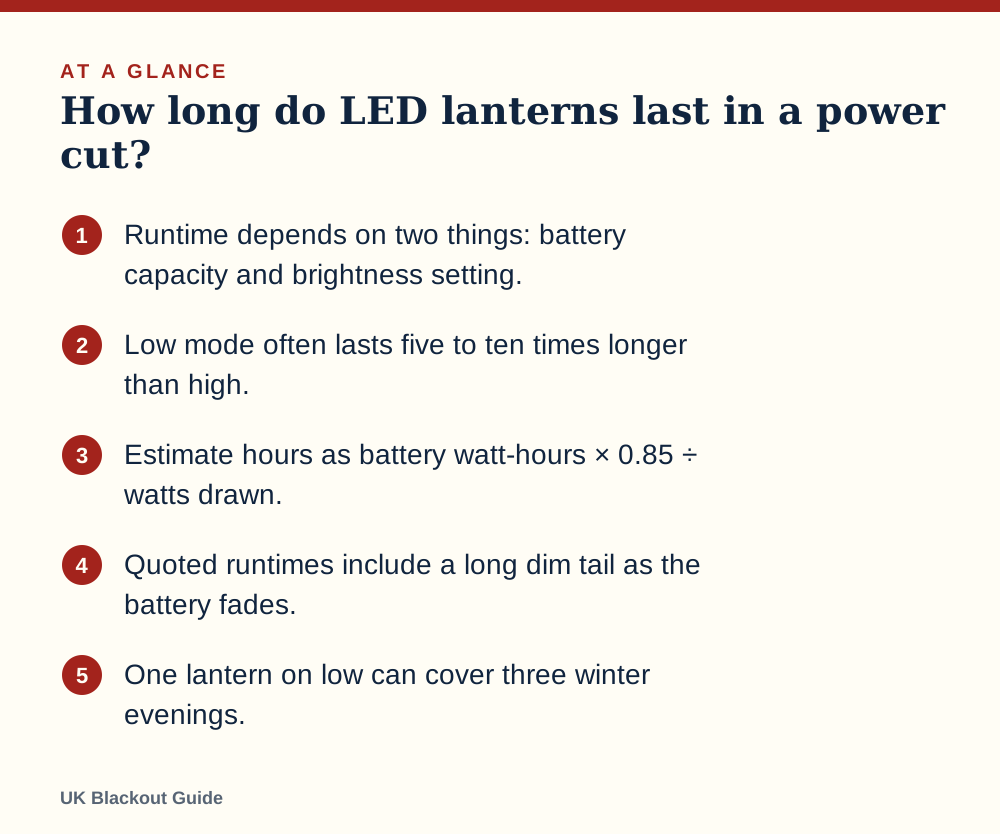
- Runtime depends on two things: battery capacity and brightness setting.
- Low mode often lasts five to ten times longer than high.
- Estimate hours as battery watt-hours × 0.85 ÷ watts drawn.
- Quoted runtimes include a long dim tail as the battery fades.
- One lantern on low can cover three winter evenings.
Brightness setting decides most of it
An LED lantern is a battery with a light on top, and the light sips or gulps depending on the setting. On high, a lantern might draw 3 to 5 watts. On low it can draw half a watt or less. The same battery therefore lasts several times longer on low.
This is why two honest answers to the question can differ by a factor of ten. When you compare lanterns, compare them on the mode you will really use. For an evening in the living room that is usually low or medium, and our explanation of lumens shows how little light a dark-adapted room needs.
Working out the runtime yourself
If the box gives battery capacity, you can check the claims. Runtime in hours is roughly the battery's watt-hours, times 0.85 to allow for losses, divided by the watts the light draws.
Many lanterns quote milliamp-hours (mAh) instead. Multiply by 3.7 and divide by 1,000 to get watt-hours for a lithium cell. So a 5,000 mAh lantern holds about 18.5 Wh. At 3 W on high that gives around 5 hours. At 0.5 W on low it gives around 31 hours.
Lanterns that take disposable cells follow the same logic, with the capacity coming from the batteries you fit. Larger cells such as D size hold far more energy than AAs, which is why big D-cell lanterns are known for very long runtimes.
Our round-up of lanterns for power cuts lists the stated low-mode runtime for each one.
Why real life falls short of the box
Quoted runtimes are usually measured until the light has faded to a small fraction of its starting output, so the last few hours can be dim. Cold rooms reduce battery performance. Rechargeable batteries also lose capacity as they age and slowly drain in storage.
None of this is a reason for concern. It means you should treat the maker's figure as a best case, and recharge stored lanterns every six months when you check the rest of your kit.
Making one lantern last three days
The Be Ready campaign asks households to be able to manage for three days. In midwinter you might want light for 6 hours each evening plus an hour in the morning, around 20 hours in total. A lantern with a 30-hour low mode covers that with room to spare, provided you keep it on low.
Switch the lantern off when the room is empty, hang it high so a lower setting does the job, and use a head torch for short tasks instead of turning the lantern up, which is how lanterns, torches and automatic lights share the work in the guide to lighting your home without power.
Recharging gives you a second margin. Topping up an 18.5 Wh lantern takes only a share of a standard power bank, and the power bank charging sums apply to lanterns as well as phones.
Common questions
Do the LEDs in a lantern wear out?
Very slowly. LEDs are typically rated for tens of thousands of hours, so in a lantern used a few evenings a year the battery will age long before the LEDs do.
Is a rechargeable or battery-powered lantern better?
Rechargeable suits most homes if you also own a power bank. Lanterns that take AA or D cells suit long cuts because spares store for years. Some lanterns do both.
Can I leave a lantern on all night?
Yes, on its lowest setting. LED lanterns stay cool and carry no fire risk, though it will use up hours you may want the next evening.
Reviewed against these sources on 18 November 2026. If official advice has changed since, follow the official advice.
General information only. This page is not professional, safety, medical, legal or financial advice, and it is not official guidance. No national blackout has been forecast or announced, and nothing here suggests one is expected. We are independent and have no connection to the government or any energy company. Always check the official sources linked on this page. Full disclaimer
Keep reading
 Buying guide
Best lanterns for power cuts
Seven LED lanterns from Amazon UK for lighting a room in a power cut, including long-runtime, solar, wind-up and battery models, chosen on listings.
Read: Best lanterns for power cuts Guide
A room-by-room lighting plan for power cuts
A room-by-room plan for lighting your home in a power cut: which light goes in the hall, kitchen, living room, bathroom and bedrooms, and why.
Read: A room-by-room lighting plan for power cuts Guide
Lighting your home without power
How to light a UK home safely in a power cut: which lights to own, what each one is for, how to keep them powered and where to store them all.
Read: Lighting your home without power Guide
Lumens explained: how bright a torch do you need?
What lumens mean on a torch or lantern box, how many you need for each job in a power cut, and why runtime matters more than peak brightness.
Read: Lumens explained: how bright a torch do you