On this page
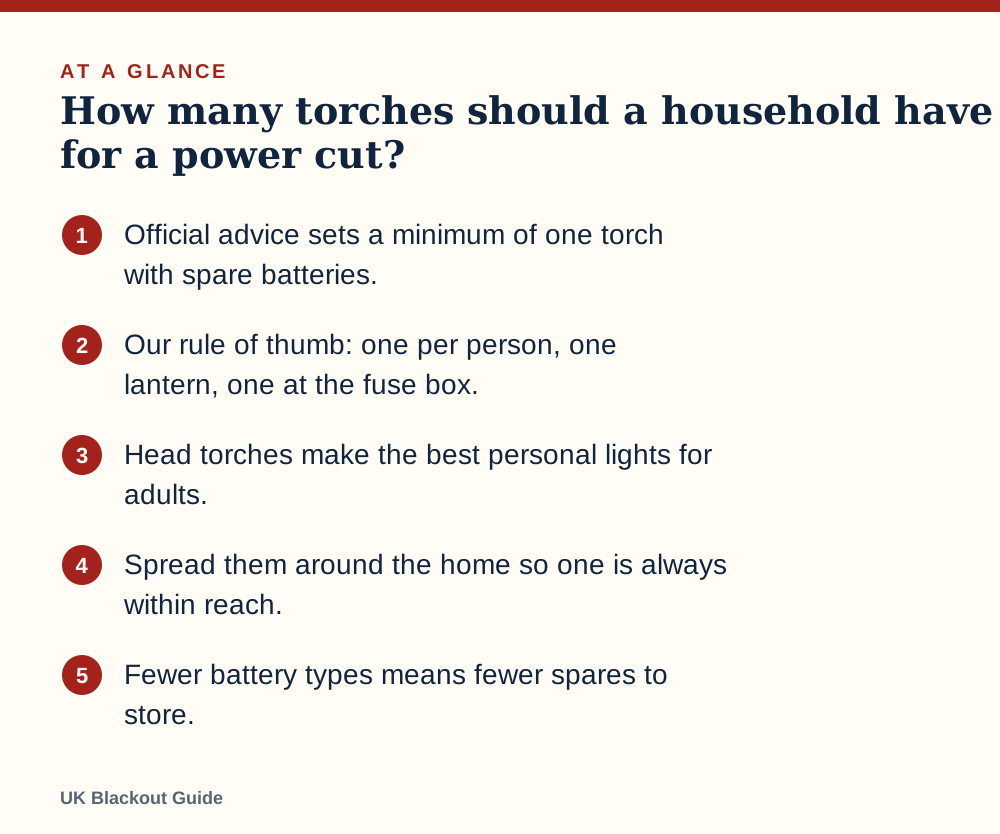
There is no official number. The government's Be Ready list simply asks for a battery or wind-up torch with spare batteries. A practical rule is one personal light for each person, plus one shared lantern, plus one torch that lives at the fuse box. For a family of four, that is six lights.
- Official advice sets a minimum of one torch with spare batteries.
- Our rule of thumb: one per person, one lantern, one at the fuse box.
- Head torches make the best personal lights for adults.
- Spread them around the home so one is always within reach.
- Fewer battery types means fewer spares to store.
Why one torch is not enough
One torch meets the letter of the official kit list, and it is far better than none. The trouble shows up within minutes of a real cut. Someone takes the torch to check the fuse box and everyone else is left in the dark. A child needs the toilet while an adult is using the light to cook. The torch gets put down somewhere and nobody can find it.
A single light is also a single point of failure. Batteries leak, bulbs get dropped, rechargeable lights are found flat. With several lights around the house, one failure is an inconvenience.
Count people first, then places
The rule we suggest has three parts, and it mixes torches, a lantern and fixed lights in the way the overall home lighting guide describes.
- One personal light per person. Each person can then move about independently. For adults a head torch is the most useful kind because it frees both hands. For children a small, light hand torch they can work themselves is better.
- One shared lantern. This lights the room where everyone gathers in the evening, so the personal lights can be switched off.
- One fixed torch at the fuse box. It never leaves, so it is always there when you need to check whether a switch has tripped.
Our round-up of head torches has picks for adults and for smaller heads.
What that looks like in different homes
| Household | Personal lights | Lantern | Fuse box torch | Total |
|---|---|---|---|---|
| One person in a flat | 1 | 1 | 1 | 3 |
| Couple | 2 | 1 | 1 | 4 |
| Family of four | 4 | 1 | 1 | 6 |
| Family of five, three floors | 5 | 2 | 1 | 8 |
Add a torch to the car if you have one, since a cut may find you away from home, and a car emergency kit should have its own. An automatic plug-in light on the landing is a worthwhile extra on top of these numbers, particularly for older people.
If that sounds like a lot to buy at once, it does not need to be. Be Ready's own advice is to build a kit gradually. Start with the lantern and one torch, then add a light each month.
Placement and batteries matter as much as the count
Six torches in one drawer are little better than one. Keep personal torches by beds, the lantern with your emergency kit and a spare by the front door, as laid out in the room-by-room lighting plan.
Try to keep to one or two battery sizes across the house, so that one box of spares feeds everything. Which cells to stock, and how many, is covered in the batteries worth stocking. Check every light twice a year: switch it on, recharge it or swap tired cells, and put it back where it lives.
You can compare models in our list of torches for power cuts.
Common questions
Does a phone count as a torch?
Not for planning purposes. It will get you to a real torch, but its battery is better saved for calls and updates.
Should every child have their own torch?
Yes, if they are old enough to use one. It gives them some control in an unfamiliar situation and stops them borrowing yours.
How many spare batteries should I keep per torch?
At least one full change for each light that takes replaceable cells. For a three-day cut on low settings that is usually more than enough.
Reviewed against these sources on 18 November 2026. If official advice has changed since, follow the official advice.
General information only. This page is not professional, safety, medical, legal or financial advice, and it is not official guidance. No national blackout has been forecast or announced, and nothing here suggests one is expected. We are independent and have no connection to the government or any energy company. Always check the official sources linked on this page. Full disclaimer
Keep reading
 Buying guide
Best head torches for power cuts
Seven head torches from Amazon UK for power cuts, including long-runtime and AAA battery models, chosen on listed features, price and buyer ratings.
Read: Best head torches for power cuts Buying guide
Best torches for power cuts
Seven LED torches from Amazon UK for power cuts: battery, wind-up and rechargeable picks, with a plain warning about impossible lumen claims.
Read: Best torches for power cuts Guide
Lighting your home without power
How to light a UK home safely in a power cut: which lights to own, what each one is for, how to keep them powered and where to store them all.
Read: Lighting your home without power Guide
Lumens explained: how bright a torch do you need?
What lumens mean on a torch or lantern box, how many you need for each job in a power cut, and why runtime matters more than peak brightness.
Read: Lumens explained: how bright a torch do you