On this page
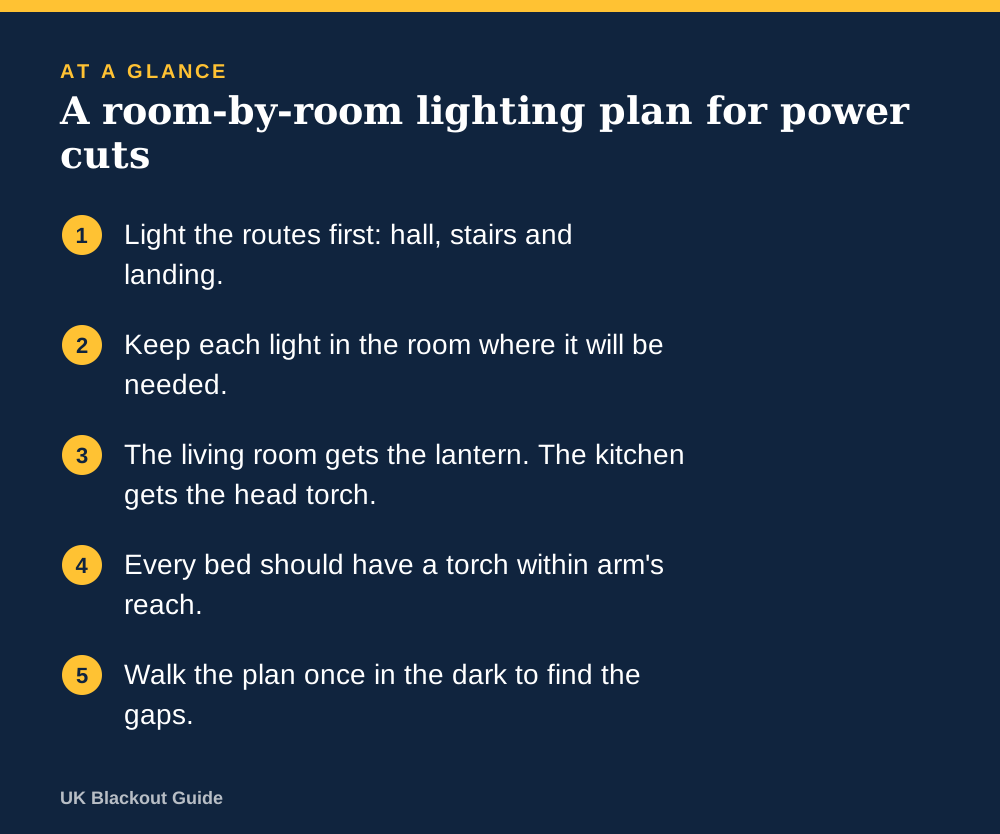
Put automatic lights where people fall (hall, stairs and landing), a lantern where people gather (living room), a head torch where hands are busy (kitchen), and a small torch by every bed. A typical three-bedroom house can be covered with about eight inexpensive lights, each kept in the room where it will be used.
- Light the routes first: hall, stairs and landing.
- Keep each light in the room where it will be needed.
- The living room gets the lantern. The kitchen gets the head torch.
- Every bed should have a torch within arm's reach.
- Walk the plan once in the dark to find the gaps.
Start with a walk around the house
Before buying anything, walk through your home one evening with the lights off and curtains closed. Notice where you slow down. It is usually the top of the stairs, a step down into a kitchen or extension, the corner where the dog bed lives and the cupboard with the fuse box in it.
Those are the places your plan has to cover first. Comfortable light for the evening comes second. This page takes the principles of lighting a home without power and turns them into a room list.
The plan at a glance
| Area | What to put there | Why |
|---|---|---|
| Hall, stairs, landing | Automatic plug-in power cut light | Comes on unaided, marks the trip hazards |
| Living room | Lantern, plus LED candles if you like | Lights the whole group for the evening |
| Kitchen | Head torch on a hook, second small lantern | Both hands free for hot food and knives |
| Bathroom | Small battery light or glow stick | No sockets, wet floor, visited at night |
| Bedrooms | Torch in each bedside drawer | First thing you reach for at 3am |
| Fuse box and meter cupboard | Torch kept inside or beside it | You need light to check whether it is a trip |
| Front and back doors | Torch or head torch by the door | Bins, car, checking on neighbours |
Hall, stairs and landing
Falls on stairs are the main injury risk in a dark house, so this is where an automatic power cut light earns its socket. It charges quietly all year and switches on the moment the mains drops, which covers the minutes before anyone has found a torch.
If there is a socket on the landing and another in the hall, use both. In a power cut in a flat, put one in the corridor between bedroom and bathroom. Communal stairwells in blocks have their own emergency lighting, which runs on batteries for a limited time, so keep a torch by your front door as well.
Living room
This is where the household will spend the evening, and in a winter cut it is likely to be the one room you keep warm as well. It needs one good lantern, placed high on a shelf or bookcase so the light spreads and nobody is staring into it.
Run it on a low or middle setting, which also decides how long an LED lantern lasts on one charge. A room lit by a single lantern looks dim for the first few minutes and comfortable after that. A couple of battery LED candles on the mantelpiece add a softer background light without the fire risk of wax ones.
Kitchen
The kitchen is where hands are full of sharp and hot things, so the light should be on your head. Keep a head torch on a hook inside a cupboard door. A lantern on the worktop tends to put your own shadow over whatever you are chopping.
If you are cooking without electricity on a camping stove, do it with a window open and never bring a barbecue or patio heater indoors: carbon monoxide has no smell.
Keep the fridge and freezer doors shut while the power is off. If you need something, decide what before you open the door, and use a torch so you are quick.
Bathroom and bedrooms
Bathrooms have no ordinary sockets, hard wet floors and often no window. People also visit them half asleep. A small battery push light, an LED candle on the shelf or a glow stick hung on the door handle is enough. You want to see the edges of things, nothing more.
Glow sticks in a power cut suit this job well because they give a soft light all night and are safe around water.
Every bed should have a torch that can be reached without getting up. A small one in the bedside drawer is enough. Tell children where theirs is and let them practise using it, because a child with their own torch is usually a calmer child.
For younger children, a rechargeable night light that keeps glowing when the mains goes is worth having in the room all year. Never leave a candle in a bedroom.
Ceiling lights that keep working
Rechargeable emergency bulbs fit a normal bayonet or screw fitting and charge from the mains while in everyday use. When the supply fails, a built-in battery can keep the bulb lit for a few hours, so the room is lit from the ceiling as usual.
How they behave in a real cut depends on the design and on your wiring, so test one before you rely on it. Many also work as a handheld light once unscrewed. They are a good fit for the kitchen and for anyone who would struggle to set up lanterns.
Fuse box, doors and outside
Keep a torch at the fuse box itself. The first thing to find out is whether the whole street is off or only your house, and working out why your power has gone off starts with looking at the trip switches. If it is a wider cut, you report it by calling 105.
A second torch or head torch by the front door covers trips outside. Stay well away from any fallen power lines, and take a light when you go to check on a neighbour.
Checklist
A room-by-room lighting plan for power cuts
- Automatic light in the hall
- Automatic light on the landing
- Lantern for the living room
- Head torch hung in the kitchen
- Small battery light or glow sticks for the bathroom
- Torch in every bedside drawer
- Torch at the fuse box
- Torch by the front door
- Spare batteries and a charged power bank
Common questions
How much does it cost to light a whole house this way?
Prices change, so we do not quote figures, but every item on this list is at the cheaper end of preparedness spending. Buy the stair light and bedside torches first and add the rest over time.
Do I need a light in every room?
No. Rooms you will not use in a cut, such as a spare room or study, can stay dark. Concentrate on routes, the room you gather in, the kitchen, bathroom and beds.
Where should spare batteries be kept?
In one known place, ideally with the rest of your emergency kit, in their packaging and away from heat. Everyone in the house should know where that is.
Will my outside security light work in a power cut?
Mains-powered ones will not. Solar security lights with their own battery will carry on working.
Reviewed against these sources on 18 November 2026. If official advice has changed since, follow the official advice.
General information only. This page is not professional, safety, medical, legal or financial advice, and it is not official guidance. No national blackout has been forecast or announced, and nothing here suggests one is expected. We are independent and have no connection to the government or any energy company. Always check the official sources linked on this page. Full disclaimer
Keep reading
 Guide
Lighting your home without power
How to light a UK home safely in a power cut: which lights to own, what each one is for, how to keep them powered and where to store them all.
Read: Lighting your home without power Buying guide
Best automatic power cut lights
Plug-in lights that switch on by themselves when the mains fails, plus a solar backup, picked from Amazon UK listings for stairs, landings and halls.
Read: Best automatic power cut lights Buying guide
Best emergency light bulbs that stay on in a power cut
Emergency light bulbs that stay on in a power cut: rechargeable bulbs from Amazon UK listings with a battery inside, plus the fitting types explained.
Read: Best emergency light bulbs that stay on in a Buying guide
Best lanterns for power cuts
Seven LED lanterns from Amazon UK for lighting a room in a power cut, including long-runtime, solar, wind-up and battery models, chosen on listings.
Read: Best lanterns for power cuts