On this page
In a flat, a power cut affects the building as well as your home. Lifts stop, stairwells go dark once emergency lighting runs down, door entry systems may fail and taller blocks can lose water pressure because pumps need electricity. Keep a head torch and some stored water, and never use flames or fuel stoves indoors.
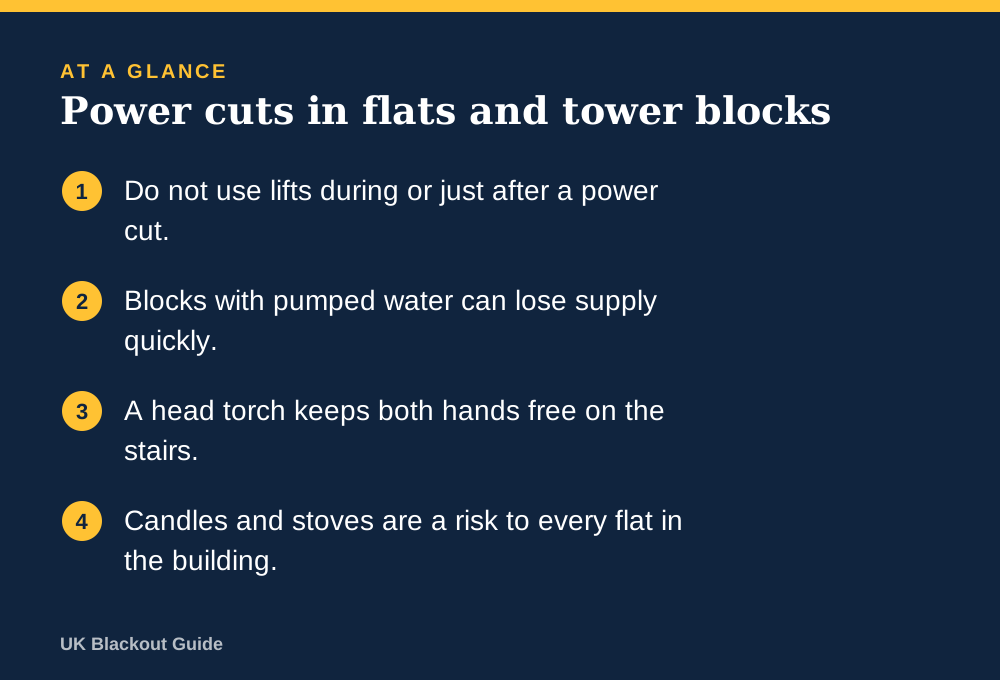
- Do not use lifts during or just after a power cut.
- Blocks with pumped water can lose supply quickly.
- A head torch keeps both hands free on the stairs.
- Candles and stoves are a risk to every flat in the building.
What the building loses, floor by floor
A house has one set of problems in a power cut. A block of flats has two: yours, and the building's. How much the second set matters depends on how high up you live.
| Shared system | What usually happens |
|---|---|
| Lifts | Stop. Some return to a floor on backup power, many do not. |
| Stairwell and corridor lights | Emergency lighting comes on, but only for a limited time. |
| Water | May stop or weaken if the block uses booster pumps. |
| Door entry and intercom | May fail. The main door might lock or release, depending on the system. |
| Car park gates and shutters | Stay as they are unless opened by hand. |
| Communal heating | Stops if the plant room pumps lose power. |
Every building is set up differently. The useful thing to do this week is ask your landlord, managing agent or housing association how yours behaves, before you need to know.
Lifts: leave them alone
If the lights flicker or the power has just returned, take the stairs. Supply often drops again in the minutes after it is restored, and a lift is the worst place to find that out.
If you are in a lift when it stops, stay calm and stay inside. Press the alarm or call button, and use your phone if you have signal. Do not try to force the doors or climb out. Lifts are built to hold safely when power is lost, and the danger comes from trying to escape.
If you or someone you live with cannot manage stairs, a power cut can leave you unable to leave an upper floor. That is exactly the kind of situation the free Priority Services Register exists for. Tell your building manager as well.
Stairs and corridors in the dark
Communal emergency lights are there to let people leave the building safely. They run on batteries and are not designed to last through a long night. Internal corridors with no windows will then be completely dark, at any time of day.
Carrying shopping, a child or a bin bag down six flights with a phone torch in your teeth is how people fall. A head torch solves it.
Water can stop sooner than you think
Mains pressure alone will only push water so high, which is why whether water works in a power cut can depend on your floor. Many taller blocks use electric booster pumps to supply the upper floors, and some feed flats from rooftop tanks that are filled by pump. When the power goes, the upper floors can lose pressure or run dry while the ground floor is fine.
If your block is pumped, keep water in the flat. The official planning figure is 3 litres of drinking water per person per day for three days, with more for cooking and washing. Storage is the hard part in a small flat, so use water containers that stack or fold.
The moment a cut starts, fill the kettle, some pans and the containers while the taps still run.
Toilets are the other question. Flushing a toilet in a power cut works once from the cistern after the water stops, and after that you need to pour water in by hand.
Doors, gates and getting in and out
Electronic entry systems vary. Some main doors unlock when power fails, some stay locked and need a key or manual override, and fobs may stop working. If your only way in is a fob, ask the managing agent what the backup is and whether you should hold a physical key.
Intercoms will probably be dead, so visitors and carers cannot buzz you. Agree a plan with anyone who visits regularly, such as a phone call from outside.
If your car is behind an electric shutter or gate, find out where the manual release is and who is allowed to use it.
Fire and fumes are everyone's risk
In a block, your fire is your neighbours' fire. Use torches and lanterns, and leave candles out of it altogether if you can.
Never use a barbecue, camping stove, patio heater or generator inside a flat, on an enclosed balcony or in a communal area. They produce carbon monoxide, which has no smell, and they are a serious fire hazard in a shared building. Check your lease too, since many blocks ban gas cylinders and barbecues on balconies outright.
Part of fire safety in a power cut is knowing your building's fire plan and where the stairs are from your door, by feel as well as by sight. Battery smoke alarms keep working in a cut, and most mains-wired ones have a backup battery. Test yours.
Without a hob you can light by hand, plan for food that needs no cooking. A flask filled from the kettle at the first flicker gives you hot drinks for hours.
Use the advantages a flat gives you
Flats have real strengths in a cut. With homes above, below and beside you, a flat in the middle of a block loses heat far more slowly than a detached house. And you have neighbours a few steps away.
Make checking on neighbours part of that: knock on doors, especially those of older residents and anyone on an upper floor who cannot use the stairs. Share what you know about restoration times, and offer to carry water up.
Limited storage and no outdoor space shape what goes into an emergency kit for a flat, so keep it small and keep it where you can reach it in the dark.
Checklist
Power cuts in flats and tower blocks
- Ask the managing agent how lifts, water and doors behave in a cut
- Head torch by the front door
- Stored drinking water if the block is pumped
- Physical key or known override for the main entrance
- Location of car park manual release
- Priority Services Register if stairs are a problem
- No-cook food for three days
- Smoke alarm tested
Common questions
Who do I report a power cut to if I live in a flat?
Call 105 as usual if the whole building or street is off. If only your flat or only the communal areas are affected, contact your landlord or managing agent as well.
Will the fire alarm in my block still work?
Communal fire alarm systems normally have battery backup, but for a limited time. Ask your building manager how long theirs lasts.
Can I use a camping stove on my balcony?
It is a fire risk in a shared building and is often banned by the lease. Rely on no-cook food and a flask instead.
Is a high-rise flat colder in a power cut?
Usually the opposite. Flats surrounded by other homes lose heat slowly, though top-floor and corner flats cool faster.
Reviewed against these sources on 18 November 2026. If official advice has changed since, follow the official advice.
General information only. This page is not professional, safety, medical, legal or financial advice, and it is not official guidance. No national blackout has been forecast or announced, and nothing here suggests one is expected. We are independent and have no connection to the government or any energy company. Always check the official sources linked on this page. Full disclaimer
Keep reading
 Question
Can I flush the toilet in a power cut?
Most UK toilets flush normally in a power cut because they work by gravity. Macerator toilets and homes with pumped water are the main exceptions.
Read: Can I flush the toilet in a power cut? Guide
How to prepare for a blackout in the UK
How to prepare for a blackout in the UK: the official Be Ready three-day list, the numbers to save, and the home checks to do. No blackout is forecast.
Read: How to prepare for a blackout in the UK Guide
Power cut at night: staying safe in the dark
What to do if the power goes off at night: get light without falling, make the house safe, decide whether to stay up and set an alarm that still works.
Read: Power cut at night: staying safe in the dark Buying guide
Best power cut essentials: the blackout kit worth buying
The blackout kit worth buying for a UK power cut: a battery torch, a lantern, a power bank, a wind-up radio, an automatic light and a flask, with picks.
Read: Best power cut essentials: the blackout kit