On this page
A flat needs the same three-day kit as a house, adjusted for less storage, no outdoor space and more reliance on building systems. Prioritise stored water, because pumps in some blocks stop in a power cut, plus a lantern, a head torch for dark stairs, and food that needs no cooking at all.
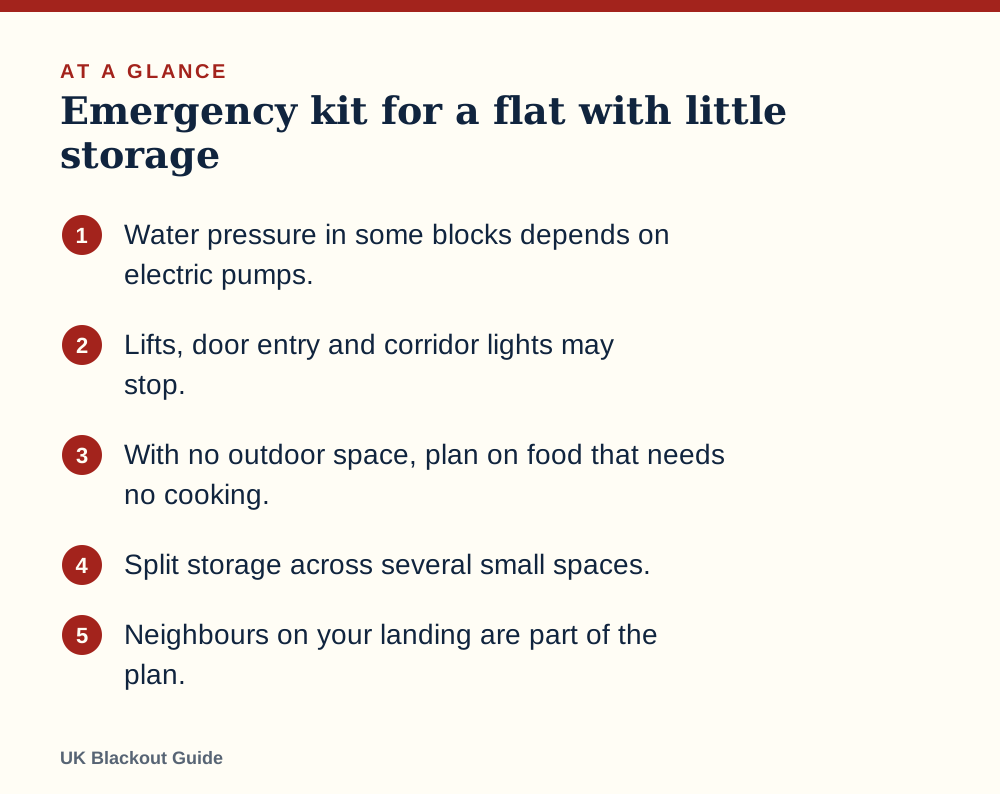
- Water pressure in some blocks depends on electric pumps.
- Lifts, door entry and corridor lights may stop.
- With no outdoor space, plan on food that needs no cooking.
- Split storage across several small spaces.
- Neighbours on your landing are part of the plan.
What changes when you live in a flat
The official Be Ready list applies to every home: three days of water and food, a torch, a radio, a power bank, first aid, warmth and cash. A flat does not need a different list. It needs different emphasis.
Three things stand out. You probably have less cupboard space. You may have no garden, balcony or shed. And you depend on shared systems you do not control, such as lifts, water pumps, door entry panels and communal lighting. Our guide to getting through a power cut in a flat covers what to do on the day. This page deals with what to have ready beforehand.
Water is the first priority higher up
Mains water can be disrupted during and after any power cut, so whether taps keep running in a power cut is never certain. In taller blocks the risk is higher, because many use electric pumps to lift water to upper floors. If the pumps stop, taps on higher storeys may slow or run dry while ground-floor taps still work. Ask your landlord or managing agent how your building is supplied.
Be Ready advises 3 litres per person per day for drinking, so 18 litres for a couple over three days. That is three six-packs of 1 litre bottles, which will slide under a bed. If you prefer refillable storage, slim stackable water containers use awkward gaps better than round ones.
Toilets are the other water question. If the supply stops, flushing a toilet without mains water means pouring a bucket of water into the pan each time.
Light for rooms, corridors and stairs
Communal emergency lighting, where fitted, is designed to help people leave the building and typically runs for a limited time. After that, internal corridors and stairwells with no windows can be completely dark, even at midday.
Inside the flat, one LED lantern lights a room far better than a torch pointed at the ceiling.
For the stairs, carry a head torch so both hands are free for the rail and your bags. Torches are safer than candles in any home. In a flat, where a fire affects everyone above you, that matters even more.
Do not use candles in a block of flats if you can avoid it, and never leave one unattended. Check that your smoke alarm works, since battery and mains-with-backup alarms should still sound in a power cut.
Food when you cannot cook outdoors
Many flats have electric hobs and ovens, so a power cut means no cooking at all. People in houses can take a camping stove into the garden. Without outdoor space, that option is largely closed to you, because a camping stove is not safe indoors.
Never use a barbecue, camping stove or patio heater indoors or on an enclosed balcony. They produce carbon monoxide, which has no smell and can kill. Many leases and building rules also ban gas cylinders.
So build the food side of your kit around things eaten cold: tinned fish, beans, sweetcorn and fruit, crackers, oatcakes, nut butter, cereal with long-life milk. Our list of meals that need no cooking turns those into something you would choose to eat. A manual tin opener is not optional.
If hot drinks matter to you, filling a vacuum flask with boiling water when a storm is forecast, or before a planned cut, gives you several hours of tea.
Lifts, door entry and getting in and out
Lifts stop in a power cut. If you or someone you live with cannot manage the stairs, that changes your plan: you need enough at home to stay put comfortably, and people who know to check on you. Register for the Priority Services Register if you qualify, and tell your landlord or managing agent about any mobility needs before there is a problem.
Electronic door entry systems and fobs behave differently from building to building when the power fails. Find out how yours works, and whether there is a manual key. If you are ever stuck in a lift, use the alarm button and wait. Do not try to force the doors.
Carrying 18 litres of water up nine floors after the lifts stop is hard work, which is another reason to store it in advance.
Fitting a kit into a small space
You do not need one big box. Split the kit by where things naturally live.
- Hall cupboard or by the door: a small box with torch, radio, power bank, batteries, first aid kit, cash and documents.
- Under the bed: bottled water, laid flat.
- Kitchen cupboard: one shelf of no-cook food, eaten and replaced as part of normal shopping.
- Wardrobe: sleeping bag or spare duvet, warm layers.
The small box is the part that must be findable in the dark, which is the main test for where to keep an emergency kit.
Your neighbours are a resource a house does not have
Flats have one clear advantage: other people are close. Find out who on your floor is elderly, has a baby or lives alone, and swap phone numbers on paper. In a long cut, checking on neighbours with a knock on the door every few hours does more good than any gadget.
Shared walls also mean flats tend to lose heat more slowly than detached houses, particularly on middle floors.
Checklist
Emergency kit for a flat with little storage
- Ask how your block's water supply and door entry work without power
- Store 9 litres of water per person, under a bed if needed
- Keep three days of food that needs no cooking
- Manual tin opener
- Lantern for the main room
- Head torch for stairwells
- Radio, power bank, first aid kit and cash in one small box by the door
- Test your smoke alarm
- Swap numbers with neighbours on your floor
Common questions
Can I use a camping stove on my balcony?
Check your lease and building rules first, as many ban gas cylinders and open flames. Never use one on an enclosed or glazed balcony, because of fire and carbon monoxide risk.
Will the lift work in a power cut?
No, expect lifts to stop. If stairs are a problem for you, plan to stay in your flat and let your landlord, neighbours and network operator know in advance.
Do I need as much water in a studio flat?
The amount depends on people, not floor space: 3 litres per person per day for drinking. For one person that is 9 litres over three days.
Is a flat warmer than a house in a power cut?
Often, yes. Shared walls, floors and ceilings slow heat loss, especially on middle floors. You still need blankets and warm layers.
Reviewed against these sources on 18 November 2026. If official advice has changed since, follow the official advice.
General information only. This page is not professional, safety, medical, legal or financial advice, and it is not official guidance. No national blackout has been forecast or announced, and nothing here suggests one is expected. We are independent and have no connection to the government or any energy company. Always check the official sources linked on this page. Full disclaimer
Keep reading
 Guide
Blackout shopping list: what to buy first, and what can wait
What to buy for the blackout, in order: a shopping list based on the government's Be Ready kit, with what to buy first, what can wait and what to skip.
Read: Blackout shopping list: what to buy first, Question
Are ready-made emergency kits worth it?
Are ready-made emergency kits worth buying in the UK? When a pre-packed kit makes sense, when it does not, and three checks to make before you pay.
Read: Are ready-made emergency kits worth it? Buying guide
Best batteries to stock for emergencies
Which batteries to stock for emergencies and power cuts: seven bulk AA and AAA alkaline packs from Amazon UK compared on shelf life, size and price.
Read: Best batteries to stock for emergencies Buying guide
Best emergency kits for UK homes
No ready-made emergency kit on Amazon UK matches the official Be Ready list. These seven listings cover the parts a UK home can buy ready-made.
Read: Best emergency kits for UK homes