On this page
A ready-made emergency kit is worth it if it gets you started when you otherwise would not, or if you are buying for someone else. It is rarely the cheapest route, and no kit is complete: you still have to add enough water, three days of food, medication, cash and documents. Building your own usually gives better quality for less.
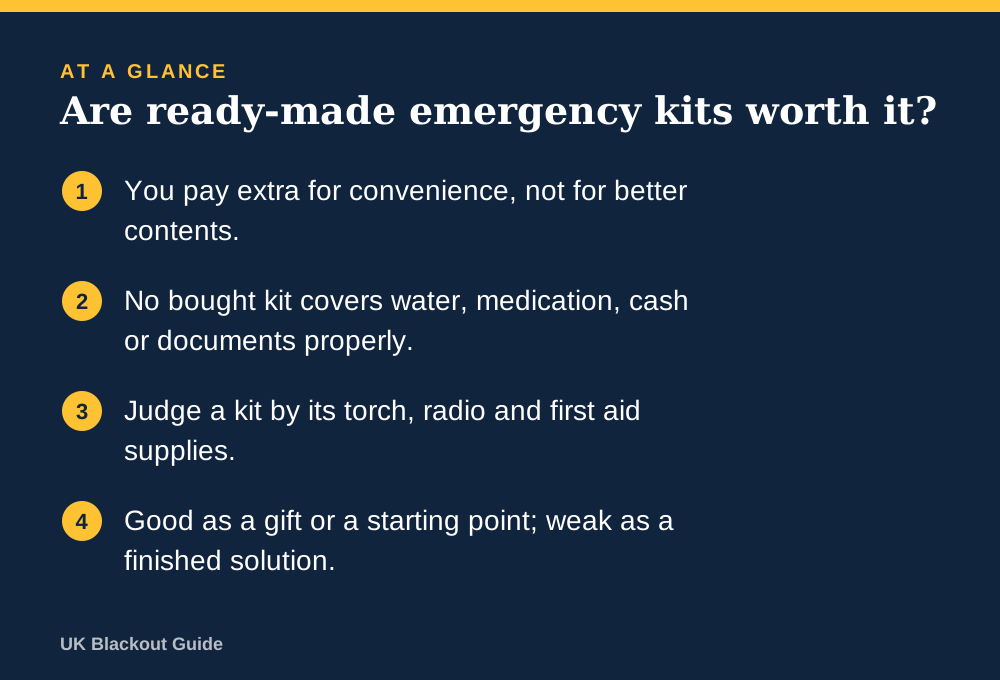
- You pay extra for convenience, not for better contents.
- No bought kit covers water, medication, cash or documents properly.
- Judge a kit by its torch, radio and first aid supplies.
- Good as a gift or a starting point; weak as a finished solution.
When buying one makes sense
The honest case for a pre-packed kit is behavioural. Plenty of people read the official list, agree with it, and never get round to it. A bag that arrives in two days and sits by the door is worth more than a perfect kit that exists only as a plan.
Bought kits also suit three specific situations: a gift for an older relative or a student moving into their first flat, a second kit for a car or holiday home, and households that simply value their time over the saving. If any of those is you, look at the ready-made kits we recommend. For presents in particular, see our emergency preparedness gifts.
When it does not
If you already own a torch, a first aid box and blankets, a kit mostly sells you duplicates. If you are on a tight budget, the same money goes further spent item by item. And if your household has particular needs, such as a baby, a medical condition or a special diet, a generic kit will miss the things that matter most to you.
Be especially careful with kits marketed on fear or on piece count. Our guide to what not to buy explains the common tricks.
Three checks before you pay
- Read the contents against the official list. Be Ready asks for water, no-cook food, tin opener, torch, radio, power bank, first aid, medication, hygiene items, warmth, cash and documents. Tick what the kit covers. Our plain-English emergency kit list makes this quick.
- Look hard at the water. The advice is 3 litres per person per day. A kit with a handful of small pouches covers a fraction of one day.
- Price the upgrades. Work out what you would replace (often the torch and power bank) and what you must add, then compare that total with building from scratch.
No commercial kit is approved or endorsed by the government, so ignore any that hint otherwise.
The middle route
Many households end up buying a modest kit as a base and improving it. That is a perfectly reasonable outcome. You get the bag and the small supplies in one go, then swap in a better torch and add your own water, food and paperwork over the following weeks.
For a fuller side-by-side look at cost, quality and effort, read our comparison of bought and home-built kits.
Common questions
Do ready-made kits include enough water?
Almost never. Official advice is 3 litres per person per day for three days, which is too heavy and bulky to ship in a kit. Plan to buy water separately.
How long do ready-made kits last?
The bag and tools last indefinitely, but food, water pouches, batteries and some first aid items have dates. Check them on arrival and every six months.
Is a more expensive kit better?
Not automatically. Price often reflects the number of items or the bag. Compare the specification of the torch, radio and first aid contents instead.
Reviewed against these sources on 18 November 2026. If official advice has changed since, follow the official advice.
General information only. This page is not professional, safety, medical, legal or financial advice, and it is not official guidance. No national blackout has been forecast or announced, and nothing here suggests one is expected. We are independent and have no connection to the government or any energy company. Always check the official sources linked on this page. Full disclaimer
Keep reading
 Guide
72-hour emergency kit UK: the Be Ready list, item by item
72 hour kit UK: the government's Be Ready three-day list explained item by item, with quantities per person, what each item is for and how to store it.
Read: 72-hour emergency kit UK: the Be Ready list, Buying guide
Best emergency kits for UK homes
No ready-made emergency kit on Amazon UK matches the official Be Ready list. These seven listings cover the parts a UK home can buy ready-made.
Read: Best emergency kits for UK homes Guide
UK emergency kit list: the official items and what we would add
The full UK emergency kit list for managing three days at home, based on the government's Be Ready advice, with quantities for water, food, light and power.
Read: UK emergency kit list: the official items and Guide
Ready-made or DIY emergency kit?
Ready-made emergency kit or build your own? A side-by-side comparison of cost, quality, effort and what every pre-packed kit still leaves you to add.
Read: Ready-made or DIY emergency kit?