On this page
A UK emergency kit should let your household manage for three days without mains power or shops. The government's Be Ready list covers bottled water (3 litres per person per day), food that needs no cooking, a torch, a battery or wind-up radio, a charged power bank, first aid, medication, warm bedding, cash and printed documents.
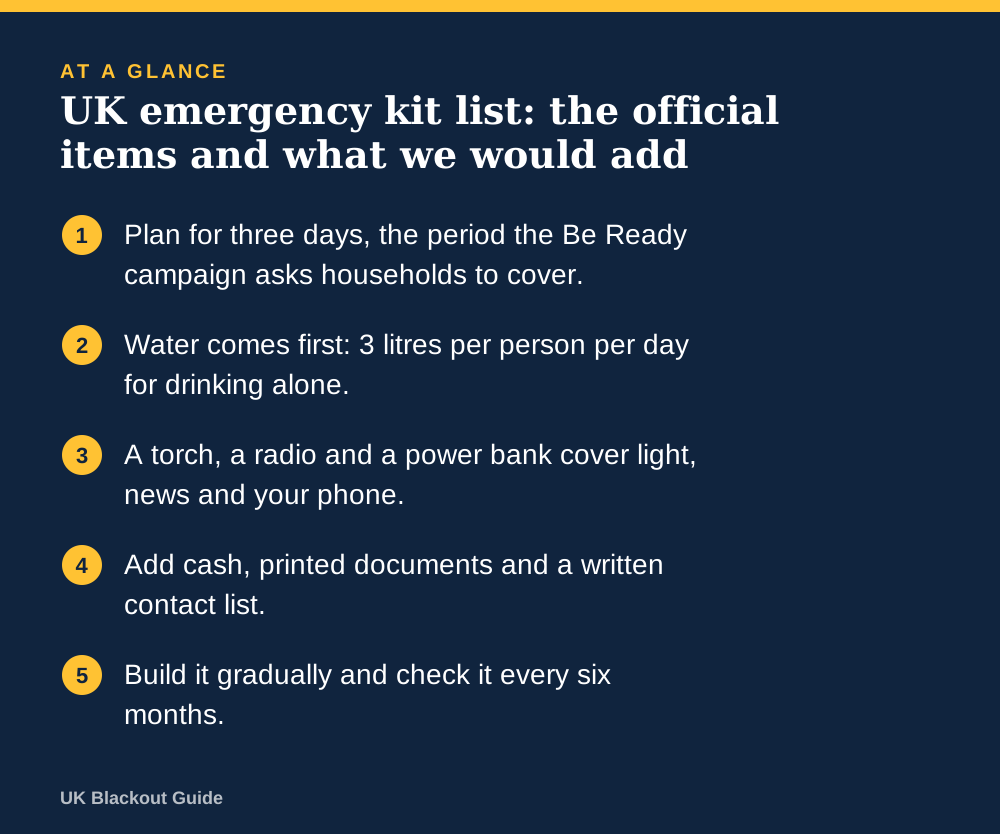
- Plan for three days, the period the Be Ready campaign asks households to cover.
- Water comes first: 3 litres per person per day for drinking alone.
- A torch, a radio and a power bank cover light, news and your phone.
- Add cash, printed documents and a written contact list.
- Build it gradually and check it every six months.
The list comes from official advice, and it is short
The UK government's Be Ready campaign, launched on 22 October 2026, asks every household to be able to manage for three days. It presents this as general preparedness for storms, floods and power cuts. It is not a forecast, and no national blackout is planned or predicted. For the short version, see what the government says to keep at home for a power cut.
The official list is modest. Most of it is ordinary household stuff gathered in one place, which is why you can put a kit together cheaply over a few months instead of buying everything in one go. The sections below follow that list, with quantities and a few notes on what to look for.
Water and food for three days
Be Ready advises 3 litres of bottled water per person per day for drinking, and more if you want to cook or wash with it. Mains water can be disrupted during and after a power cut, so this is the part of the kit people most often skip and most often miss.
| Household | Drinking water for 3 days |
|---|---|
| 1 person | 9 litres |
| 2 people | 18 litres |
| 4 people | 36 litres |
Our guide to how much water to keep and where to put it covers washing and cooking allowances too.
Food should be non-perishable and need no cooking or fridge: tinned fish, beans, fruit and rice pudding, oatcakes, cereal bars, peanut butter, long-life milk. Pick things you already eat, then add a manual tin opener, because a cupboard of tins is useless without one. There is a worked menu in our three-day food plan. A multi-tool with a tin opener makes a sound spare, and we compare them in best multi-tools for home emergencies.
Light, news and a charged phone
The official wording is a battery or wind-up torch with spare batteries, and it adds that torches are safer than candles. One torch per adult is a sensible target, kept where you can find it in the dark. Our pick of torches that suit a power cut favours long runtime over raw brightness.
A battery or wind-up FM radio is how you get news if the internet and mobile networks struggle. The BBC has said it would keep broadcasting on FM from an emergency studio with generator-backed transmitters, so FM reception matters more than extra features. See the wind-up and solar radios we recommend if you want one that does not depend on spare batteries.
Add a charged power bank. A 20,000 mAh bank gives a typical phone roughly three to four charges, which is enough for one person to stay reachable for three days if they are careful. The sum is explained in how many phone charges a power bank really gives.
Health and hygiene
The list asks for a first aid kit, essential medication, hand sanitiser and wet wipes. If the water goes off, sanitiser and wipes do most of the work of keeping hands clean before eating.
For medication, the practical step is to avoid running down to your last few days before reordering. Write down what each person takes and the dose, and keep that note in the kit. If anyone depends on powered medical equipment, follow your own clinician's advice and ask them now what to do if the power fails.
A basic first aid kit handles cuts, burns and sprains. If you are unsure what a decent one contains, see what a household first aid kit should hold.
Warmth, cash and paperwork
Blankets, sleeping bags and warm clothing are on the official list because most UK heating stops when the power does. A gas boiler still needs electricity for its controls and pump. You do not need to store bedding in the kit, only know where it is.
Keep some cash in notes and coins. Cash machines and card payments failed locally in Lancaster in 2015, and card payments were widely disrupted across Spain and Portugal in April 2025. How much is a personal decision, and we set out a way to think about it in how much cash to keep at home.
Finally, printed copies of documents and a written list of contacts and medication. Phone numbers stored only in a flat phone are numbers you do not have. Our guide to which documents to copy lists the ones worth printing.
The extras that depend on who lives with you
The official list ends with baby supplies and pet food. For babies, ready-to-feed formula is preferred because it needs no boiled water, plus nappies for three days. For pets, three days of their normal food and any medicines.
Beyond that, think about your own home. A flat with an electric hob and no outside space needs different things from a house with a gas hob and a garden. Glasses, hearing aid batteries, a spare inhaler and a pack of cards for bored children all belong in a kit if they apply to you.
Add one unofficial item: the number 105 written on the lid. It is the free power cut line for England, Scotland and Wales. In Northern Ireland the number is 03457 643643.
Build it slowly, then look at it twice a year
Be Ready's own advice is to build the kit gradually and check it every six months. Adding a few tins and a pack of water to the weekly shop gets you there in a month or two without a big bill.
Batteries leak, food dates pass and power banks drain. A short six-monthly kit check keeps the whole thing usable, and takes about twenty minutes.
Checklist
UK emergency kit list: the official items and what we would add
- Bottled water: 3 litres per person per day for 3 days
- Three days of food that needs no cooking or fridge
- Manual tin opener
- Torch and spare batteries for each adult
- Battery or wind-up FM radio
- Charged power bank and cable
- First aid kit, medication, sanitiser and wet wipes
- Blankets, sleeping bags and warm clothes
- Cash in notes and coins
- Printed documents and a written contact list
Common questions
Do I need to buy a special emergency kit?
No. The official list is mostly everyday items. A ready-made kit can save time, but you still need to add water, food, medication and cash yourself.
Does the kit have to be in one box?
It helps to keep the small items together in one box or bag so you can find them in the dark. Water, food and bedding can stay in their usual places as long as you know where they are.
Are candles part of the official kit?
No. Be Ready lists a battery or wind-up torch and says torches are safer than candles.
Is three days enough?
Three days is the period the Be Ready campaign asks households to cover. The government has not asked households to prepare for longer. Some rural homes were off for more than a week after Storm Arwen in 2021, which is what happened then and not a prediction.
Reviewed against these sources on 18 November 2026. If official advice has changed since, follow the official advice.
General information only. This page is not professional, safety, medical, legal or financial advice, and it is not official guidance. No national blackout has been forecast or announced, and nothing here suggests one is expected. We are independent and have no connection to the government or any energy company. Always check the official sources linked on this page. Full disclaimer
Keep reading
 Guide
72-hour emergency kit UK: the Be Ready list, item by item
72 hour kit UK: the government's Be Ready three-day list explained item by item, with quantities per person, what each item is for and how to store it.
Read: 72-hour emergency kit UK: the Be Ready list, Guide
Blackout shopping list: what to buy first, and what can wait
What to buy for the blackout, in order: a shopping list based on the government's Be Ready kit, with what to buy first, what can wait and what to skip.
Read: Blackout shopping list: what to buy first, Buying guide
Best emergency preparedness gifts
Ten emergency preparedness gifts that work in a power cut: radios, power banks, head torches, hand warmers and flasks picked from Amazon UK listings.
Read: Best emergency preparedness gifts Question
What does the government say to keep at home for a power cut?
What to buy for the blackout, according to the government: the Be Ready list of water, food, a torch, an FM radio, a power bank, medication and cash.
Read: What does the government say to keep at home