On this page
Multiply the power bank's mAh by 0.65, then divide by your phone's battery size in mAh. A 20,000 mAh power bank gives about 3 to 4 full charges of a typical phone, and a 10,000 mAh one gives about 1.5 to 2. You never get the full printed capacity because energy is lost in conversion and as heat.
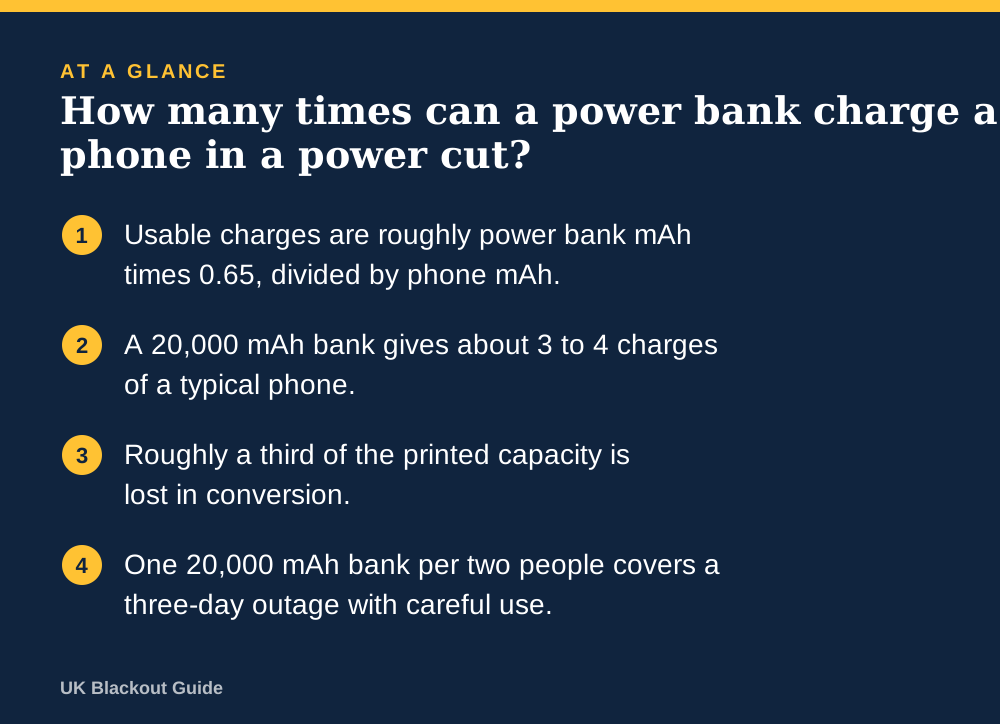
- Usable charges are roughly power bank mAh times 0.65, divided by phone mAh.
- A 20,000 mAh bank gives about 3 to 4 charges of a typical phone.
- Roughly a third of the printed capacity is lost in conversion.
- One 20,000 mAh bank per two people covers a three-day outage with careful use.
The sum that gives a realistic answer
The number on the box is not the number of milliamp-hours that reach your phone. A fair rule is that about 65 per cent gets there. So the sum is: power bank mAh, times 0.65, divided by your phone's battery in mAh.
Take a 20,000 mAh power bank and a phone with a 4,000 mAh battery. 20,000 times 0.65 is 13,000. Divide by 4,000 and you get 3.25 charges. With a larger 5,000 mAh phone battery the same bank gives 2.6.
You can find your phone's battery size in its specifications online. Most current phones sit between about 3,500 and 5,000 mAh.
Charges from common power bank sizes
| Power bank | Usable (65%) | 4,000 mAh phone | 5,000 mAh phone |
|---|---|---|---|
| 5,000 mAh | 3,250 mAh | 0.8 charges | 0.65 charges |
| 10,000 mAh | 6,500 mAh | 1.6 charges | 1.3 charges |
| 20,000 mAh | 13,000 mAh | 3.25 charges | 2.6 charges |
| 30,000 mAh | 19,500 mAh | 4.9 charges | 3.9 charges |
These are full charges from empty. In practice you top up from 20 or 30 per cent, so the bank feels as though it lasts longer than the table suggests, and making your phone battery last stretches it further still.
Where the missing third goes
As our power bank explainer sets out, the cells inside a power bank store energy at a lower voltage than USB delivers. Stepping the voltage up, pushing it down a cable and stepping it back down inside the phone all waste a little as heat. Using the phone while it charges, wireless charging and cold rooms all cost more.
An old power bank also holds less than it did when new. If yours has been in a drawer for years, read how long a power bank holds its charge and test it before you rely on it.
How much capacity a household needs for three days
The Be Ready campaign lists a charged power bank in its emergency kit, the simplest way to charge a phone in a blackout, and asks households to manage for three days. If each phone is kept in low power mode and used for calls, texts and news checks, one full charge can last a day or more. That makes one 20,000 mAh bank a reasonable three-day supply for two phones.
Our list of the best power banks for power cuts sticks to those criteria.
Common questions
Is a 10,000 mAh power bank enough for a power cut?
For one person and a short cut, yes. It gives about 1.5 full charges of a typical phone. For a household or a three-day outage, 20,000 mAh is a safer size.
Why does my power bank give fewer charges than advertised?
The printed figure is the cell capacity before conversion losses. Around a third is lost as heat and in voltage conversion, and older banks lose capacity with age.
Does fast charging use up the power bank quicker?
It empties the bank faster in time, and slightly more is lost as heat, but the number of charges you get is broadly the same.
Reviewed against these sources on 18 November 2026. If official advice has changed since, follow the official advice.
General information only. This page is not professional, safety, medical, legal or financial advice, and it is not official guidance. No national blackout has been forecast or announced, and nothing here suggests one is expected. We are independent and have no connection to the government or any energy company. Anything involving electricity, gas, fuel or food safety should be checked with a qualified professional or the relevant official body before you act on it. Always check the official sources linked on this page. Full disclaimer
Keep reading
 Guide
Backup power for your home: every option compared
Power banks, power stations, generators, solar panels, cars and UPS units compared: what each can run in a UK power cut, for how long, and who needs which.
Read: Backup power for your home: every option Buying guide
Best phone chargers for a blackout
Nine ways to keep a phone charged in a blackout: power banks, crank and solar chargers, car chargers and cables from Amazon UK, compared honestly.
Read: Best phone chargers for a blackout Buying guide
Best power banks for power cuts and blackouts
Seven 20,000 mAh power banks from Amazon UK for keeping phones charged through a power cut or blackout, with the sums on how many charges you really get.
Read: Best power banks for power cuts and blackouts Guide
How to charge your phone in a blackout
Five ways to charge a phone with the mains off, from power banks and cars to solar and laptops, with the sums for how many charges each one really gives.
Read: How to charge your phone in a blackout