On this page
Yes, if its output can handle the start-up surge of 600 W or more. A fridge-freezer averages 40 to 80 W, so a 500 Wh power station runs one for roughly 5 to 10 hours and a 1,000 Wh unit for 10 to 21 hours. Running it in bursts rather than constantly stretches that much further.
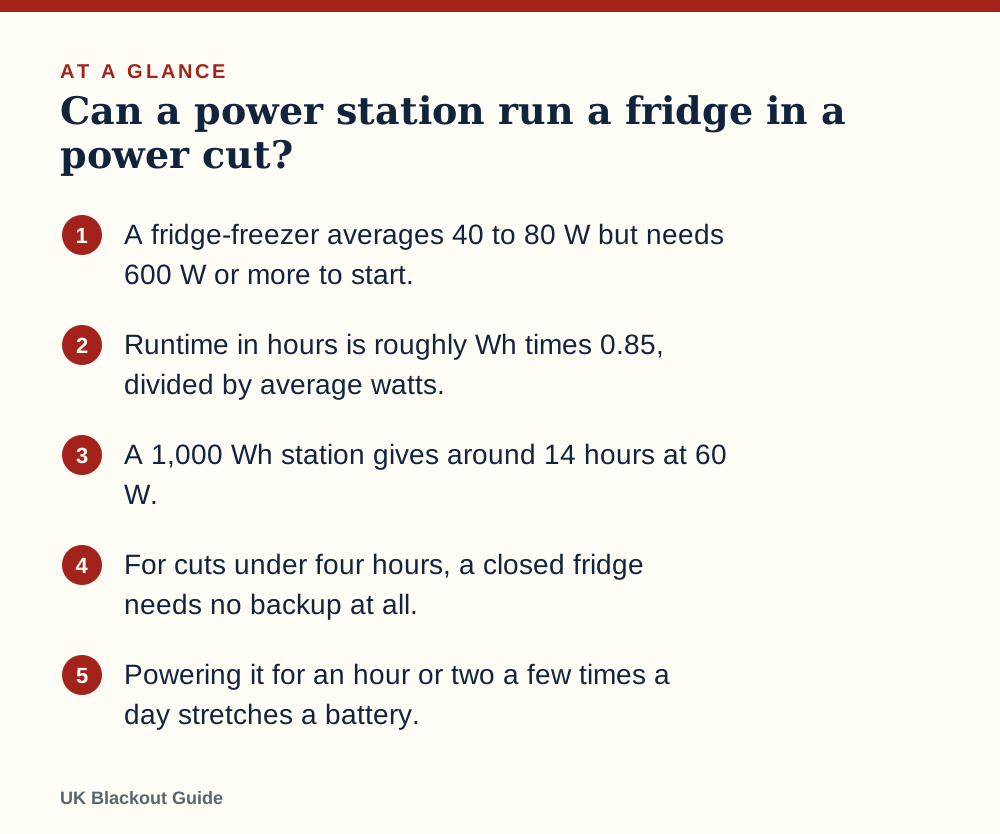
- A fridge-freezer averages 40 to 80 W but needs 600 W or more to start.
- Runtime in hours is roughly Wh times 0.85, divided by average watts.
- A 1,000 Wh station gives around 14 hours at 60 W.
- For cuts under four hours, a closed fridge needs no backup at all.
- Powering it for an hour or two a few times a day stretches a battery.
The start-up surge is the first hurdle
A fridge-freezer does not draw power steadily. The compressor runs for a while, rests, then starts again, and each start needs a brief surge of 600 W or more. Averaged over the day, the appliance uses only about 40 to 80 W.
So the power station's output rating matters before its capacity does. Look for a continuous AC output of at least 600 W, and ideally a surge or peak rating above 1,000 W. A small station with a 300 W outlet will trip every time the compressor tries to start, even with a full battery. Our list of the best portable power stations notes which have the surge capacity for a compressor.
Runtime for three common sizes
Use the standard sum: watt-hours times 0.85, divided by the average draw. Your fridge's real average depends on its age, size, the room temperature and how often the door opens, so the table gives a range.
| Power station | Usable energy | At 80 W | At 60 W | At 40 W |
|---|---|---|---|---|
| 500 Wh | 425 Wh | 5 hours | 7 hours | 10.5 hours |
| 1,000 Wh | 850 Wh | 10.5 hours | 14 hours | 21 hours |
| 2,000 Wh | 1,700 Wh | 21 hours | 28 hours | 42 hours |
A plug-in energy monitor, used for a day while the mains is on, will tell you your own fridge's average and take the guesswork out.
You may not need to power it for a short cut
The Food Standards Agency says a fridge should stay cold for around 4 hours if you keep the door shut. A full freezer typically stays frozen for about 48 hours, and a half-full one for about 24. A rota cut of about three hours needs no backup at all, only a closed door.
Backup starts to earn its place when a cut runs past four hours, or when the fridge holds something that matters, such as medicines. See how long food lasts in a fridge without power for what to keep and what to throw away. If in doubt, throw it out.
How to make the battery last several days
You do not need to run the fridge constantly. Plugging it in for an hour or two, three or four times a day, pulls the temperature back down and uses far less than leaving it connected. A fridge thermometer shows whether you are holding 5°C or below, which is the level the FSA advises.
Keep the door shut between sessions, and do not put warm food in. In winter an unheated room helps. In a long outage, the freezer is usually the priority because it holds more food and more value, and saving your freezer in a long power cut sets out a plan.
The full method, including extension leads and solar top-ups, is in running a fridge-freezer on backup power.
Common questions
Can a 300 W power station run a fridge?
Usually not. The average draw is low enough, but the compressor's start-up surge of 600 W or more will trip a 300 W outlet.
Is it safe to plug a fridge into a power station indoors?
Yes. Power stations give off no fumes, so they can be used indoors. Keep the unit on a hard, dry surface with space around its vents.
Will a small 12V portable fridge last longer?
Yes. A compressor cool box uses less power than a household fridge-freezer and can hold a few key items, such as medicines, for much longer on the same battery.
Reviewed against these sources on 18 November 2026. If official advice has changed since, follow the official advice.
General information only. This page is not professional, safety, medical, legal or financial advice, and it is not official guidance. No national blackout has been forecast or announced, and nothing here suggests one is expected. We are independent and have no connection to the government or any energy company. Anything involving electricity, gas, fuel or food safety should be checked with a qualified professional or the relevant official body before you act on it. Always check the official sources linked on this page. Full disclaimer
Keep reading
 Guide
Backup power for your home: every option compared
Power banks, power stations, generators, solar panels, cars and UPS units compared: what each can run in a UK power cut, for how long, and who needs which.
Read: Backup power for your home: every option Buying guide
Best portable power stations for power cuts
Portable power stations for UK power cuts, from a 75 Wh unit for the router to 2 kWh solar bundles, picked from Amazon UK listings with runtime sums.
Read: Best portable power stations for power cuts Guide
How many watts do household appliances use?
Typical wattages for household appliances, from phone chargers and routers to kettles and heaters, and how to use them to plan backup power.
Read: How many watts do household appliances use? Guide
Portable power stations explained
How portable power stations work, what watt-hours and watts mean, what one can and cannot run in a UK power cut, and the features that matter.
Read: Portable power stations explained