On this page

Leave the freezer shut. A full freezer typically stays frozen for about 48 hours and a half-full one for about 24, according to the Food Standards Agency. If the cut will last longer, your options are backup power, moving food to a home that has electricity, or cooking and eating what thaws. If in doubt, throw it out.
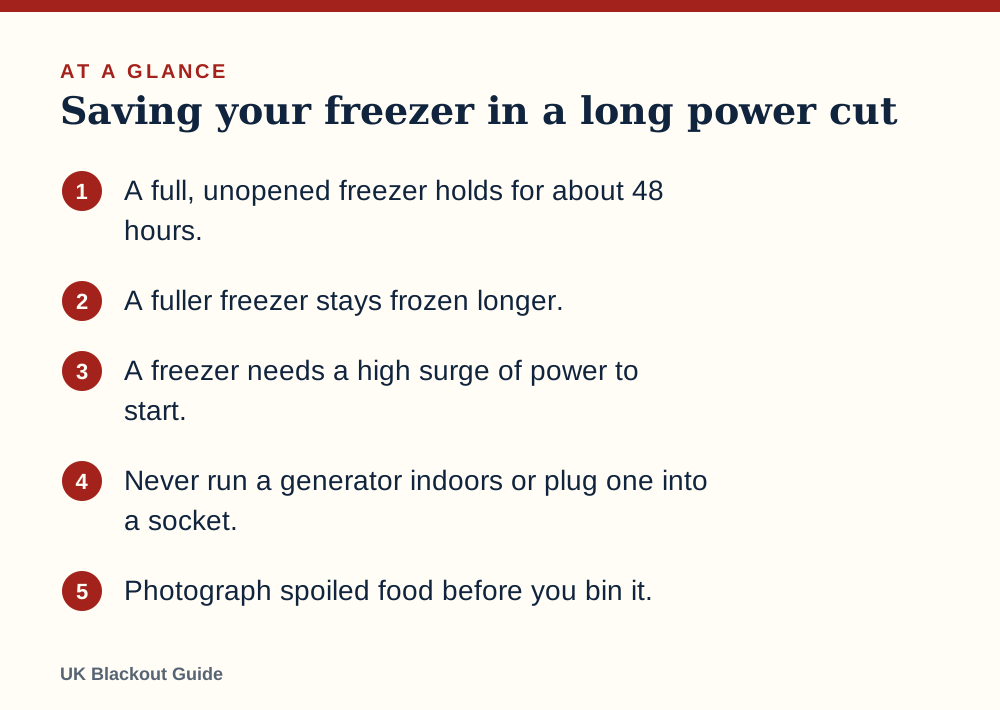
- A full, unopened freezer holds for about 48 hours.
- A fuller freezer stays frozen longer.
- A freezer needs a high surge of power to start.
- Never run a generator indoors or plug one into a socket.
- Photograph spoiled food before you bin it.
Before any power cut: make the freezer harder to thaw
The most useful work happens on an ordinary day. A full freezer typically stays frozen for about 48 hours without power, against about 24 hours for a half-full one, because frozen food holds the cold and empty space does not.
So fill the gaps. Plastic bottles of tap water, filled three-quarters full to leave room for expansion, turn empty shelves into blocks of ice. They double as ice packs for a cool box and as drinking water once thawed.
Fit a freezer thermometer so that after a cut you know what happened inside, not what you assume happened.
Group raw meat and fish together on the lowest shelf or in one basket, so that if they thaw, their juices do not drip onto other food.
Hours 0 to 24: do nothing
For the first day the right action is no action. Note the time the power went off, keep the door or lid shut and resist checking. Every look costs you holding time.
Report the cut on 105 and ask for an estimated restoration time. Given how long a freezer stays frozen without power, most cuts end long before it is at risk, and for those you simply carry on.
You can lay a duvet or blankets over a chest freezer for extra insulation while it is off. Take them away as soon as the power returns, because a running freezer needs air around it.
Hours 24 to 48: decide
If there is still no power after a day, or you have been told restoration will take several days, make a plan while the food is still solid. After Storm Arwen in November 2021 some rural homes were off for more than a week, so long cuts do happen, though rarely.
You have three realistic choices, and you can combine them.
Move it. A friend or relative a few miles away may have power. Pack frozen food tightly into cool boxes or insulated bags, fill the gaps with your frozen water bottles and move it in one trip. Frozen food packed tightly together stays frozen much longer than the same food spread out.
Power it. See the next section.
Eat it. Take out what you can cook and eat that day in one opening, starting with the most valuable items. Cooking without electricity will need a gas hob or an outdoor stove.
Running a freezer on backup power
Running a fridge-freezer on backup power is harder than the wattage suggests. A fridge-freezer averages only 40 to 80 watts over time, but its compressor needs a surge of 600 watts or more for a moment each time it starts. Backup power has to handle that surge, which rules out small power banks and most small power stations.
Runtime is roughly the battery's watt-hours multiplied by 0.85, divided by the appliance's watts. One of the large power stations, at 2,000 Wh, running a freezer that averages 60 W gives about 28 hours (2,000 × 0.85 ÷ 60). You can stretch that by powering the freezer for a few hours at a time and leaving it shut in between.
Under the generator safety rules, a generator must run outdoors, well away from doors and windows, never in a garage. Run an extension lead from it to the freezer. Never plug a generator into a house socket: the back-feed can kill engineers working on the line and damage your home.
When the power comes back
Check the thermometer and the food before the freezer has had time to refreeze everything and hide the evidence. Food that is still frozen solid can stay where it is.
Food that has softened or thawed needs a decision item by item. The Food Standards Agency has the detail on refreezing food after a power cut. Ice cream that has melted, and anything you are unsure about, should go.
If you have had to throw food away, photograph it and make a list first. Some home contents policies cover freezer contents, so check whether your insurance covers freezer food.
Keeping it in proportion
A freezer full of food feels like a lot to lose, and for some households it is a real cost. It is still only food. Do not take risks with a generator, a stove or your own health to rescue it, and do not eat something doubtful because it was expensive.
Checklist
Saving your freezer in a long power cut
- Fill empty freezer space with bottles of water
- Fit a freezer thermometer
- Note the time the power went off
- Keep the door shut for the first 24 hours
- Decide by day two: move it, power it or eat it
- Check food before it refreezes
- Photograph and list anything you throw away
Common questions
Should I turn the freezer to its coldest setting before a storm?
If you have warning of likely power cuts, using the fast-freeze or coldest setting beforehand gives the contents a little extra margin. Turn it back afterwards.
Can I pack snow or bags of ice around the food?
Ice in sealed bags placed inside the freezer or a cool box helps. Avoid loose snow or meltwater touching food packaging.
Will switching the freezer back on damage it after a long cut?
Normally not. Unplugging it during the cut protects it from a surge when supply returns, and you can plug it back in once the power is steady.
Does a chest freezer hold longer than an upright?
Generally yes, because cold air stays in when the lid is opened and chest freezers tend to be well filled. The 48 and 24 hour figures are still the guide to use.
Reviewed against these sources on 18 November 2026. If official advice has changed since, follow the official advice.
General information only. This page is not professional, safety, medical, legal or financial advice, and it is not official guidance. No national blackout has been forecast or announced, and nothing here suggests one is expected. We are independent and have no connection to the government or any energy company. Anything involving electricity, gas, fuel or food safety should be checked with a qualified professional or the relevant official body before you act on it. Always check the official sources linked on this page. Full disclaimer
Keep reading
 Question
How long does food last in a fridge without power?
A fridge should stay cold for around 4 hours without power if the door stays shut, says the Food Standards Agency. What to keep and bin after that.
Read: How long does food last in a fridge without Guide
Food safety in a power cut: fridge and freezer rules
Fridge and freezer rules for a UK power cut: how long food stays safe, what to check when the power returns and what to throw away, based on FSA advice.
Read: Food safety in a power cut: fridge and Buying guide
Best cool boxes for saving fridge food in a power cut
Cool boxes, insulated bags and freezer blocks for saving fridge food in a power cut, chosen from Amazon UK listings on size, type and buyer ratings.
Read: Best cool boxes for saving fridge food in a Buying guide
Best fridge and freezer thermometers for power cuts
Fridge and freezer thermometers that tell you whether food stayed cold through a power cut, including battery-free dials and max and min memory models.
Read: Best fridge and freezer thermometers for