On this page
You can cook without electricity on a mains gas hob lit with a match, or outdoors on a camping stove, storm kettle or barbecue. Never use camping stoves or barbecues indoors, in a garage or in a tent, because they produce carbon monoxide, which has no smell. If you have no safe heat source, eat food that needs no cooking.
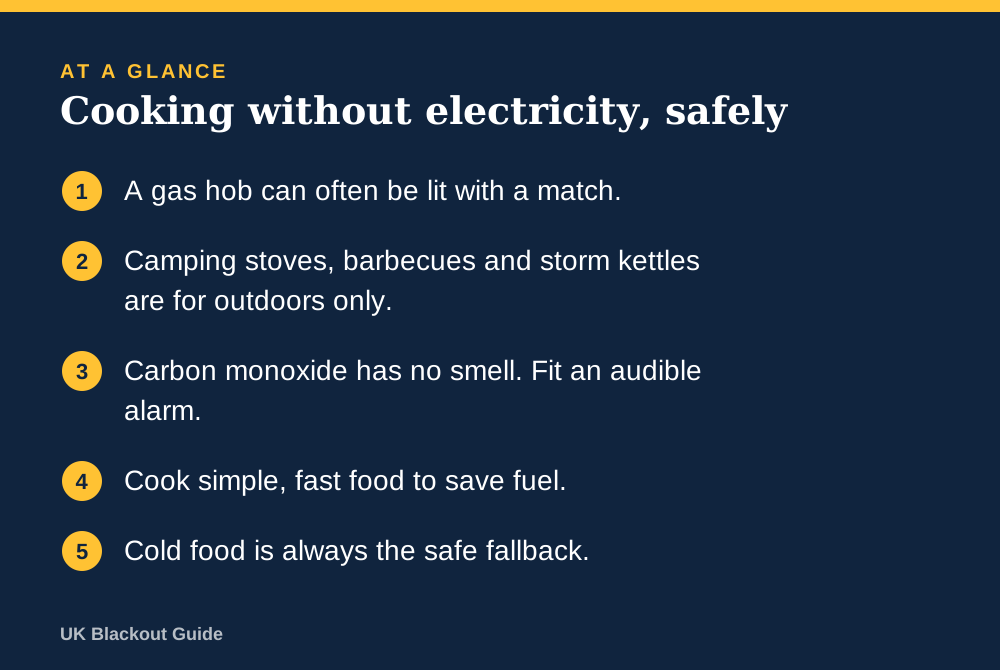
- A gas hob can often be lit with a match.
- Camping stoves, barbecues and storm kettles are for outdoors only.
- Carbon monoxide has no smell. Fit an audible alarm.
- Cook simple, fast food to save fuel.
- Cold food is always the safe fallback.
Start with what is already in your kitchen
If you cook on mains gas, you may not need anything else. Gas hob burners do not need electricity to burn, only to spark, so many can be lit with a match or a long gas lighter while you turn the knob. Some hobs have safety devices that prevent this, so check your manual now, while the lights are on.
Gas ovens are less predictable and many modern ones will not work without mains power. Electric, ceramic and induction hobs will not work at all.
A gas hob is for cooking. Do not leave burners running to warm the room, because using a gas hob for heat brings risks that cooking a meal does not.
A wood burner or multi-fuel stove with a flat top will heat a pan or kettle slowly. Stoves that rely on an electric fan or pellet feed will not carry on without power.
The carbon monoxide rule
Every other option on this page burns fuel and gives off carbon monoxide (CO). CO has no smell and no colour. The symptoms of carbon monoxide poisoning are headache, dizziness, nausea, breathlessness and collapse, and they are easy to mistake for tiredness or a bug.
Never use a camping stove, barbecue, generator or patio heater indoors, in a garage, in a porch or in a tent. Opening a window does not make it safe, which is the short answer to whether you can use a camping stove indoors.
If you suspect CO, get everyone into fresh air and call the gas emergency number on 0800 111 999. Call 999 if anyone has collapsed or is struggling to breathe.
Any home with a gas hob, boiler or solid fuel fire should already have an audible carbon monoxide alarm.
Cooking outdoors on a camping stove
A single-burner camping stove is the most practical back-up for most homes. It boils a pan of water in minutes and will heat soup, beans, pasta or a tin of stew.
Use it outside, on a level, stable surface such as a patio table or paving slab, away from doors, windows and anything that can burn. Shelter it from wind without boxing it in. Change gas canisters outdoors, away from any flame, and let the stove cool before you move it.
Storm kettles and barbecues
A storm kettle is a double-walled metal kettle with a small fire in its base. It boils water using twigs, pine cones or dry cardboard, so it needs no gas at all. It is an outdoor tool and only one of several ways to boil water without electricity, but hot water covers drinks, instant noodles, couscous, porridge and hot water bottles.
A barbecue will cook most things if you have dry charcoal, but it is slow to light and wasteful for a single pan. Use it outdoors only and leave it outside until the ashes are completely cold, because cooling charcoal still gives off CO.
Cook less, and cook fast
Fuel is limited, it may be dark, and you may be cooking in the cold. Choose food that only needs heating through: tinned soup, beans, stew, ready-cooked rice pouches. Quick-cook pasta, couscous and instant noodles use far less fuel than rice or dried pulses.
Do the cooking in daylight if you can. Setting up a stove outside is easier and safer when you can see what you are doing, and a hot meal at four in the afternoon can be kept warm for the evening.
Put a lid on the pan, heat only the water you need, and make one hot meal a day stretch by keeping hot drinks and hot food going in flasks.
Use up fridge food first, within the time limits set out in our food safety rules for a power cut, and cook it thoroughly.
Fire safety when you are cooking by torchlight
Most kitchen fires start with an unattended pan, and a power cut adds darkness, distraction and unfamiliar equipment. Wear a head torch so both hands are free, keep children and pets away from the stove, and never leave it lit.
Keep a fire blanket within reach of wherever you cook, as part of your wider fire safety in a power cut, and remember that mains-wired smoke alarms may be relying on their back-up batteries.
Common questions
Can a portable power station run an electric hob or kettle?
A kettle draws 2,000 to 3,000 watts, which is beyond most small power stations and drains large ones quickly. Gas or solid fuel is a far more practical way to heat water.
Is it safe to store camping gas canisters at home?
Follow the storage instructions printed on the canister. In general, keep them cool, upright, away from heat and flames, and outside the living space.
Can I cook under a gazebo or in an open garage if it is raining?
No. Garages and enclosed or partly enclosed shelters let carbon monoxide build up. Cook in the open air or eat cold food.
Will my gas supply keep working in a power cut?
In an ordinary local power cut, mains gas normally continues. In a prolonged national outage that cannot be guaranteed, which is why no-cook food is the official baseline.
Reviewed against these sources on 18 November 2026. If official advice has changed since, follow the official advice.
General information only. This page is not professional, safety, medical, legal or financial advice, and it is not official guidance. No national blackout has been forecast or announced, and nothing here suggests one is expected. We are independent and have no connection to the government or any energy company. Anything involving electricity, gas, fuel or food safety should be checked with a qualified professional or the relevant official body before you act on it. Always check the official sources linked on this page. Full disclaimer
Keep reading
 Question
Can I use a camping stove indoors in a power cut?
No. Camping stoves must not be used indoors, in garages or in tents because they produce carbon monoxide. Where to use one safely in a power cut.
Read: Can I use a camping stove indoors in a power Question
How do I boil water without electricity?
How to boil water in a power cut without an electric kettle: gas hob, camping stove, storm kettle or wood burner, and which must only be used outdoors.
Read: How do I boil water without electricity? Buying guide
Best camping stoves for power cuts
Portable gas camping stoves for hot food and drinks in a power cut, picked from Amazon UK listings, with firm rules on outdoor-only use and CO.
Read: Best camping stoves for power cuts Buying guide
Best kettles for boiling water without electricity
Kettles for boiling water without electricity: storm kettles and stove-top camping kettles from Amazon UK listings, with safety advice for power cuts.
Read: Best kettles for boiling water without