On this page
Boil water once and store the heat. Fill vacuum flasks while you still have power, or after one boil on a gas hob or an outdoor stove, and you can make tea, soup and instant meals for hours without lighting anything again. Fuel-burning stoves and storm kettles must be used outdoors.
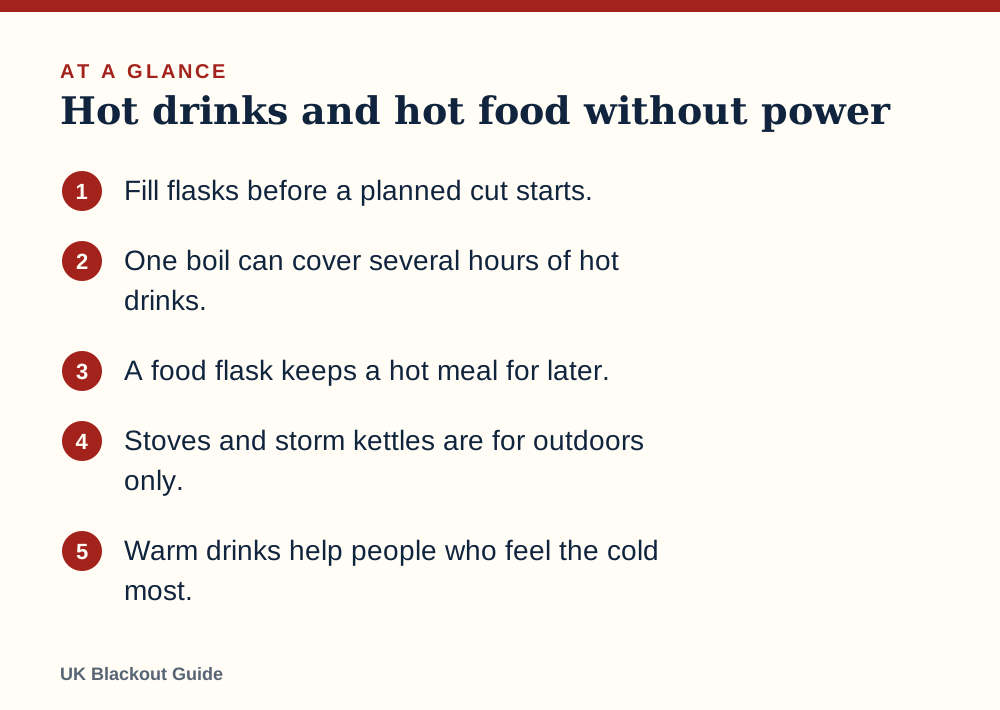
- Fill flasks before a planned cut starts.
- One boil can cover several hours of hot drinks.
- A food flask keeps a hot meal for later.
- Stoves and storm kettles are for outdoors only.
- Warm drinks help people who feel the cold most.
Why a hot drink matters more than it seems
A power cut in winter is mostly a problem of cold and morale. A warm drink helps with both. It gives you something warm to hold, it breaks up a long dark evening, and it is one of the few comforts that costs almost nothing to arrange in advance.
It matters most for older people, small children and anyone who is unwell, because they feel the cold sooner. A flask of tea is no substitute for layers and blankets, which our guide to keeping warm in a power cut covers, but it makes a cold house easier to sit in.
The flask routine
The simplest plan uses no special equipment beyond one or two decent vacuum flasks, such as those in our pick of the best flasks.
- If you get warning, boil the kettle and fill every flask before the power goes. A planned rota power cut would last about three hours at a time, and a filled flask will comfortably see you through that.
- If the cut is unexpected, boil a full pan once on whatever safe heat source you have, then decant it straight into flasks.
- Keep one flask for plain water. Plain hot water makes tea, coffee, instant soup, porridge or a baby's feed. Tea made in the flask goes stewed and limits what you can do with it.
- Refill at the next boil, not when the flask is empty.
Flasks hold heat best when preheated and filled to the top, which is most of the answer to how long a flask keeps water hot.
Getting the water hot in the first place
Every method of cooking without electricity will also heat water. Your options, roughly in order of convenience:
- A mains gas hob, which can often be lit with a match when the electric ignition is dead.
- A wood burner or multi-fuel stove with a flat top, if you have one. It is slow, but it is heat you are making anyway.
- A camping stove, used outside.
- A storm kettle, used outside. The storm kettles we recommend for power cuts boil water on twigs and scrap cardboard.
Never use a camping stove, barbecue or storm kettle indoors, in a garage or in a tent. They give off carbon monoxide, which has no smell. Take the pan or kettle outside, boil, and bring the hot water back in.
A portable power station is rarely the answer for boiling. A kettle draws 2,000 to 3,000 watts, more than many power stations can supply, and each boil takes a large bite out of the battery, as the sums on whether a power station can run a kettle show.
Hot food from hot water alone
Once you have a flask of near-boiling water, a surprising amount of food needs nothing else. Pour it on and wait:
- Instant porridge pots and sachets
- Instant noodles and cup soups
- Couscous, which only needs to stand covered for a few minutes
- Instant mash
- Stock cubes or yeast extract, for a hot savoury drink
- Hot chocolate made with milk powder
Water from a flask that was filled some hours ago will be hot, not boiling. That is fine for drinks and instant food. It is not hot enough to cook raw ingredients or to make up powdered infant formula safely.
Using a food flask as a slow hot meal
A food flask is a short, wide-mouthed vacuum flask you can eat from. Heat a tin of soup, stew, chilli or beans until it is piping hot, pour it into a flask you have preheated with hot water, and it stays at a good eating temperature for a later meal.
This lets you cook once, in daylight, and still have a hot dinner after dark without going back outside to the stove.
Put the food in hot and eat it within the time the maker states. Do not use a food flask to keep food lukewarm for hours, because warm food is where bacteria grow fastest. The Food Standards Agency has guidance on keeping food hot.
Other jobs for the same hot water
Water that has cooled too far for a good cup of tea is still useful. It will fill a hot water bottle, which is one of the most efficient ways to warm a person or a bed, and slightly cooled water is the safe way to fill a hot water bottle without a kettle.
It will also do for a wash, the washing up, or warming a baby's bottle of ready-to-feed formula by standing it in a jug.
If you are looking after an older relative in a power cut, arriving with two filled flasks is one of the most useful things you can do.
Common questions
Can I leave milk in a flask of tea?
It is better not to. Milk kept warm for hours can spoil. Keep hot water in the flask and add milk to the cup.
What milk can I use if the fridge has been off?
Long-life (UHT) milk, milk powder and small sealed portions all keep at room temperature until opened, so they suit a power cut kit.
Is a gas hob safe to use in a power cut?
A fixed mains gas hob is designed for indoor cooking and can often be lit with a match. Use it for cooking only, never to heat the room.
How many flasks does a household need?
One large flask for plain hot water covers most needs. A second for an older relative or for night feeds is worth having.
Reviewed against these sources on 18 November 2026. If official advice has changed since, follow the official advice.
General information only. This page is not professional, safety, medical, legal or financial advice, and it is not official guidance. No national blackout has been forecast or announced, and nothing here suggests one is expected. We are independent and have no connection to the government or any energy company. Anything involving electricity, gas, fuel or food safety should be checked with a qualified professional or the relevant official body before you act on it. Always check the official sources linked on this page. Full disclaimer
Keep reading
 Buying guide
Best flasks for power cuts
Vacuum flasks for keeping boiled water hot through a power cut, picked from Amazon UK listings on capacity, stated hours hot and buyer ratings.
Read: Best flasks for power cuts Buying guide
Best food flasks for hot meals in a power cut
Food flasks that keep soup or stew hot for hours in a power cut, so you cook once and eat later. Picked from Amazon UK listings on size and stated hours hot.
Read: Best food flasks for hot meals in a power cut Buying guide
Best kettles for boiling water without electricity
Kettles for boiling water without electricity: storm kettles and stove-top camping kettles from Amazon UK listings, with safety advice for power cuts.
Read: Best kettles for boiling water without Question
How long does a flask keep water hot in a power cut?
How long a vacuum flask keeps water hot, what affects it, how to get the most from one in a power cut and when the water is still hot enough to use.
Read: How long does a flask keep water hot in a