On this page
Warm the people before you try to warm the house. Put on layers early, gather everyone in one small room, close doors and curtains, and use blankets, sleeping bags and hot water bottles. Never bring a barbecue, camping stove, patio heater or generator indoors for heat, because they produce carbon monoxide.
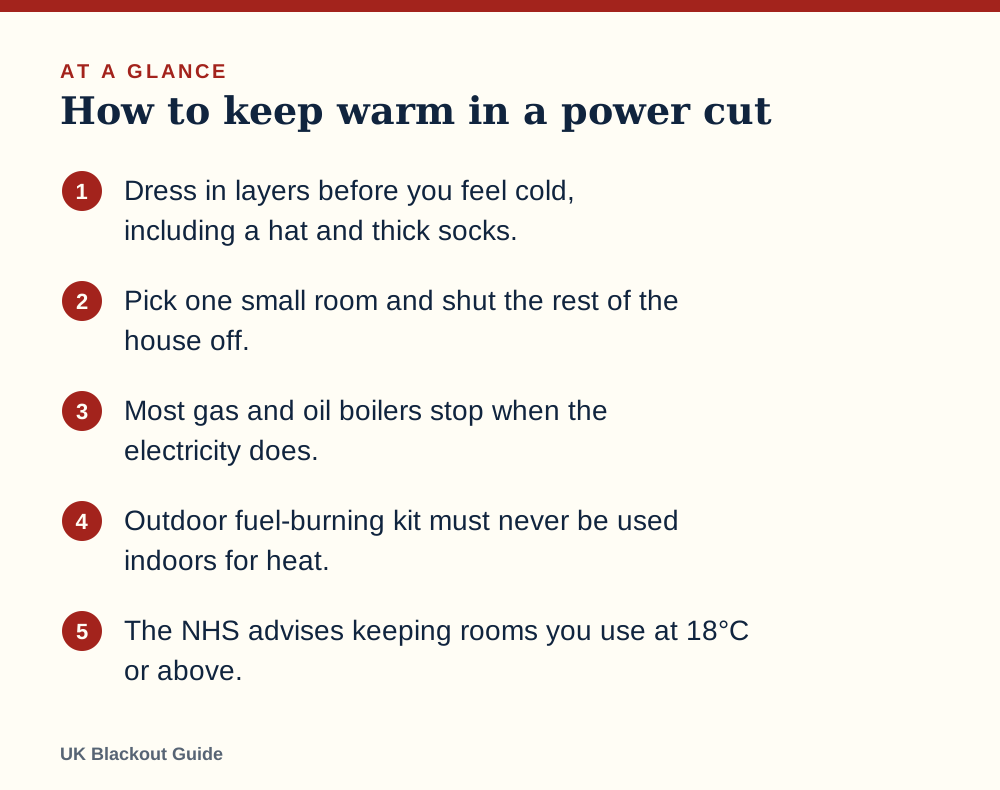
- Dress in layers before you feel cold, including a hat and thick socks.
- Pick one small room and shut the rest of the house off.
- Most gas and oil boilers stop when the electricity does.
- Outdoor fuel-burning kit must never be used indoors for heat.
- The NHS advises keeping rooms you use at 18°C or above.
Work in this order: people, room, house
A house loses heat slowly. A well-insulated home can stay comfortable for several hours after the heating stops, and a draughty one cools much faster. Either way, the cheapest heat you have is the heat your own body makes, so the first job is to stop losing it.
That gives you a simple order of work. Dress warmly first. Then shrink the space you are trying to keep warm. Only then think about adding heat, and only from sources that are safe indoors. The official Be Ready advice says the same thing in fewer words: keep warm with layers and blankets, and close doors and curtains.
Put layers on before you get cold
It is far easier to stay warm than to warm up again once you are chilled. As soon as you know the power is off and the heating has stopped, add a layer, even if the room still feels fine.
Several thin layers trap more air than one thick jumper, the principle behind layering clothes for indoor warmth. Start with a close-fitting base layer, add a fleece or wool jumper, and finish with a loose outer layer. A hat, thick socks and slippers matter more than people expect, because cold floors and an uncovered head drain heat quickly.
Shrink your home down to one room
Choose the smallest room that everyone can sit in comfortably, ideally one with few outside walls. Close its door, draw the curtains and block the gap under the door with a rolled towel, or with a proper draught excluder if you bought one ahead of time. Shut the doors to every room you are not using so that cold air stays put.
Bring what you need in with you: torches, a radio, drinks, snacks, games and chargers. Each person gives off body heat, so a family in one small room will be noticeably warmer than the same family spread around the house. The full one warm room method explains how to choose and set up the space.
Add heat that is safe indoors
Most central heating stops in a power cut. Gas and oil boilers need electricity for their controls, pump and ignition, which is why a gas boiler will not run without mains power. Storage heaters, heat pumps and plug-in heaters stop too.
What still works, among the safe ways to heat a room without electricity: a wood burner or open fire that has been swept and maintained, a gas fire that lights without mains electricity, and a portable gas cabinet heater designed for indoor use and run with ventilation. Hot water bottles and hot drinks add small amounts of heat exactly where you need it.
Carbon monoxide warning. Never use a generator, barbecue, camping stove or patio heater indoors, in a garage or in a tent. Carbon monoxide has no smell and can kill. Do not use a gas hob or oven to heat a room. Fit an audible carbon monoxide alarm that meets EN 50291 in any room with a fuel-burning appliance.
Use hot water, food and movement
If you have a hot water cylinder, the water in it will stay hot for hours after the power goes, so fill hot water bottles and flasks early. A filled flask gives you hot drinks through the evening without lighting anything. If you have no hot water, there are still ways to fill a hot water bottle without a kettle.
Eat regularly. Your body burns food to make heat, so regular meals and snacks help, even cold ones. Get up and move around every hour or so, but stop short of sweating, because damp clothes cool you down. Avoid alcohol: it makes you feel warmer while your body loses heat faster.
Plan the night before it gets dark
Sleeping warm without heating is the hardest part of a winter outage, because the house keeps cooling while you are lying still. Decide early where everyone will sleep. Sharing one room is warmer than separate bedrooms, and it means one torch and one alarm cover everybody.
A winter-rated sleeping bag from our list of sleeping bags suited to a cold house, with a blanket on top, is warmer than a duvet alone. Put insulation underneath as well as on top, wear a hat, and take a covered hot water bottle to bed.
Know who needs checking on
Babies, older people and anyone with a long-term health condition lose heat faster and may not notice or say that they are cold. Check them often. Feel a baby's chest or the back of their neck, not their hands.
Learn the signs of hypothermia: shivering, cold pale skin, slurred speech, confusion and unusual tiredness. Hypothermia means a body temperature below 35°C and it is a 999 call. If there is someone vulnerable in your household, join the Priority Services Register now, so your network operator knows before the next cut. If your home becomes too cold to stay in safely, call 105 and ask what local support is open. A neighbour with a wood burner may be the warmest option on the street, so knock on doors both to offer help and to ask for it.
Checklist
How to keep warm in a power cut
- Add a base layer, jumper, hat and thick socks straight away
- Choose one small room and close every other door
- Draw curtains and block the gap under the door
- Fill flasks and hot water bottles while water is still hot
- Check the carbon monoxide alarm works
- Set up beds in one room before dark
- Check on babies, older relatives and neighbours
Common questions
How long does a house stay warm after the heating goes off?
It depends on insulation, outside temperature and wind. A well-insulated home may stay comfortable for several hours, while an older draughty one cools much sooner. Closing doors and curtains straight away slows the loss.
Is it safe to use candles for warmth?
No. A candle gives very little heat and is a fire risk, especially near blankets and bedding. Use blankets and layers for warmth and battery lights for light.
Should I sit in the car with the engine running to keep warm?
Only in the open air and never in a garage, because exhaust contains carbon monoxide. It also uses fuel you may need later. Warm layers indoors are usually the better choice.
Will an electric blanket work from a power bank?
A mains electric blanket will not. Low-voltage USB heated clothing is designed for power banks and is a better fit for a power cut.
Reviewed against these sources on 18 November 2026. If official advice has changed since, follow the official advice.
General information only. This page is not professional, safety, medical, legal or financial advice, and it is not official guidance. No national blackout has been forecast or announced, and nothing here suggests one is expected. We are independent and have no connection to the government or any energy company. Anything involving electricity, gas, fuel or food safety should be checked with a qualified professional or the relevant official body before you act on it. Always check the official sources linked on this page. Full disclaimer
Keep reading
 Guide
Sleeping warm without heating
How to sleep warm in a house with no heating: building the bed, sleeping bag ratings, hot water bottles, what to wear and what never to leave burning.
Read: Sleeping warm without heating Buying guide
Best hot water bottles for power cuts
Hot water bottles for power cuts: six 2 litre bottles from Amazon UK listings, with safe filling advice and how to heat the water when the kettle is off.
Read: Best hot water bottles for power cuts Buying guide
Best sleeping bags for a winter power cut
Sleeping bags for a winter power cut, picked from Amazon UK listings on season rating, hood, size and price, for sleeping warm in an unheated house.
Read: Best sleeping bags for a winter power cut Buying guide
Best thermals for a house with no heating
Thermals for a house with no heating: six thermal underwear sets from Amazon UK listings for staying warm indoors in a power cut, with fit advice.
Read: Best thermals for a house with no heating