On this page
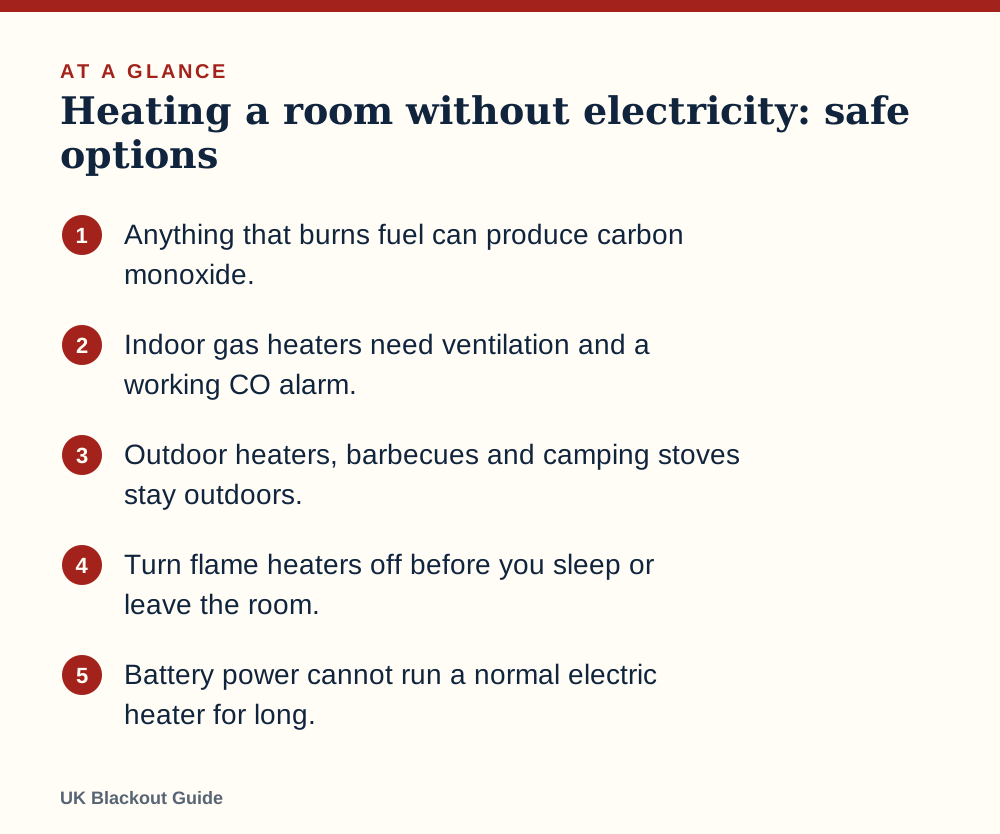
The safe options are a maintained wood burner or open fire, a gas fire that lights without mains power, and a portable gas cabinet heater designed for indoor use and run with ventilation. Never heat a room with a barbecue, camping stove, patio heater, generator or gas hob. Fit a carbon monoxide alarm before you rely on any flame.
- Anything that burns fuel can produce carbon monoxide.
- Indoor gas heaters need ventilation and a working CO alarm.
- Outdoor heaters, barbecues and camping stoves stay outdoors.
- Turn flame heaters off before you sleep or leave the room.
- Battery power cannot run a normal electric heater for long.
Start with what your home already has
Before you buy anything, look at what is already fitted. Many UK homes have a heat source that does not need mains electricity and has simply not been used for years.
A wood burner or open fire needs no power at all. Some older gas fires light with a built-in spark or a match and carry on working in a power cut, while many modern ones with remote controls or fans do not. Check the manual now, not on the night. Your boiler is a different matter: central heating almost always needs electricity, even when the fuel is gas or oil.
How the main options compare
| Heat source | Works with no mains power | Safe indoors | Main condition |
|---|---|---|---|
| Wood burner or open fire | Yes | Yes | Swept chimney, dry fuel, CO alarm in the room |
| Fitted gas fire | Some models | Yes | Serviced by a Gas Safe engineer |
| Portable gas cabinet heater | Yes | Yes, if made for indoor use | Ventilation, CO alarm, never left on overnight |
| Hot water bottles and warm layers | Yes | Yes | Heats people, not the room |
| Gas hob or oven | Hob often lights with a match | For cooking only | Never use it as a heater |
| Patio heater, barbecue, camping stove, generator | Yes | No | Outdoors only, always |
The pattern in the table is simple. Appliances designed and installed for indoor heating are safe when maintained. Anything designed for the garden, the campsite or the kitchen is not a room heater.
Wood burners and open fires
A solid fuel fire is the strongest heat source most homes can have in a power cut, and it needs nothing from the grid. The conditions are a chimney that has been swept, dry seasoned wood or the correct smokeless fuel, and a fireguard if you have children or pets.
Keep a few days of dry fuel indoors through winter so you are not fetching damp logs in the dark. If your stove has a back boiler or an electric fan, read our answer on using a wood burner in a power cut first, because some of those systems rely on a pump.
Portable gas heaters made for indoor use
A cabinet heater that runs from a butane cylinder is the most common standalone option among portable gas heaters for home use. It needs no electricity, gives useful heat for a living room, and a full cylinder lasts many hours. Heaters sold for indoor use normally have a flame failure device and a sensor that shuts the heater off if oxygen in the room drops.
They still burn gas inside your home, so whether a portable gas heater is safe indoors comes down to firm rules. Keep a window slightly open, keep the heater clear of furniture and curtains, never dry washing on it, never move it while lit and turn it off before anyone goes to sleep. Do not use one in a bedroom or bathroom.
What must never be used to heat a room
Never use these indoors, in a garage or in a tent: generators, barbecues (charcoal or gas), camping stoves and patio heaters. They produce carbon monoxide, which has no smell and can kill. Symptoms are headache, dizziness, nausea, breathlessness and collapse.
A barbecue is dangerous even when it looks finished, because cooling charcoal keeps giving off carbon monoxide. That is why bringing a barbecue indoors is never safe. A gas hob or oven is built to cook on for short periods, so running the hob for warmth is also out. If you smell gas at any time, call the gas emergency number on 0800 111 999.
Home-made heaters built from candles and flowerpots give almost no heat and add a real fire risk, the opposite of good fire safety in a power cut. They are not worth trying.
Fit the alarm before you need the heat
Any room with a fuel-burning appliance should have an audible carbon monoxide alarm that meets EN 50291. A battery alarm keeps working when the mains is off, which is exactly when you may be using a fire you have not lit for a while. Press the test button at the start of winter and whenever you light a fire for the first time.
A working smoke alarm matters just as much when open flames are in use. Where to put the carbon monoxide alarm, and what to do if it sounds, is part of dealing with carbon monoxide in power cuts.
Why battery power is not the answer for heat
Electric heat uses a lot of energy. A fan heater draws about 2,000 watts, so a 500 Wh power station would run one for roughly 12 minutes (500 × 0.85 ÷ 2,000). Even a large 2,000 Wh unit manages under an hour. That is why running an electric heater from a power station rarely makes sense.
Batteries are better spent on heating a person. USB heated clothing draws a few watts and runs for hours from a power bank. If you have no safe flame heater, the realistic plan is good clothing, bedding and one small room kept as warm as you can.
Common questions
Can I use a paraffin heater indoors?
Only one designed for indoor use, with ventilation and a carbon monoxide alarm, and following the maker's instructions exactly. Paraffin heaters burn fuel in the room, so the same carbon monoxide and fire rules apply as for gas heaters.
Is it safe to leave a gas heater on overnight?
No. Turn portable gas heaters off before you sleep and rely on a sleeping bag, blankets and a hot water bottle through the night.
Do I need ventilation with a wood burner?
Yes. A stove needs an air supply to burn properly and a clear flue to carry gases away. Never block air vents in a room with a fuel-burning appliance.
Can a patio heater be used in a conservatory or garage?
No. Patio heaters are for the open air only. A conservatory, garage or porch is an enclosed space and carbon monoxide can build up quickly.
Reviewed against these sources on 18 November 2026. If official advice has changed since, follow the official advice.
General information only. This page is not professional, safety, medical, legal or financial advice, and it is not official guidance. No national blackout has been forecast or announced, and nothing here suggests one is expected. We are independent and have no connection to the government or any energy company. Anything involving electricity, gas, fuel or food safety should be checked with a qualified professional or the relevant official body before you act on it. Always check the official sources linked on this page. Full disclaimer
Keep reading
 Question
Are portable gas heaters safe indoors in a power cut?
Portable gas heaters are safe indoors only if made for indoor use and run with ventilation and a CO alarm. The rules, and which heaters to keep outside.
Read: Are portable gas heaters safe indoors in a Buying guide
Best carbon monoxide alarms for power cut heating and cooking
Carbon monoxide alarms for power cut heating and cooking: seven battery alarms from Amazon UK listings, with advice on EN 50291 and where to put them.
Read: Best carbon monoxide alarms for power cut Buying guide
Best heaters for power cuts (no electricity needed)
Heaters for power cuts that need no electricity: five portable gas heaters from Amazon UK listings, with firm safety rules on indoor use and ventilation.
Read: Best heaters for power cuts Question
Can I bring a barbecue indoors for heat in a power cut?
Never bring a barbecue indoors for heat. Why charcoal and gas barbecues cause carbon monoxide poisoning, even when cooling, and safer ways to keep warm.
Read: Can I bring a barbecue indoors for heat in a