On this page
Yes, within limits. A foil blanket reflects radiated body heat and blocks draughts and evaporation, which slows heat loss. It has no thickness, so it does not insulate like a wool blanket or sleeping bag. Use one over your clothes and under a proper blanket, as an extra layer and not as your only cover.
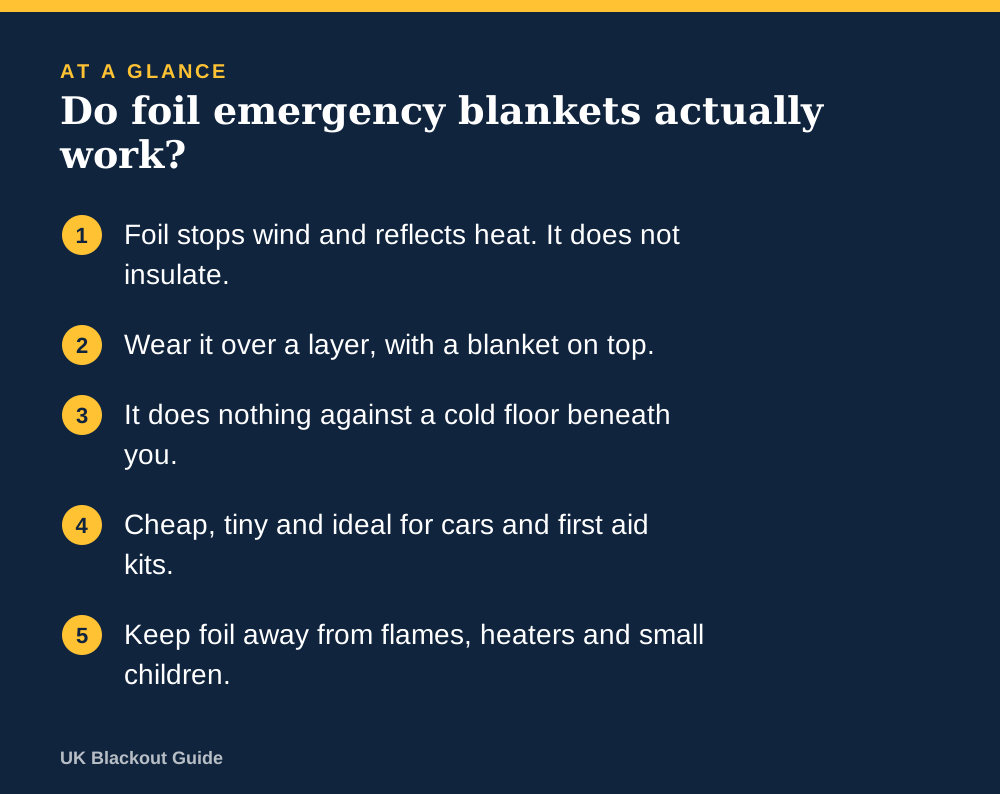
- Foil stops wind and reflects heat. It does not insulate.
- Wear it over a layer, with a blanket on top.
- It does nothing against a cold floor beneath you.
- Cheap, tiny and ideal for cars and first aid kits.
- Keep foil away from flames, heaters and small children.
What the foil is doing
Your body loses heat in several ways. It radiates heat outwards, it warms the air next to the skin which then drifts away, it loses heat when moisture evaporates, and it conducts heat into anything cold it touches.
A foil emergency blanket is a very thin plastic sheet with a metallic coating. The shiny surface reflects radiated heat back towards you. Because the sheet is airtight and waterproof, it also stops moving air carrying warmth away and traps moisture so less heat is lost through evaporation. That is why they are handed to runners at the end of a marathon: the runners are warm, damp and standing in the wind.
Where it falls short
What foil cannot do is insulate. Insulation comes from trapped still air, which needs thickness. A foil sheet is thinner than a carrier bag. Lie on a cold floor wrapped only in foil and the floor will draw heat straight through it. Sit in a cold room in one for hours and you will still get cold, only more slowly.
There are practical drawbacks too. Foil blankets tear easily, rustle with every movement, slip off, and trap sweat, so your clothes become damp underneath. A sleeping bag or wool blanket is far better for getting through a night, as explained in sleeping warm without heating.
How to get the most from one at home
Treat foil as one layer in a system for keeping warm in a power cut. Put on your normal warm clothes, wrap the foil around your body over them, then add a blanket, coat or sleeping bag on top. The clothing gives the insulation, the foil cuts down what escapes from it, and the top layer holds everything in place and quietens the rustle.
Other uses that work in a cold house:
- laid under a bottom sheet or between a mattress and a blanket to reflect heat back up
- taped behind a blanket hung over a draughty window or door
- wrapped around someone who is wet or shocked while you fetch proper bedding
Keep foil blankets away from candles, fires and heaters. Do not leave babies or young children alone with one, because the thin film can cover the face.
Worth having, in the right place
For a few pounds a pack, foil blankets earn a place in the car emergency kit, a grab bag and the first aid kit, where a wool blanket will not fit. They are useful first aid for someone getting dangerously cold while you wait for help. Know the signs of hypothermia and remember that the first aid is to wrap the person in blankets and call 999.
For the house itself, spend first on real bedding, starting with warm blankets for power cuts to go on top of the foil.
Common questions
Which side of a foil blanket faces in?
On a plain silver blanket it makes no real difference. On two-colour blankets, makers usually say silver side towards the body to keep heat in. Follow the instructions on the pack.
Can I sleep under just a foil blanket?
Not comfortably or warmly in a cold house. Use it as an extra layer with proper bedding above and insulation beneath you.
Do foil blankets expire?
They have no working parts, but the thin film can become brittle along its folds after years in a hot car. Check them when you review your kit and replace any that crack.
Reviewed against these sources on 18 November 2026. If official advice has changed since, follow the official advice.
General information only. This page is not professional, safety, medical, legal or financial advice, and it is not official guidance. No national blackout has been forecast or announced, and nothing here suggests one is expected. We are independent and have no connection to the government or any energy company. Anything involving electricity, gas, fuel or food safety should be checked with a qualified professional or the relevant official body before you act on it. Always check the official sources linked on this page. Full disclaimer
Keep reading
 Buying guide
Best emergency foil blankets
Emergency foil blankets for power cuts, cars and grab bags: six packs and ponchos from Amazon UK listings, and what foil can and cannot do for warmth.
Read: Best emergency foil blankets Guide
Signs of hypothermia at home, and what to do
The signs of hypothermia to watch for in a cold home, who is most at risk in a power cut, what to do while you wait for help and what not to do.
Read: Signs of hypothermia at home, and what to do Buying guide
Best blankets for power cuts
Wool and fleece blankets for keeping warm in a power cut, picked from Amazon UK listings on material, size and price, with advice on how many to keep.
Read: Best blankets for power cuts Buying guide
Best carbon monoxide alarms for power cut heating and cooking
Carbon monoxide alarms for power cut heating and cooking: seven battery alarms from Amazon UK listings, with advice on EN 50291 and where to put them.
Read: Best carbon monoxide alarms for power cut