On this page
A good vacuum flask filled with boiling water stays hot enough for tea for several hours and is usually still warm the next day. Makers commonly claim 12 to 24 hours, measured in ideal conditions. Size, build quality, preheating and how often you open it all change the result, so treat any claim as a best case.
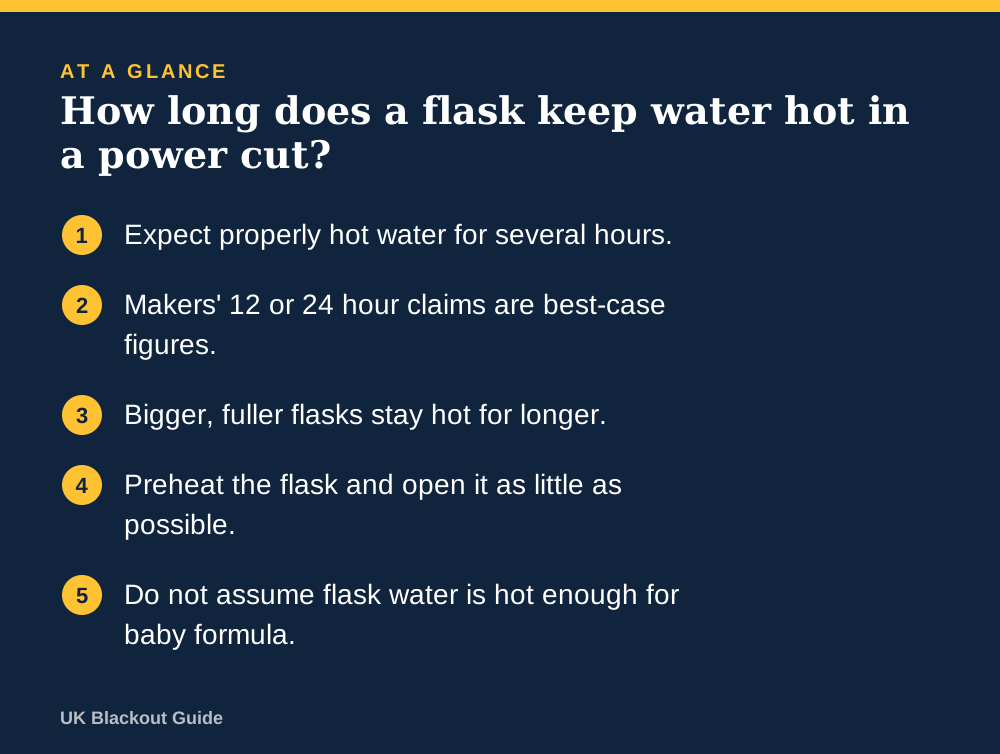
- Expect properly hot water for several hours.
- Makers' 12 or 24 hour claims are best-case figures.
- Bigger, fuller flasks stay hot for longer.
- Preheat the flask and open it as little as possible.
- Do not assume flask water is hot enough for baby formula.
What to expect in practice
A vacuum flask does not keep water at boiling point. It slows the loss of heat. The water is at its hottest when you fill it and cools steadily from then on, quickly at first and more slowly later.
In practical terms, water from a decent flask for power cuts makes a good hot drink for several hours after filling. Later on it will be hot enough for instant soup or a wash, and by the next morning it is usually warm, not hot.
Manufacturers often quote 12 or 24 hours. Those figures usually describe how long the contents stay above a stated temperature when a full, preheated flask is left unopened. Your kitchen in a power cut is not a test bench, so expect less.
That is still plenty for the commonest case. A planned rota cut would last about three hours at a time, and a flask filled just beforehand will be very hot throughout, which is the basis of our routine for hot drinks and hot food without power.
What makes one flask better than another
- Size. A large volume of water holds heat longer than a small one. A full 1 litre flask outlasts a 350 ml travel mug by a wide margin.
- Construction. Double-walled stainless steel with a true vacuum between the walls is the standard to look for. Single-walled or foam-insulated bottles lose heat much faster.
- The lid. Most heat escapes through the top. A well-fitting insulated stopper matters as much as the body, and a pour-through design avoids taking the stopper out.
- Condition. A flask that has been dropped and dented can lose its vacuum. If the outside feels hot soon after filling, it has failed and should be replaced.
For hot meals, a wide-mouthed food flask works on the same principle.
Five ways to keep it hotter for longer
- Preheat it. Fill the flask with hot water for a few minutes, tip that out, then fill with boiling water. Otherwise the cold steel takes the first share of the heat.
- Fill it to the top. Air space cools the water. A half-full flask cools much faster.
- Fill it straight from the boil. However you boil water without electricity, water that has stood in a pan for ten minutes has already lost a good deal.
- Open it only when you need to. Pour what you want and close it at once.
- Keep it out of the cold. A flask on a stone windowsill loses heat faster than one wrapped in a towel indoors.
When hot is not hot enough
For tea, soup and instant noodles, "still hot" is good enough. Two uses need more care.
When you are feeding a baby in a power cut, powdered infant formula must be made with water of at least 70°C, according to NHS guidance. A flask can be used for this, but only if the water is still that hot, and you cannot judge that by feel. If there is any doubt, boil fresh water.
Hot water bottles are the opposite case. They should never be filled with boiling water, so flask water that has cooled for a few hours is close to ideal if you need to fill a hot water bottle without a kettle.
Common questions
Can I put tea or soup in a flask instead of water?
Yes, though plain water is more flexible. Milky drinks should not be kept warm for hours, and soup should go in piping hot and be eaten within the time the maker states.
Do flasks keep cold drinks cold as well?
Yes. The same vacuum insulation slows heat getting in, so a flask will keep water cold in a summer power cut.
How do I know if my old flask still works?
Fill it with boiling water and feel the outside after a few minutes. If the body is noticeably warm, the vacuum has gone and it will not hold heat well.
Reviewed against these sources on 18 November 2026. If official advice has changed since, follow the official advice.
General information only. This page is not professional, safety, medical, legal or financial advice, and it is not official guidance. No national blackout has been forecast or announced, and nothing here suggests one is expected. We are independent and have no connection to the government or any energy company. Anything involving electricity, gas, fuel or food safety should be checked with a qualified professional or the relevant official body before you act on it. Always check the official sources linked on this page. Full disclaimer
Keep reading
 Buying guide
Best flasks for power cuts
Vacuum flasks for keeping boiled water hot through a power cut, picked from Amazon UK listings on capacity, stated hours hot and buyer ratings.
Read: Best flasks for power cuts Guide
Feeding a baby in a power cut
How to feed a baby safely in a power cut: breastfeeding, ready-to-feed and powdered formula, sterilising bottles without electricity and warming feeds.
Read: Feeding a baby in a power cut Guide
Hot drinks and hot food without power
How to keep hot drinks and hot food going in a UK power cut using flasks, a safe way to boil water and food that only needs hot water added.
Read: Hot drinks and hot food without power Buying guide
Best camping stoves for power cuts
Portable gas camping stoves for hot food and drinks in a power cut, picked from Amazon UK listings, with firm rules on outdoor-only use and CO.
Read: Best camping stoves for power cuts