On this page
Breastfeeding carries on as normal. For formula-fed babies, keep ready-to-feed formula in stock: the government's Be Ready list prefers it because it needs no water or heating. Powdered formula must be made with water of at least 70°C, so you need a safe way to boil water. Follow NHS guidance and your health visitor's advice.
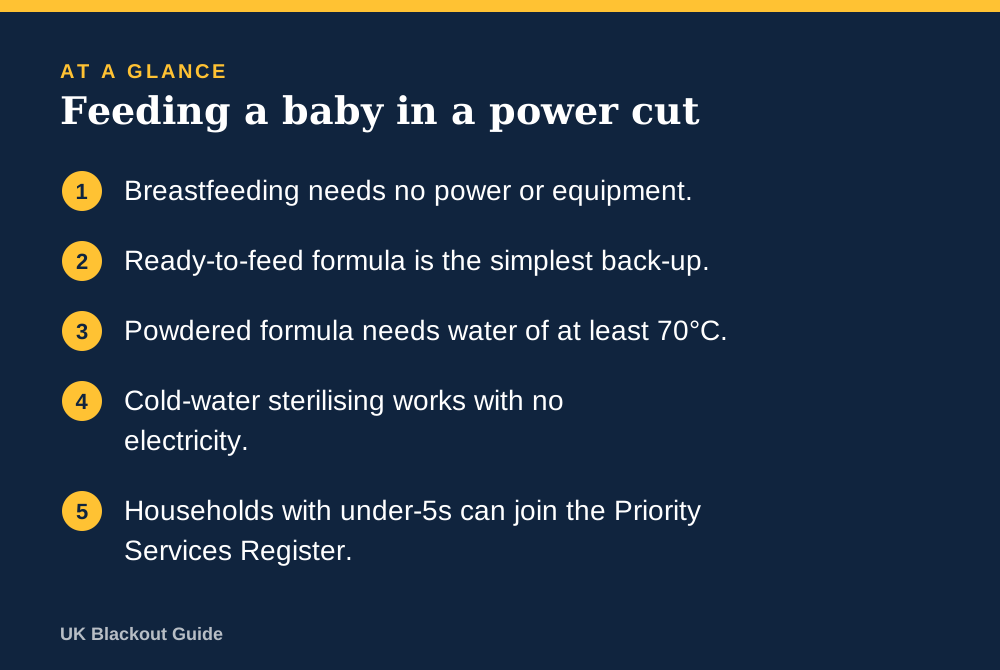
- Breastfeeding needs no power or equipment.
- Ready-to-feed formula is the simplest back-up.
- Powdered formula needs water of at least 70°C.
- Cold-water sterilising works with no electricity.
- Households with under-5s can join the Priority Services Register.
Start with three days of supplies
The official Be Ready kit list includes baby supplies, and it names ready-to-feed formula as the preferred type, along with nappies. The campaign asks every household to be able to manage for three days. For a baby that means three days of feeds, nappies, wipes and any medicines, kept with the rest of your family emergency kit where you can find them in the dark.
This page is general information. Babies differ, and premature or unwell babies have particular needs, so follow the advice of your midwife, health visitor or GP where it differs from anything here.
Feeding is one part of looking after babies and toddlers in a power cut, alongside warmth, sleep and light for night feeds.
If you are breastfeeding
Nothing changes. Breast milk needs no water, no heating and no sterilising, which makes it the most resilient way to feed a baby in any emergency. Keep yourself warm, fed and drinking enough.
If you use an electric pump, think about a manual one as a back-up, or a power bank if your pump charges by USB.
Expressed milk in the fridge or freezer is the part to watch. A fridge should stay cold for around 4 hours unopened, and a full freezer for about 48 hours. If stored milk has warmed up or thawed and you are not sure it is still safe, do not use it. The NHS publishes storage guidance for expressed milk, and your health visitor can advise.
Ready-to-feed formula: the simplest back-up
Ready-to-feed liquid formula is sterile until opened and needs no water. Shake it, pour it into a sterilised bottle and feed. It can be given at room temperature. Most babies will take it that way, though one used to warm feeds may complain at first.
It costs more than powder, so most families treat it as a reserve. Enough for three days, in the stage your baby is on, is the target. Check the dates at your six-monthly kit check and use it up before it expires.
Once a carton or bottle is opened, the rules on the pack apply, and they usually assume a working fridge. Without one, open only what you need for that feed and throw away what is left.
Making up powdered formula without a kettle
Powdered formula is not sterile. NHS guidance is to make each feed with water that has been boiled and is still at least 70°C, which in practice means freshly boiled water left to cool for no more than 30 minutes. That temperature kills bacteria that may be in the powder.
So you need a way to boil water without electricity. A mains gas hob lit with a match will do it.
Otherwise you need a camping stove, used outdoors only.
Never bring a camping stove indoors to make a night feed. It produces carbon monoxide, which has no smell, and that settles whether a camping stove can be used indoors.
A vacuum flask saves you going outside for every feed. Fill a clean flask with freshly boiled water and seal it. The NHS describes this method for feeding away from home. The catch is temperature: the water must still be at least 70°C when you make the feed, and a flask loses heat steadily.
Check how long your flask keeps water hot before you rely on it. Cool the made-up feed under a cold tap or in a jug of cold water, test it on your wrist, and throw away anything left at the end of the feed.
Which water to use
Use tap water if it is running and your water company has not told you otherwise. If you are relying on bottled water, the NHS says it is not usually recommended for formula because some brands contain too much sodium or sulphate. Check the label: the NHS figures are less than 200 mg of sodium (Na) and no more than 250 mg of sulphate (SO4) per litre. Bottled water is not sterile, so boil it just as you would tap water.
If the tap supply is in doubt, follow the steps for making water safe to drink and use the most cautious option you have.
Sterilising without electricity
Electric steam and microwave sterilisers will not work. Two methods will:
- Cold-water sterilising. Sterilising tablets or fluid dissolved in a lidded container of cold water. Follow the maker's instructions for the soaking time and change the solution as directed. This needs no heat at all, so it is worth keeping tablets in your kit.
- Boiling. The NHS method is to boil bottles and teats in a large pan for at least 10 minutes, keeping everything under the water.
Wash bottles and teats in clean soapy water before either method. Sterile, single-use bottles are another option to hold in reserve.
Older babies and extra help
For babies on solids, keep pouches and jars that are safe at room temperature, and use them at one sitting once opened. Cow's milk for toddlers follows the same fridge rules as for everyone else, covered in whether milk is safe after a power cut.
Households with children under 5 can join the free Priority Services Register, so your network operator knows to offer extra support in a cut.
Checklist
Feeding a baby in a power cut
- Three days of ready-to-feed formula, if you use formula
- Cold-water sterilising tablets and a lidded container
- A clean flask kept for boiled water
- A safe way to boil water
- Nappies, wipes and nappy bags for three days
- Baby food pouches or jars for older babies
- Priority Services Register sign-up
Common questions
Can I give my baby cold formula?
Ready-to-feed formula can be given at room temperature. Powdered formula must still be made with water of at least 70°C and then cooled before feeding.
How do I warm a bottle without power?
Stand the bottle in a jug of warm water from a flask for a few minutes, then test the temperature on the inside of your wrist.
Can I make up several bottles in advance?
The NHS advises making each feed fresh. With no working fridge, made-up feeds cannot be stored safely, so make one at a time.
What if I run out of formula during a long power cut?
Contact your health visitor, GP, pharmacy or NHS 111 for advice. Do not water down feeds or use other milks for a young baby without medical advice.
Reviewed against these sources on 18 November 2026. If official advice has changed since, follow the official advice.
General information only. This page is not professional, safety, medical, legal or financial advice, and it is not official guidance. No national blackout has been forecast or announced, and nothing here suggests one is expected. We are independent and have no connection to the government or any energy company. Anything involving electricity, gas, fuel or food safety should be checked with a qualified professional or the relevant official body before you act on it. Always check the official sources linked on this page. Full disclaimer
Keep reading
 Buying guide
Best camping stoves for power cuts
Portable gas camping stoves for hot food and drinks in a power cut, picked from Amazon UK listings, with firm rules on outdoor-only use and CO.
Read: Best camping stoves for power cuts Buying guide
Best flasks for power cuts
Vacuum flasks for keeping boiled water hot through a power cut, picked from Amazon UK listings on capacity, stated hours hot and buyer ratings.
Read: Best flasks for power cuts Question
Can I use a camping stove indoors in a power cut?
No. Camping stoves must not be used indoors, in garages or in tents because they produce carbon monoxide. Where to use one safely in a power cut.
Read: Can I use a camping stove indoors in a power Question
How long does a flask keep water hot in a power cut?
How long a vacuum flask keeps water hot, what affects it, how to get the most from one in a power cut and when the water is still hot enough to use.
Read: How long does a flask keep water hot in a