On this page
A family kit is the standard three-day list multiplied by the number of people, plus items for each child's age. For a family of four that means 36 litres of drinking water, three days of food children will eat, a night light, a stocked first aid kit, and for babies, ready-to-feed formula and nappies.
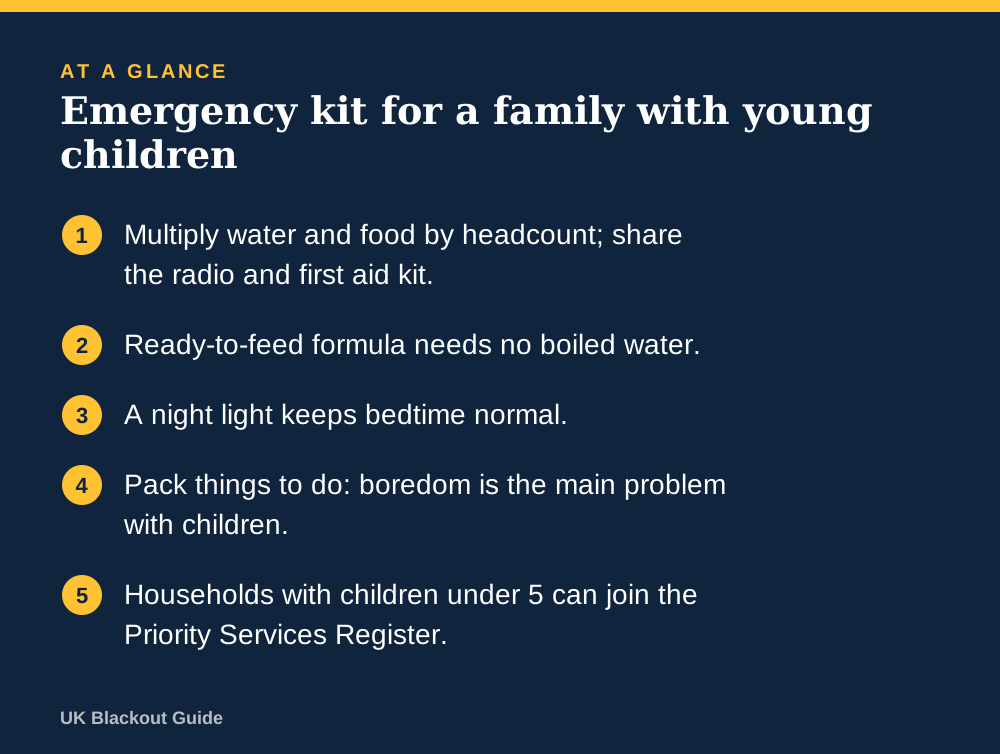
- Multiply water and food by headcount; share the radio and first aid kit.
- Ready-to-feed formula needs no boiled water.
- A night light keeps bedtime normal.
- Pack things to do: boredom is the main problem with children.
- Households with children under 5 can join the Priority Services Register.
Start with the numbers for your household
Some items on a household emergency kit list scale with the number of people and some do not. Getting that straight stops you over-buying torches and under-buying water.
| Scales with people | One per household is enough |
|---|---|
| Water: 3 litres each per day | FM radio |
| Food for 3 days | First aid kit |
| Blankets or sleeping bags | Tin opener |
| Warm layers | Document folder and contact list |
| Medication | Cash |
To work out how much water a family of four needs, start with drinking water. For two adults and two children it comes to 36 litres over three days. Small children drink less than adults, but washing hands, faces and bottles takes more than you expect, so do not scale it down.
For light, aim for one torch per adult, plus a lantern for the room everyone gathers in.
Babies: feeding, changing and warmth
Be Ready lists baby supplies and says ready-to-feed formula is preferred for feeding a baby without power. The reason is practical: it needs no boiled water and no steriliser running on mains power. Keep three days of cartons if your baby is formula fed, even if you normally use powder, and follow NHS and manufacturer guidance on preparation and storage.
Add three days of nappies, wipes, nappy bags and barrier cream, and any teething gel or medicines you rely on. Babies cannot regulate their temperature as well as adults, so layers, a hat and a way to share warmth matter when looking after babies and toddlers in a power cut. Follow safe sleep guidance from your midwife or health visitor at all times, including during a cold night without heating.
Food children will eat without a fight
A power cut is not the time to introduce new foods. Stock the no-cook versions of what your children already accept: cereal and long-life milk, crackers, breadsticks, peanut butter if there are no allergies, tinned fruit, raisins, squeezy fruit pouches, cereal bars.
Include a few treats. A familiar biscuit does a lot for morale at four in the afternoon when the tablet has run flat. Rotate this food through normal lunchboxes so nothing goes out of date.
If anyone in the family has allergies or a special diet, their three days of safe food is the most important food in the kit. Do not assume shops will be open or that card payments will work.
Light at bedtime
Dark is the part of a power cut children find hardest. A house with no street light glow, no landing light and no standby LEDs is darker than most children have ever experienced.
A battery or rechargeable night light keeps bedtime close to normal and lets you check on them without a torch beam in the face.
Giving each child their own small torch helps too, since being in charge of a light makes the dark less worrying. Use torches and lanterns, not candles, anywhere children are.
How you describe what is happening matters as much as the kit, and explaining a power cut to a child in words that reassure without overpromising is worth thinking about in advance.
A first aid kit that reflects who is in the house
A general first aid kit covers cuts, grazes and minor burns. For a family, add the things you reach for most: child-dose pain and fever relief suitable for each child's age, a thermometer that runs on batteries, plasters in small sizes, antiseptic wipes and any prescribed items such as inhalers or adrenaline pens.
Follow the dosing on the pack and your pharmacist's or doctor's advice. Write each child's regular medication and any allergies on the contact sheet.
Things to do when the screens go dark
For most families, a power cut with children is more boring than dangerous. Tablets and consoles last a few hours, then you need a plan. A small box of things that only come out in a power cut turns it into something closer to a treat.
Cards, a couple of games for power cuts that work by lantern light, colouring books, a pad and pencils, a paperback to read aloud.
The paperwork side of a family kit
Write down phone numbers for both parents, grandparents, school or nursery, your GP surgery and a neighbour. Children old enough to read should know where this list is. A simple family communication plan also covers who collects whom if school closes and phones are not working.
If you have a child under 5, you can join the Priority Services Register for free, through your supplier or network operator. Your network operator will then know there is a young child in the home during a power cut.
Checklist
Emergency kit for a family with young children
- 3 litres of water per person per day for 3 days
- Three days of no-cook food the children already eat
- Ready-to-feed formula, nappies and wipes for babies
- Torch for each adult and a lantern for the main room
- Night light for children's bedrooms
- First aid kit with child-dose medicines
- Blanket or sleeping bag for every person
- Box of games, cards and colouring
- Written contact list including school and GP
- Priority Services Register sign-up if you have a child under 5
Common questions
How many nappies should I keep in an emergency kit?
Enough for three days at your baby's normal rate, plus a few spare. Check the size every six months, because babies outgrow stored nappies quickly.
Can I make up powdered formula in a power cut?
Powdered formula needs freshly boiled water, which is difficult without power. That is why official advice prefers ready-to-feed cartons for an emergency kit.
Should children know where the kit is?
Yes. Showing children the kit and letting them try the torches makes a power cut less alarming and means they can help.
Do I need a separate kit for each child?
No. One household kit works, with each child's specific items clearly labelled inside it.
Reviewed against these sources on 18 November 2026. If official advice has changed since, follow the official advice.
General information only. This page is not professional, safety, medical, legal or financial advice, and it is not official guidance. No national blackout has been forecast or announced, and nothing here suggests one is expected. We are independent and have no connection to the government or any energy company. Always check the official sources linked on this page. Full disclaimer
Keep reading
 Guide
Blackout shopping list: what to buy first, and what can wait
What to buy for the blackout, in order: a shopping list based on the government's Be Ready kit, with what to buy first, what can wait and what to skip.
Read: Blackout shopping list: what to buy first, Guide
UK emergency kit list: the official items and what we would add
The full UK emergency kit list for managing three days at home, based on the government's Be Ready advice, with quantities for water, food, light and power.
Read: UK emergency kit list: the official items and Question
Are ready-made emergency kits worth it?
Are ready-made emergency kits worth buying in the UK? When a pre-packed kit makes sense, when it does not, and three checks to make before you pay.
Read: Are ready-made emergency kits worth it? Buying guide
Best batteries to stock for emergencies
Which batteries to stock for emergencies and power cuts: seven bulk AA and AAA alkaline packs from Amazon UK compared on shelf life, size and price.
Read: Best batteries to stock for emergencies