On this page
Children take their cue from you, so explain simply that the electricity has stopped and that people are fixing it. Give each child their own safe light, keep meals and bedtime as normal as you can, dress them warmly and have screen-free games ready. Use torches and glow sticks, not candles.
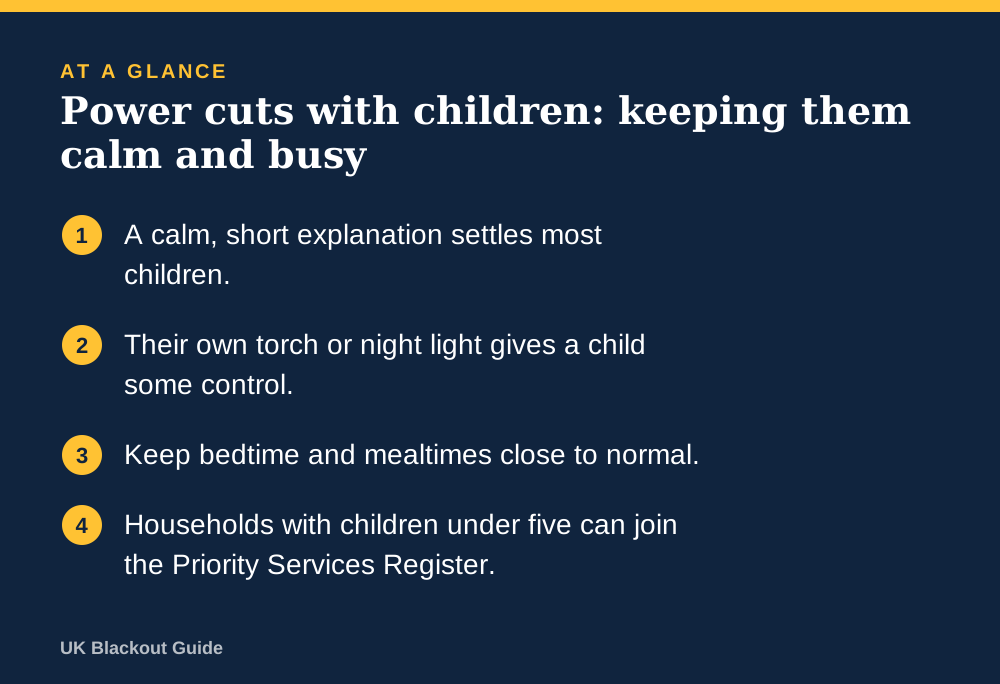
- A calm, short explanation settles most children.
- Their own torch or night light gives a child some control.
- Keep bedtime and mealtimes close to normal.
- Households with children under five can join the Priority Services Register.
Start with what you say
To a young child, a power cut is the house suddenly behaving strangely. The lights do not work, the tablet will not charge, and the adults are walking about with torches. How frightening that is depends almost entirely on how the adults seem.
When you explain a power cut to a child, keep it short and true. The electricity that comes down the wires has stopped for a while. It has happened to lots of houses, not only ours. Engineers are out mending it. We have torches, food and blankets, so we are fine.
Then answer what they actually ask, which is often narrower than you expect. Will my night light work? Can we still have tea? Older children who have seen blackout headlines may have bigger worries, so ask what they have heard and correct anything that is wrong.
Give every child a light of their own
Darkness is the part children mind most, and it is the easiest to fix. Hand each child a light that belongs to them for the evening. It turns a worrying situation into something closer to an adventure, and it means nobody is following you from room to room.
For under-fives, a soft night light that runs on its own battery is ideal, because it can stay on all night by the bed.
Glow sticks are the other favourite. They give a gentle light for several hours, produce no heat and cannot start a fire. Hang one on a bedroom door handle or the bathroom door so children can find their way.
Do not use candles around children. The official Be Ready advice is that torches are safer, and a candle at child height or within reach of a curious toddler is a fire and burn risk.
Keep the shape of the day
Routine tells children that things are under control. Have tea at teatime, even if it is sandwiches. Do teeth, pyjamas and a story at the usual hour, by torchlight. If the bedroom is cold or very dark, let everyone sleep in one room and call it a sleepover.
A few practical points:
- If water is running, do baths and teeth early, in daylight if you can. Mains water can be affected during and after a cut.
- Stair gates and safety catches still work, but you may not see that one has been left open. Check them.
- Put a torch or glow stick in the bathroom.
- Charge nothing but phones from your power bank. A tablet will drain it quickly.
Food without a cooker
Children are less flexible than adults about meals, so lean towards familiar no-cook meals. Bread, wraps, cheese, fruit, cereal, crackers, tinned fish, peanut butter and yoghurt eaten in the first hours will cover a day.
Use fridge food first and keep the door shut between meals. The Food Standards Agency says an unopened fridge should stay cold for around 4 hours. After that, be strict with dairy, cooked meat and leftovers for young children. If in doubt, throw it out.
For feeding a baby in a power cut, the Be Ready kit list suggests keeping ready-to-feed formula, because it needs no water, kettle or mixing.
Warm enough, and safe
Small children lose heat faster than adults and often will not tell you they are cold. Feel the back of the neck or the chest, not the hands. Add layers early, put a hat on indoors if the house is cooling, and keep everyone together in one room with the door closed.
Babies and toddlers in a power cut should not be overheated either, and loose blankets and hot water bottles do not belong in a cot. Follow the safe sleep advice you were given by your midwife or health visitor.
Never bring a barbecue, camping stove or patio heater indoors for warmth or cooking. They give off carbon monoxide, which has no smell. Children are affected sooner than adults. Headache, dizziness and sickness are warning signs. Get everyone outside and call 999.
Filling the hours without screens
Once the novelty wears off, usually after about forty minutes, you need something to do. This is where a small stash of games for power cuts pays for itself.
Beyond board games: shadow puppets on the wall with a torch, torch tag in the hallway, a den made from the blankets you have already fetched, reading aloud, or a quiz with a wind-up radio on in the background.
Give older children a job. Being in charge of the torches, keeping the log of what time the power went off, or checking on the family next door makes them part of the solution.
A little preparation that children can help with
Children cope better with things they have rehearsed. Show them where the torches live and let them practise turning them on. Do one evening with the lights off on purpose. Let them choose a game and a snack for your emergency kit for families.
If you have a child under five, your household qualifies for the free Priority Services Register, which means your network operator knows to offer extra support in a cut.
Common questions
At what age should I explain power cuts to a child?
As soon as they are old enough to notice the lights. A two-year-old needs one reassuring sentence, while an older child can understand that engineers are repairing a fault.
Are glow sticks safe for toddlers?
They are safe to look at and hold under supervision, but toddlers should not chew them. Hang them out of reach as a night light for the very young.
How do I warm a baby's bottle without power?
Stand it in a jug of hot water from a flask. Ready-to-feed formula can also be given at room temperature.
Should I keep my children home from school after an overnight cut?
Check with the school. If it has power and your children have slept, a normal day is usually the most reassuring thing.
Reviewed against these sources on 18 November 2026. If official advice has changed since, follow the official advice.
General information only. This page is not professional, safety, medical, legal or financial advice, and it is not official guidance. No national blackout has been forecast or announced, and nothing here suggests one is expected. We are independent and have no connection to the government or any energy company. Always check the official sources linked on this page. Full disclaimer
Keep reading
 Question
How do I explain a power cut to a child?
Simple, honest ways to explain a power cut to a child, with wording for different ages, what helps at bedtime and how to answer questions about the news.
Read: How do I explain a power cut to a child? Buying guide
Best power cut essentials: the blackout kit worth buying
The blackout kit worth buying for a UK power cut: a battery torch, a lantern, a power bank, a wind-up radio, an automatic light and a flask, with picks.
Read: Best power cut essentials: the blackout kit Buying guide
Best surge protectors for power cuts
Surge protectors for power cuts: extension leads that guard a TV, computer or router from the spike when the mains returns, chosen from Amazon UK listings.
Read: Best surge protectors for power cuts Question
Can a power cut damage appliances?
A power cut rarely harms appliances by itself. The risk comes from surges and flickering when supply returns, and from computers losing power mid-task.
Read: Can a power cut damage appliances?