On this page

Keep ready-to-feed formula or your usual feeding supplies, nappies and wipes for three days, a flask of hot water, extra layers and a battery night light. Dress the baby in layers and keep to safe sleep advice, without loose bedding or hot water bottles in the cot. Households with children under five can join the Priority Services Register for free.
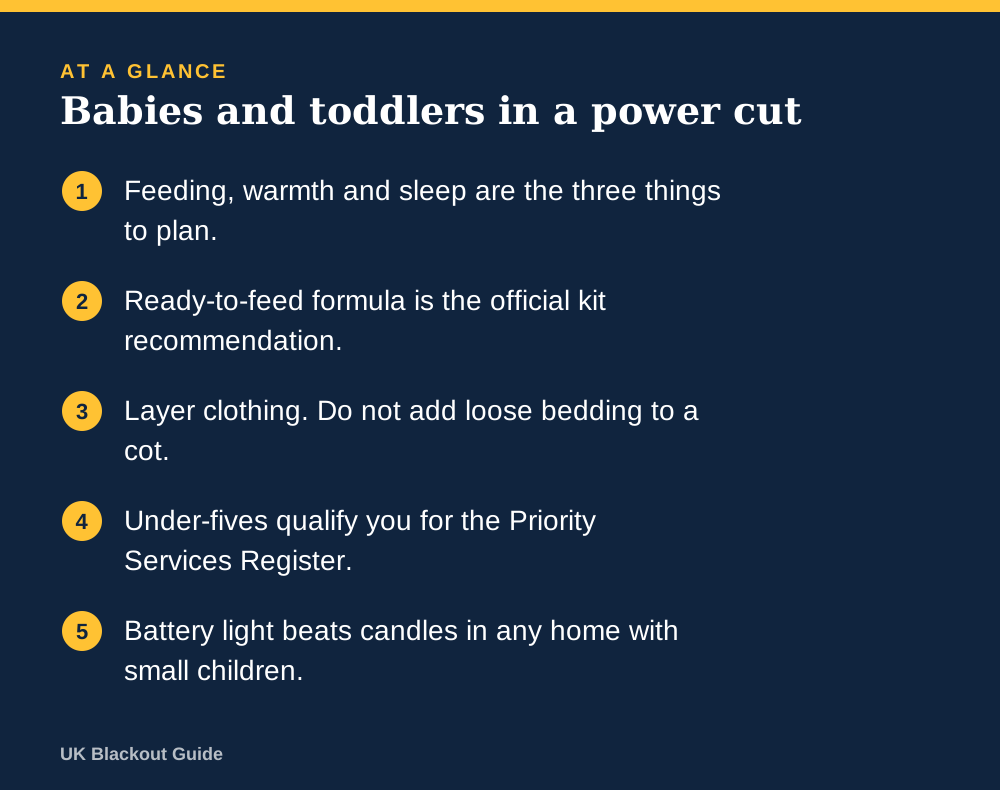
- Feeding, warmth and sleep are the three things to plan.
- Ready-to-feed formula is the official kit recommendation.
- Layer clothing. Do not add loose bedding to a cot.
- Under-fives qualify you for the Priority Services Register.
- Battery light beats candles in any home with small children.
What changes when the power goes off
A baby's day depends on more mains electricity than most parents notice until it stops. The kettle, the steriliser, the bottle warmer, the monitor, the night light, the white noise machine, the heating and the washing machine all go at once.
None of that is dangerous in a short cut. It only needs a low-tech substitute for each job, chosen in advance. This page takes them in the order they tend to become a problem: the next feed, then warmth, then bedtime.
The next feed
Feeding a baby in a power cut is simplest if you breastfeed, which carries on as normal and is one less thing to plan. If you express, a manual pump is a cheap spare for an electric one, and expressed milk in the fridge follows the same rule as other chilled food: keep the door shut.
For formula, the government's Be Ready kit list specifically suggests ready-to-feed cartons. They need no water, no kettle and no mixing, and unopened cartons keep in a cupboard. Three days' worth is the target. Powdered formula has to be made with freshly boiled water, so you would need a safe way to boil water without electricity.
Sterilising is the other gap. Cold-water sterilising tablets or solution need no power at all. Keep a small pack and a lidded container with your kit.
One of the flasks suited to power cuts, filled with boiling water before bed in winter, or when a planned cut is due, gives you hot water for several hours for warming a bottle in a jug or for a wash.
Keeping a small child warm safely
Babies cannot regulate their temperature as well as adults, and that works in both directions. In a cold house they chill quickly, yet piling on covers can overheat them. The safe approach is thin layers on the child, not heavy bedding over the top.
Add a vest, a sleepsuit and a cardigan, and a hat while awake in a cold room. Feel the chest or the back of the neck to judge warmth. Hands and feet often feel cool and are a poor guide.
Keep to the safe sleep advice your midwife or health visitor gave you, even in a cold house. No hot water bottles, heat packs, duvets or loose blankets in a cot, and no hats for sleeping indoors. A baby sleeping bag of a suitable tog is the simple answer.
Pick the smallest room you can all use, shut the door and close the curtains. Bodies warm a small space surprisingly well, though it is still worth knowing how cold is too cold for a house.
Never use a camping stove, barbecue or patio heater indoors to warm a room. Carbon monoxide has no smell and small children are affected faster than adults.
Bedtime in the dark
Toddlers who sleep with a plug-in night light may refuse to settle without it. One of the rechargeable or battery night lights for children, used every night as the normal one, means a power cut changes nothing in their room.
A head torch for the adult doing the night feed keeps both hands free.
Leave candles out of it. A crawling baby, a cot bumper and a flame should never share a room, and the official advice is that torches are safer.
Baby monitors usually have a battery in the parent unit but not always in the nursery unit. Check yours. If it has none, the simplest fix is to sleep in the same room for the night.
Nappies, washing and laundry
Keep three days of nappies and wipes beyond what you normally have in the house, alongside the rest of your emergency kit for families. Mains water can be disrupted in and after a power cut, so wipes, hand sanitiser and nappy sacks matter more than usual. If you use cloth nappies, a pack of disposables in the kit saves you from a growing bucket and no washing machine.
For a top-and-tail wash, flask water cooled to a safe temperature in a bowl is plenty.
Toddlers: explain it and give them a job
A two-year-old takes their mood from you. If you treat the cut as a slightly exciting change of routine, so will they, which is the heart of explaining a power cut to a child at any age. Give them their own small torch and a task, such as finding the teddies, or borrow one of the activity ideas from our guide to a power cut with children.
Watch the new hazards at toddler height: flasks of hot water, torches with button batteries that can be opened, and stair gates you cannot see in the dark.
Register, and know when to get help
Any household with a child under five can join the Priority Services Register at no cost. It tells your network operator there is a young child at the address.
If your baby seems unusually sleepy, floppy, cold to the touch on the chest, or is feeding poorly, call NHS 111. Call 999 if they are struggling to breathe or you cannot wake them.
Checklist
Babies and toddlers in a power cut
- Three days of ready-to-feed formula or usual feeding supplies
- Cold-water sterilising tablets and a lidded container
- Three days of nappies, wipes and nappy sacks
- One-litre flask kept by the kettle
- Rechargeable night light in daily use
- Baby sleeping bag and spare layers
- Head torch for night feeds
- Priority Services Register entry made
Common questions
Can I warm a bottle without electricity?
Yes. Stand the bottle in a jug of hot water from a flask for a few minutes and test the temperature on your wrist before feeding.
Is it safe to co-sleep to keep a baby warm?
Follow the safe sleep advice from your midwife or health visitor. Extra layers on the baby and a suitable baby sleeping bag are the recommended way to add warmth.
Will my baby monitor work in a power cut?
Only if both units have batteries, and wifi models also need the router. Check yours in advance, or sleep in the same room.
Does expressed breast milk stay safe in the fridge?
Keep the door shut. A closed fridge should stay cold for around four hours. For anything longer, ask your midwife, health visitor or NHS 111.
Reviewed against these sources on 18 November 2026. If official advice has changed since, follow the official advice.
General information only. This page is not professional, safety, medical, legal or financial advice, and it is not official guidance. No national blackout has been forecast or announced, and nothing here suggests one is expected. We are independent and have no connection to the government or any energy company. Nothing here is medical advice: follow your own clinician, pharmacist or equipment supplier. Always check the official sources linked on this page. Full disclaimer
Keep reading
 Question
How do I explain a power cut to a child?
Simple, honest ways to explain a power cut to a child, with wording for different ages, what helps at bedtime and how to answer questions about the news.
Read: How do I explain a power cut to a child? Buying guide
Best battery smoke alarms that work in a power cut
Battery smoke alarms that work in a power cut, chosen from Amazon UK listings on sealed battery life, stated standards, pack size and buyer ratings.
Read: Best battery smoke alarms that work in a Buying guide
Best CPAP battery backups for power cuts
CPAP battery backups for a power cut at night, chosen from Amazon UK listings on stated watt-hours, voltage and machine compatibility, with runtime maths.
Read: Best CPAP battery backups for power cuts Buying guide
Best rechargeable fans for a summer power cut
Rechargeable fans that run from their own battery in a summer power cut and top up from a power bank. Seven Amazon UK listings compared on stated runtime.
Read: Best rechargeable fans for a summer power cut