On this page
Leave spare insulin in the fridge with the door shut, where it should stay cold for around four hours. For a longer cut, move it to a cool box with ice packs wrapped in a towel so the insulin cannot freeze. Check the leaflet for your product's storage limits, and ask your pharmacist or diabetes team before using insulin that has been warm or frozen.
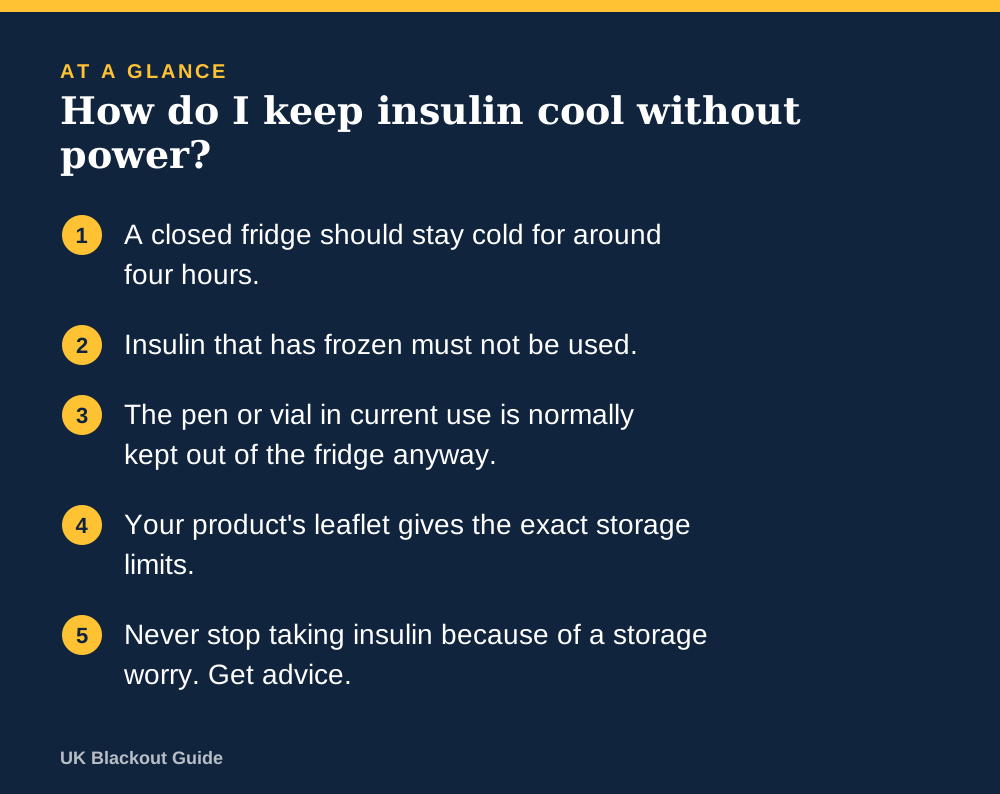
- A closed fridge should stay cold for around four hours.
- Insulin that has frozen must not be used.
- The pen or vial in current use is normally kept out of the fridge anyway.
- Your product's leaflet gives the exact storage limits.
- Never stop taking insulin because of a storage worry. Get advice.
Start by not opening the fridge
The Food Standards Agency says an unopened fridge should stay cold for around four hours. For most power cuts, which are fixed within a few hours, your spare insulin is safest left exactly where it is. Avoid putting it in the door shelves, which warm fastest.
The pen, cartridge or vial you are currently using is a separate matter. Most insulin in use is kept at room temperature for a limited period, as set out in the leaflet that comes with it. A power cut does not change that unless the house becomes very hot. The same door-shut rule protects your food, as described in how long a fridge keeps food cold without power.
Moving insulin to a cool box
If the cut passes the four-hour mark with no end in sight, transfer your stock to an insulated cool box with frozen ice packs, or to one of the portable fridges suited to power cuts and medicines if you have a powered one.
- Wrap each ice pack in a tea towel.
- Keep the insulin in its cardboard box, inside a plastic tub if you have one.
- Place it so that it does not touch the packs.
- Add a fridge thermometer if you own one, and close the lid firmly.
- Stand the box in the coolest room, out of the sun.
Do not let insulin freeze. Frozen insulin does not work properly, even after thawing, and should not be used. Direct contact with an ice pack is the usual cause.
Our cool boxes round-up compares insulation.
Options that need no ice
Evaporative cooling wallets, sold for travelling with insulin, are activated by soaking in water and keep the contents cooler than the surrounding air for a day or more. They do not reach fridge temperature. They are designed to protect insulin from heat, which makes them most useful for a summer cut or for the pen you are using. Follow the maker's instructions.
In winter, an unheated room indoors may be cool enough. Avoid windowsills, cars and outbuildings, where the temperature can drop below freezing overnight. In hot weather, our guide to a power cut in a heatwave has ways to keep one room cooler.
A friend or relative with power, or your pharmacy, may be able to store your stock for you. It is worth asking in advance.
If you think it got too warm, or too cold
Insulin that has been damaged may look cloudy when it should be clear, or have lumps or crystals. It can also look entirely normal. Write down how long it was out of the fridge and the temperatures you recorded, then ring your pharmacist or diabetes team. Use NHS 111 out of hours. They can check the manufacturer's guidance and arrange a replacement supply if needed.
Do not stop taking insulin because you are unsure about a vial. Get advice first. If your blood glucose readings are unexpectedly high and you feel unwell, follow the sick day rules your team gave you and seek urgent help. Call 999 in an emergency.
Keep your testing kit, spare batteries for a meter and hypo treatments in your emergency kit. The general approach for other medicines is in storing medicines without a fridge.
Common questions
Can I keep insulin in the freezer compartment to keep it colder?
No. Insulin must not be frozen. Keep it in the main part of the fridge, or in a cool box away from direct contact with ice.
Does an insulin pump stop in a power cut?
Pumps run on their own batteries, so a cut does not stop them. Keep spare batteries or a charged power bank for the pump and any sensor reader or phone it uses.
Should I tell anyone I use insulin?
Yes. Join the free Priority Services Register and note insulin on your written medication list.
Reviewed against these sources on 18 November 2026. If official advice has changed since, follow the official advice.
General information only. This page is not professional, safety, medical, legal or financial advice, and it is not official guidance. No national blackout has been forecast or announced, and nothing here suggests one is expected. We are independent and have no connection to the government or any energy company. Nothing here is medical advice: follow your own clinician, pharmacist or equipment supplier. Always check the official sources linked on this page. Full disclaimer
Keep reading
 Guide
Keeping medicines cool without a fridge
What to do with medicines that need refrigeration when the power goes off: how long a closed fridge stays cold, safe ways to keep them cool and who to ask.
Read: Keeping medicines cool without a fridge Guide
Babies and toddlers in a power cut
A practical plan for a power cut with a baby or toddler: feeds, safe warmth, sleep, night light, nappies and the baby items to add to your household kit.
Read: Babies and toddlers in a power cut Buying guide
Best battery smoke alarms that work in a power cut
Battery smoke alarms that work in a power cut, chosen from Amazon UK listings on sealed battery life, stated standards, pack size and buyer ratings.
Read: Best battery smoke alarms that work in a Buying guide
Best CPAP battery backups for power cuts
CPAP battery backups for a power cut at night, chosen from Amazon UK listings on stated watt-hours, voltage and machine compatibility, with runtime maths.
Read: Best CPAP battery backups for power cuts