On this page
You can run most CPAP machines from a dedicated CPAP battery or a portable power station. Machines typically draw 30 to 60 watts without the humidifier, so a 500 Wh power station gives roughly seven to fourteen hours on paper. Check your own machine's figures, ask your sleep clinic what they advise if you miss a night, and test the setup before you need it.
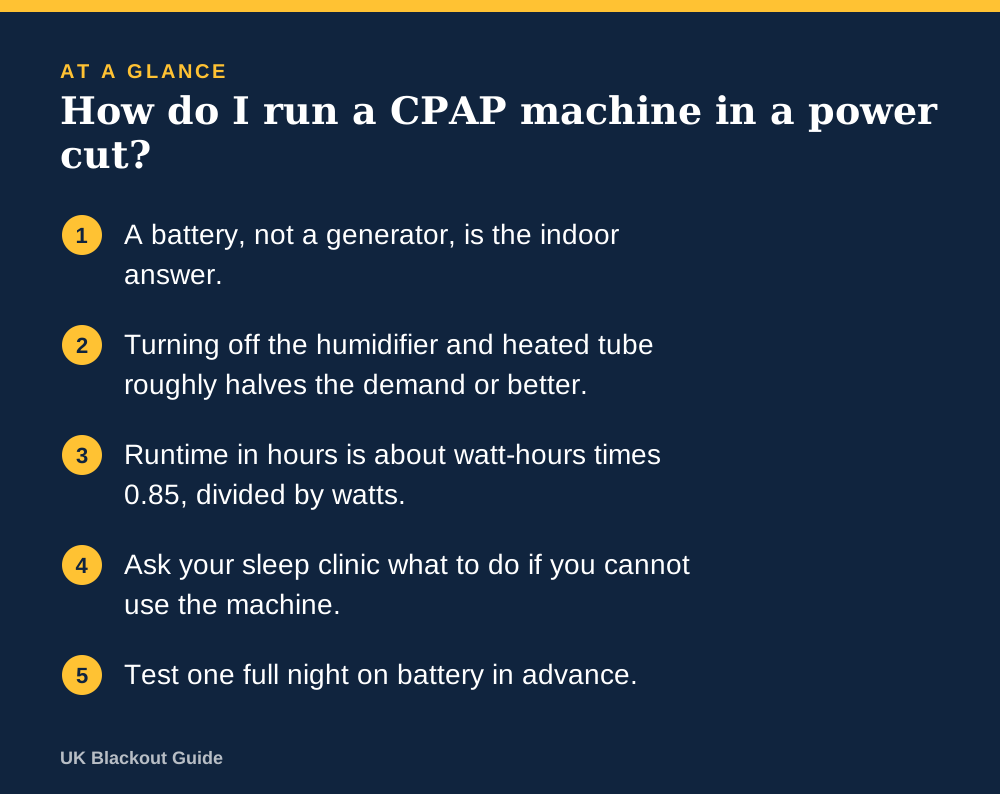
- A battery, not a generator, is the indoor answer.
- Turning off the humidifier and heated tube roughly halves the demand or better.
- Runtime in hours is about watt-hours times 0.85, divided by watts.
- Ask your sleep clinic what to do if you cannot use the machine.
- Test one full night on battery in advance.
Ask your clinic first
How much a missed night matters varies from person to person. For many people with sleep apnoea, one or two nights without therapy means poor sleep and a tired day. For others, particularly those using a machine for other breathing conditions, it is more serious.
Your sleep clinic or equipment supplier can tell you which applies to you, whether your model has an approved battery, and what to do if you cannot use it. This page is general information, and their advice comes first. If you have severe breathing difficulty at any time, call 999. If you also use oxygen, see what to do if you use an oxygen concentrator at home.
Two ways to power it
A dedicated CPAP battery. These packs connect to the machine's DC input with a lead made for that model. Because nothing is converted to mains voltage and back, less energy is wasted. They are compact and many are designed for travel. The catch is compatibility: the voltage and connector must match your machine exactly. Our CPAP battery backups round-up is sorted by the machines each one fits.
A portable power station. This is a larger battery with ordinary three-pin sockets, so the machine plugs in with its normal adaptor. It is less efficient but more versatile, since the same unit will charge phones and run a lamp. Choose one with a pure sine wave output. The power stations list gives capacities.
Working out how long it will last
Find the wattage on the machine's label or in the manual. As a guide, CPAP machines typically draw 30 to 60 watts with the humidifier and heated tube switched off. With them on, the draw can be much higher.
Runtime in hours is roughly the battery's watt-hours multiplied by 0.85, then divided by the watts drawn. For a 500 Wh power station:
- at 30 W: about 14 hours
- at 60 W: about 7 hours
These are paper figures. Pressure setting, mask leak, room temperature and battery age all change the result. The method is explained step by step in what size power station you need.
The biggest saving is to switch off the humidifier and heated tubing while on battery. Ask your clinic whether that is suitable for you. Some people find the air too dry without it.
Test it, then make the rest of the plan
Run one normal night on the battery and note how much charge is left in the morning. That single test tells you more than any calculation.
Then cover the gaps. Join the free Priority Services Register so your network operator knows you use powered medical equipment. Keep the battery charged and top it up every few months. Decide where you would sleep if a cut ran for several nights, for example with a relative who has power.
Do not run a petrol generator indoors, in a garage or outside an open bedroom window to power a CPAP. Carbon monoxide has no smell and is most dangerous to people who are asleep.
Wider planning for home devices is in our guide to medical equipment in a power cut.
Common questions
Can I run a CPAP from a car battery?
Some machines have a 12-volt lead for this, but check the manual and your supplier first. A purpose-made battery or power station is simpler and safer indoors.
Will a small power bank run a CPAP?
Ordinary phone power banks cannot. A few high-capacity models with the right DC output can, for limited hours, if the manufacturer confirms compatibility.
Does my CPAP have a built-in battery?
Most home machines do not. A few travel models have optional battery packs. Your supplier can confirm.
Reviewed against these sources on 18 November 2026. If official advice has changed since, follow the official advice.
General information only. This page is not professional, safety, medical, legal or financial advice, and it is not official guidance. No national blackout has been forecast or announced, and nothing here suggests one is expected. We are independent and have no connection to the government or any energy company. Nothing here is medical advice: follow your own clinician, pharmacist or equipment supplier. Always check the official sources linked on this page. Full disclaimer
Keep reading
 Guide
Medical equipment at home in a power cut
How to plan for a power cut if you rely on medical equipment at home: who to tell, what to ask your supplier, backup power options and when to call 999.
Read: Medical equipment at home in a power cut Buying guide
Best CPAP battery backups for power cuts
CPAP battery backups for a power cut at night, chosen from Amazon UK listings on stated watt-hours, voltage and machine compatibility, with runtime maths.
Read: Best CPAP battery backups for power cuts Guide
Pets in a power cut, including fish tanks and reptiles
How to look after dogs, cats, small animals, reptiles, birds and fish in a power cut, including food, water, warmth and which pets need backup power.
Read: Pets in a power cut, including fish tanks and Question
Powered wheelchairs and mobility scooters in a power cut: what to plan for
Whether a powerchair or mobility scooter needs backup power in a power cut, how to stay charged, charging from a power station and what else to plan for.
Read: Powered wheelchairs and mobility scooters in