On this page
Add up the watts of what you want to run, multiply by the hours you need, then divide by 0.85. Most homes wanting Wi-Fi, lamps, phones and a laptop for an evening need about 500 to 600 Wh. Running a fridge-freezer for a day takes closer to 2,000 Wh.
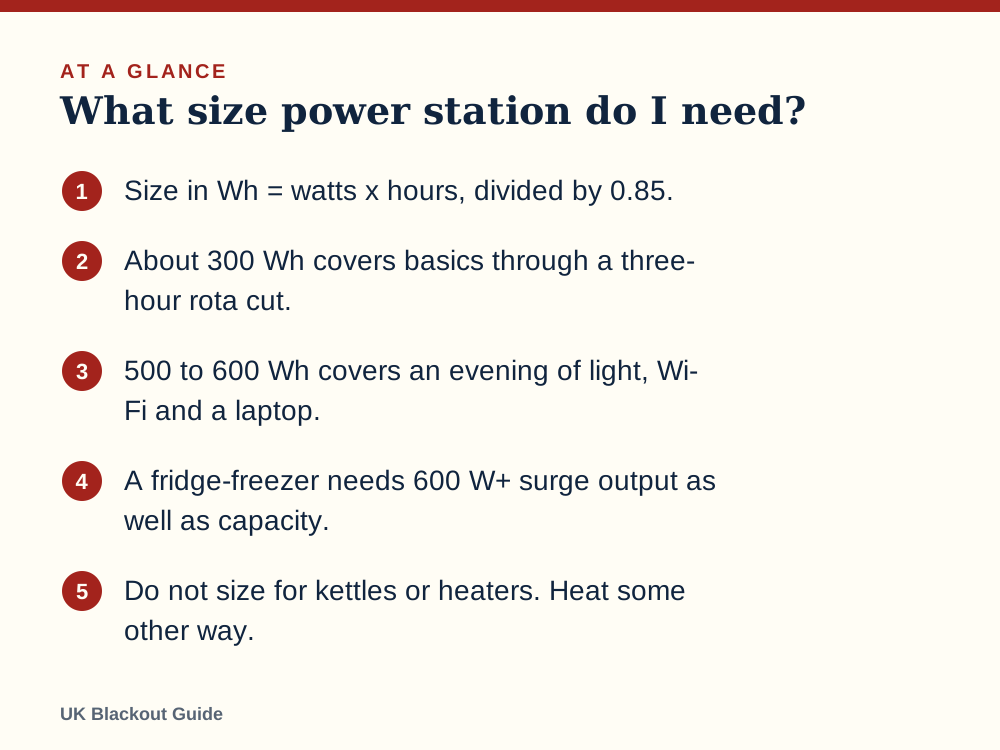
- Size in Wh = watts x hours, divided by 0.85.
- About 300 Wh covers basics through a three-hour rota cut.
- 500 to 600 Wh covers an evening of light, Wi-Fi and a laptop.
- A fridge-freezer needs 600 W+ surge output as well as capacity.
- Do not size for kettles or heaters. Heat some other way.
The four-step sum
- List the devices. Only what you would really run in a cut, not everything you own.
- Find the watts for each. Look at the rating plate or power adaptor, or use our table of watts used by typical appliances.
- Multiply each by the hours you need it. That gives watt-hours (Wh). Add them up.
- Divide the total by 0.85. This allows for the energy the power station's own electronics use.
The result is the capacity to look for. Separately, add up the watts of everything that might run at the same moment. The unit's continuous output rating must be higher than that figure.
Example one: getting through a rota cut
In a national energy shortage, planned rota power cuts could last about three hours at a time. Say you want the internet, two lamps and a laptop through one of them.
- Router: 12 W x 3 hours = 36 Wh
- Two LED lamps: 20 W x 3 hours = 60 Wh
- Laptop: 60 W x 3 hours = 180 Wh
That is 276 Wh. Divide by 0.85 and you need about 325 Wh. The load at any moment is only 92 W, so any unit can supply it. A compact station of 300 to 400 Wh does this job, and recharges from the wall before the next cut.
Example two: a full evening without power
Now stretch it to a winter evening and add the phones.
- Router: 12 W x 6 hours = 72 Wh
- Two LED lamps: 20 W x 6 hours = 120 Wh
- Laptop: 60 W x 4 hours = 240 Wh
- Two phones charging: 15 W each for 2 hours = 60 Wh
The total is 492 Wh, and dividing by 0.85 gives about 580 Wh. This is why units around 500 to 600 Wh are the most popular size: they match what an ordinary household wants for one evening. If the cut runs into a second day, you ration, dropping the laptop first.
Example three: a CPAP machine overnight
Running a CPAP in a power cut takes roughly 30 to 60 W without the humidifier. At 40 W for 8 hours that is 320 Wh, or about 375 Wh after dividing by 0.85. For two nights with no way to recharge, double it to 750 Wh.
Heated humidifiers and heated hoses raise the draw considerably, so many users switch them off on battery. Check the wattage of your own machine and ask your equipment supplier or clinician what they advise. If you rely on powered medical equipment you should join the Priority Services Register.
Example four: keeping a fridge-freezer cold
A fridge-freezer averages 40 to 80 W because its compressor cycles on and off. At 60 W for 24 hours it uses 1,440 Wh, which means about 1,700 Wh of capacity. That puts you in the 2,000 Wh class for one day, the size covered by our large power station shortlist.
Capacity is only half the test of whether a power station can run a fridge. The compressor needs 600 W or more for a moment each time it starts, so the station's surge rating has to clear that with room to spare. A small unit with a 300 W output will not start a fridge, however much charge it holds.
You may not need to run it at all. According to the Food Standards Agency, a full freezer typically stays frozen for about 48 hours with the door shut.
Sizes at a glance
| Capacity | Usable energy | Realistic job |
|---|---|---|
| 250 to 300 Wh | 210 to 255 Wh | Router and phones for a day, or lamps for several evenings |
| 500 to 600 Wh | 425 to 510 Wh | An evening of router, lamps, laptop and phones, or one CPAP night |
| 1,000 Wh | 850 Wh | A working day at a desk, two CPAP nights, or a fridge for about 14 hours |
| 2,000 Wh | 1,700 Wh | A fridge-freezer for about a day, plus small loads |
Reasons to go up or down a size
Go up a size if the device is medical, if you live somewhere with a history of long cuts, or if you cannot recharge between outages. Batteries also fade with age, so a little headroom keeps the unit useful for longer.
Go down a size if you can recharge. A 100 W solar panel can return 300 to 400 Wh on a clear summer day, though often only 30 to 80 Wh on a dull winter one, as covered in what portable solar delivers in UK weather. Smaller units are also lighter, cheaper and more likely to be carried to where they are needed. A small unit is often enough for a low-wattage job such as an aquarium air pump, as shown in keeping a fish tank alive in a power cut.
Do not size for a kettle or heater. A kettle draws 2,000 to 3,000 W, and the numbers in running a kettle from a power station show why a camping stove used safely, or a flask filled in advance, is the better plan.
When you have your number, compare it against our portable power station recommendations.
Common questions
Is it better to buy one big power station or two small ones?
Two small units give flexibility and a spare if one fails, but only a large unit has the surge output to start a fridge. Choose by your biggest single load.
What does the watt rating need to be?
Higher than the combined watts of everything running at once, with surge capacity above 600 W if a fridge or freezer is on the list.
Can I run my gas boiler from a power station?
The controls and pump draw about 100 to 150 W, so the capacity sums work, but the boiler needs a safe way to connect. Ask a qualified electrician or heating engineer and never improvise the wiring.
How do I find the watts if there is no label?
A plug-in energy monitor between the appliance and the wall shows its actual draw. Measure over a day for anything that cycles, such as a fridge.
Reviewed against these sources on 18 November 2026. If official advice has changed since, follow the official advice.
General information only. This page is not professional, safety, medical, legal or financial advice, and it is not official guidance. No national blackout has been forecast or announced, and nothing here suggests one is expected. We are independent and have no connection to the government or any energy company. Anything involving electricity, gas, fuel or food safety should be checked with a qualified professional or the relevant official body before you act on it. Always check the official sources linked on this page. Full disclaimer
Keep reading
 Guide
Portable power stations explained
How portable power stations work, what watt-hours and watts mean, what one can and cannot run in a UK power cut, and the features that matter.
Read: Portable power stations explained Guide
Running a fridge or freezer on backup power
When a fridge or freezer needs backup power in a power cut, what size power station or generator will start one, and how long it will keep running.
Read: Running a fridge or freezer on backup power Question
Are power stations safe to use indoors in a power cut?
Battery power stations are safe to use indoors because they burn no fuel and give off no fumes. The sensible rules for charging, placing and storing one.
Read: Are power stations safe to use indoors in a Buying guide
Best power stations to run a fridge freezer in a blackout
Large 1 to 3 kWh power stations that can start and run a fridge-freezer through a blackout, picked from Amazon UK listings with estimated runtimes.
Read: Best power stations to run a fridge freezer