On this page
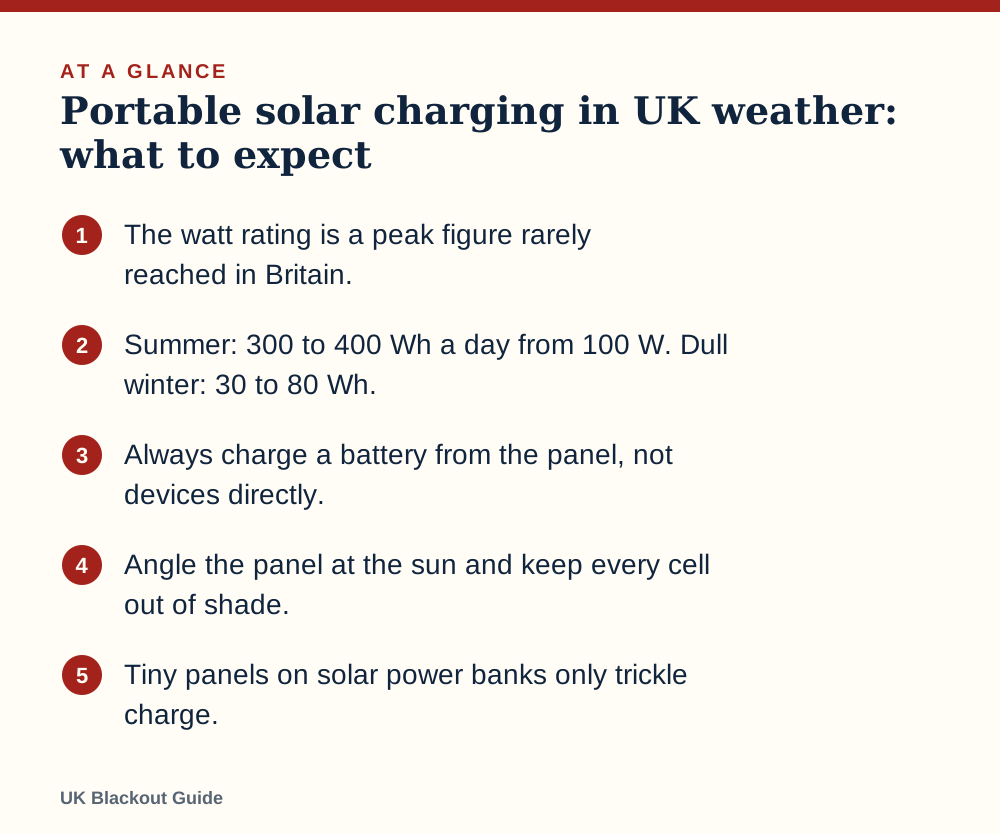
A 100 W portable solar panel in the UK typically yields roughly 300 to 400 Wh on a clear summer day and often only 30 to 80 Wh on a dull winter day. That is enough to run a router and lamps and charge phones in summer, and enough for phone charging alone in midwinter.
- The watt rating is a peak figure rarely reached in Britain.
- Summer: 300 to 400 Wh a day from 100 W. Dull winter: 30 to 80 Wh.
- Always charge a battery from the panel, not devices directly.
- Angle the panel at the sun and keep every cell out of shade.
- Tiny panels on solar power banks only trickle charge.
What the wattage on the label means
A portable solar panel sold as 100 W produces 100 W only under laboratory conditions: strong, direct sunlight hitting it square on, with the panel cool. Outdoors in Britain you will see less than the label figure most of the time, and far less under cloud.
What matters for planning is energy over a whole day, measured in watt-hours (Wh). Daily yield depends on how many hours of useful light you get and how strong it is. Both collapse in a British winter, when the sun is low, the days are short and thick cloud is common.
Summer and winter yields compared
| Panel size | Clear summer day | Dull winter day |
|---|---|---|
| 100 W | 300 to 400 Wh | 30 to 80 Wh |
| 200 W | 600 to 800 Wh | 60 to 160 Wh |
The 200 W row simply doubles the typical figures for 100 W. Treat all of these as rough guides. A bright, cold, clear winter day will beat the dull-day figure, and a grey summer day will fall well short of the clear-day one.
The gap between seasons is roughly five to ten times. That single fact should shape your plan: portable solar is a strong tool from late spring to early autumn and a weak one in the months when long power cuts are most likely.
What that energy actually runs
Energy collected by a panel goes into a battery, and you lose some getting it out again. Using the usual allowance of 85%, a summer day's 300 to 400 Wh becomes about 255 to 340 Wh at the socket. That would run:
- a 12 W router for 21 to 28 hours, or
- a 60 W laptop for 4 to 5.5 hours, or
- a 40 W CPAP machine for 6 to 8.5 hours.
In practice, a summer household could keep the router on all day, charge several phones and light the evening with LED lamps, every day, from one 100 W panel and a mid-sized power station.
A dull winter day's 30 to 80 Wh becomes about 25 to 68 Wh. A full phone charge takes somewhere around 15 to 20 Wh, so you can count on one to four phone charges, or a 10 W lamp for 2.5 to 7 hours. It will not keep a fridge going: a fridge-freezer averaging 60 W uses about 1,440 Wh a day, many times what a portable panel collects in winter.
Pair the panel with a battery
A panel's output rises and falls with every cloud. Phones and laptops dislike that and may stop charging or refuse to start. A battery in between smooths it out and stores energy for after dark, when you need it.
For a power station, check three things before buying a panel: the connector type, the voltage range the solar input accepts, and the maximum input in watts. A panel bigger than the input limit is wasted money. If you have not chosen a power station yet, work out what size of power station you need first.
For phones only, a small panel with a USB output feeding an ordinary power bank is enough, and how many phone charges a power bank provides tells you what size of bank to pair it with.
Getting the most from British daylight
Position makes a large difference, and it costs nothing.
- Face south. Point the panel towards the midday sun and, if you are at home, turn it to follow the sun morning and afternoon.
- Tilt it. Prop it steeply in winter when the sun is low, and flatter in summer. Lying flat on the lawn in December wastes most of the light.
- Avoid all shade. A shadow across one corner from a fence post or washing line can cut output from the whole panel.
- Put it outside. Window glass reduces what reaches the cells, and the angle is usually wrong. A panel behind double glazing produces a fraction of its outdoor output.
- Keep it clean and cool. Wipe off dew, frost and dirt.
Run the cable indoors through a slightly open window and keep the power station itself inside in the dry. Bring the panel in at night and in high wind.
Solar power banks need honest expectations
A solar power bank is an ordinary power bank with a small panel on its face. That panel is a tiny fraction of the area of a 100 W folding panel, so it collects a tiny fraction of the energy. In good summer sun it may take days to add one phone charge, and in winter it adds very little.
They still have a place. Charged from the mains beforehand, the battery does the real work, and the panel offers a slow trickle if an outage drags on, which is the honest measure of how well solar power banks work in practice. Models with several fold-out panels do noticeably better than single-panel ones.
Where portable solar fits in your plan
For the three days the Be Ready campaign asks households to manage, a pre-charged power bank or power station matters far more than a panel. Solar comes into its own in longer outages, when stored energy runs out and there is no mains to refill it, which is why it sits at the centre of planning off-grid power for weeks.
Whatever the season, lowering demand is cheaper than adding panels. Use the tips in making a phone battery last longer and a winter panel's small harvest stretches a long way.
If you also have panels on the roof, note that they behave differently: most rooftop solar stops in a power cut unless the system has battery backup able to run independently of the grid.
Common questions
Do portable solar panels work on cloudy days?
Yes, but at a small fraction of their rated output. A 100 W panel often yields only 30 to 80 Wh over a dull winter day.
Can I leave a folding solar panel out in the rain?
Many panels are splash resistant, but their connectors and any attached power station usually are not. Check the rating and keep the battery under cover.
Is a 200 W panel twice as good as a 100 W one?
Roughly, in the same light, provided your power station's solar input can accept it. Check the maximum input watts and voltage first.
Will a solar panel charge through a window?
It will produce something, but much less than outdoors because glass and a poor angle both reduce the light reaching the cells.
Reviewed against these sources on 18 November 2026. If official advice has changed since, follow the official advice.
General information only. This page is not professional, safety, medical, legal or financial advice, and it is not official guidance. No national blackout has been forecast or announced, and nothing here suggests one is expected. We are independent and have no connection to the government or any energy company. Anything involving electricity, gas, fuel or food safety should be checked with a qualified professional or the relevant official body before you act on it. Always check the official sources linked on this page. Full disclaimer
Keep reading
 Question
Do solar power banks work in a blackout?
Solar power banks work as ordinary power banks, but the built-in panel is too small to refill them in UK light. What the panel adds, and what works better.
Read: Do solar power banks work in a blackout? Buying guide
Best phone chargers for a blackout
Nine ways to keep a phone charged in a blackout: power banks, crank and solar chargers, car chargers and cables from Amazon UK, compared honestly.
Read: Best phone chargers for a blackout Buying guide
Best portable solar panels for blackouts
Portable solar panels for blackouts: folding panels that refill a power station or charge phones with no mains, with honest UK summer and winter output.
Read: Best portable solar panels for blackouts Buying guide
Best solar power banks for emergencies
Solar power banks and crank radio chargers for emergencies, from Amazon UK: what the small panel really does in British weather, and six worth a look.
Read: Best solar power banks for emergencies