On this page
Usually not. Most home solar systems shut down automatically when the grid goes off, even in bright sunshine. They only keep working if the system includes a battery and inverter able to run independently of the grid. Portable solar panels are separate and work in a power cut, feeding a power station or power bank.
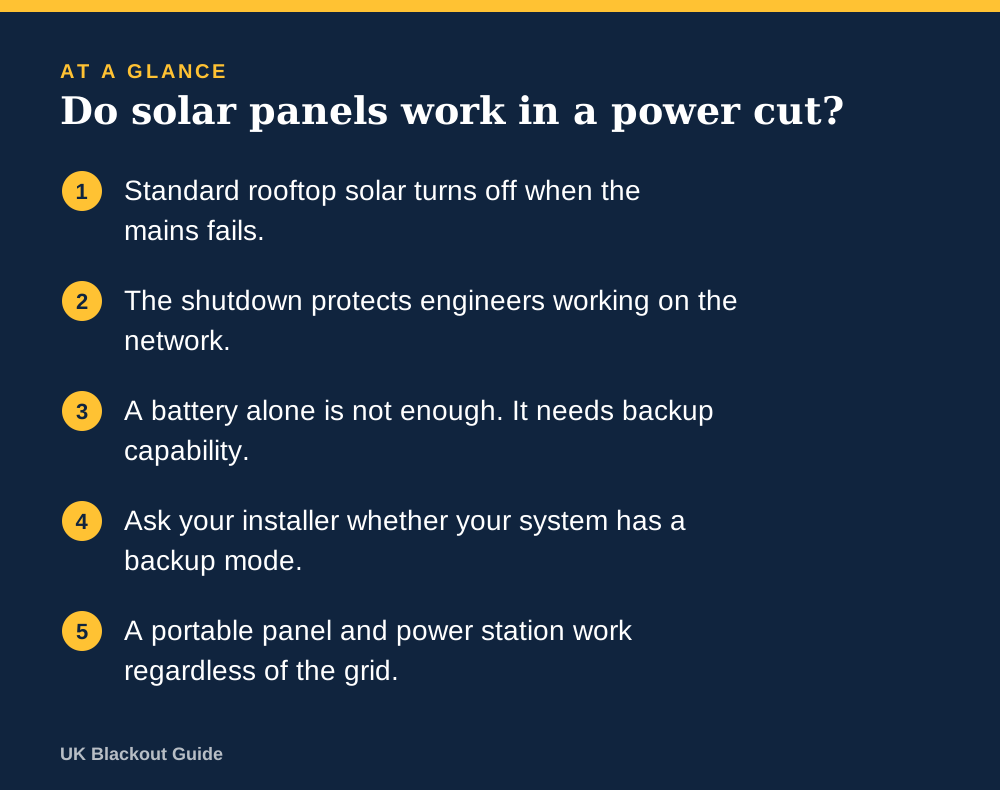
- Standard rooftop solar turns off when the mains fails.
- The shutdown protects engineers working on the network.
- A battery alone is not enough. It needs backup capability.
- Ask your installer whether your system has a backup mode.
- A portable panel and power station work regardless of the grid.
Why rooftop solar switches itself off
A standard solar installation is grid-tied. The inverter that converts the panels' output into household electricity uses the mains as its reference, matching the grid's voltage and timing. When the mains disappears, the inverter is designed to disconnect within moments.
This is a safety feature, not a fault. If your panels kept feeding electricity into the street cables during a power cut, engineers repairing a line they believed to be dead could be electrocuted. It is the same back-feed danger that makes plugging a generator into a wall socket so hazardous.
The result surprises many owners: a sunny roof full of panels and a dark house underneath. If you have never had a daytime power cut since the panels went in, you may not know which kind of system you have.
A battery helps only if it has backup capability
Adding a home battery does not by itself change this. Many battery systems are installed purely to store cheap or surplus electricity for the evening, and they shut down with the grid just as the panels do.
To keep working in a cut, the system needs to be able to form its own small island of power, physically isolated from the network. Installers describe this in different ways: backup mode, emergency power supply (EPS), islanding or off-grid capability. It normally involves a compatible hybrid inverter and extra switching hardware, fitted by a qualified installer.
Backup setups for home batteries in a blackout come in two broad forms. Some power a single dedicated socket or a handful of chosen circuits, such as lights, the fridge and the boiler. Others can support the whole house within the limits of the battery and inverter.
How to check what your own system does
Start with the paperwork from your installer and the inverter's manual, and look for the terms above. If it is unclear, ring the installer and ask one direct question: if the grid goes down at midday, what in my house stays on.
If the answer is that you have a backup socket, find it and label it now. If backup is possible but was not fitted, ask what the upgrade would involve. Do not attempt any modification yourself. Solar arrays produce dangerous voltages whenever light falls on them, and the isolation that protects network engineers has to be done properly.
Your smart meter in a power cut and the solar monitoring app will usually go blank too, because they depend on mains power and your router.
What a backup-capable system can realistically run
Even with backup, think in terms of essentials. The inverter has a maximum output, and the battery has a fixed capacity that the panels may not refill in winter. A fridge-freezer averaging 40 to 80 W, a router at 10 to 15 W, a few LED lamps at 5 to 10 W each and gas boiler controls at 100 to 150 W add up to a load most backup systems can carry.
Kettles at 2,000 to 3,000 W and fan heaters at 2,000 W are another matter. They may exceed the backup output, and they empty a battery quickly. Electric showers, ovens and car chargers are usually excluded from backup circuits altogether.
Season matters as much as hardware. British panels produce far less in December than in June, so a system that sails through a summer cut may need careful rationing in winter, which is the catch in whether solar panels can run a house off-grid.
Portable panels work whatever the grid is doing
A folding portable solar panel has no connection to your house wiring, so the shutdown rule does not apply. You unfold it in the garden or on a balcony, plug it into a power station or power bank, and it charges whenever there is daylight.
The output is modest. A 100 W panel typically yields roughly 300 to 400 Wh on a clear summer day and often 30 to 80 Wh on a dull winter day. In summer that nearly refills a 500 Wh power station daily, which is enough for a router, lamps and phones indefinitely. In winter it covers phone charging and a few hours of light.
The panel needs a battery to be useful, since output swings with every passing cloud, and positioning matters as much as size for portable solar charging in UK conditions.
Deciding whether to upgrade for power cuts
If you already have solar and are choosing a battery anyway, ask for backup capability to be quoted at the same time, as it is easier to include from the start. If you have no solar at all, fitting a roof system purely as blackout insurance is hard to justify, because no national blackout is planned or predicted and most cuts are short.
For most homes, a portable power station covers the realistic risk at a fraction of the commitment.
Common questions
Why can't I just flip a switch to use my panels in a power cut?
A grid-tied inverter needs the mains to operate and is built to disconnect when it fails, to protect engineers. Only extra backup hardware fitted by an installer can change that safely.
Do solar panels get damaged by a power cut?
No. The inverter simply stops and restarts by itself a few minutes after the mains returns.
Will my solar hot water diverter still work?
No. It relies on the solar inverter running, so it stops when the grid does unless the system has backup capability.
Can I plug a portable panel straight into a phone?
Some panels have a USB socket for this, but output varies with the light. Charging a power bank from the panel and the phone from the bank is more reliable.
Reviewed against these sources on 18 November 2026. If official advice has changed since, follow the official advice.
General information only. This page is not professional, safety, medical, legal or financial advice, and it is not official guidance. No national blackout has been forecast or announced, and nothing here suggests one is expected. We are independent and have no connection to the government or any energy company. Anything involving electricity, gas, fuel or food safety should be checked with a qualified professional or the relevant official body before you act on it. Always check the official sources linked on this page. Full disclaimer
Keep reading
 Guide
Backup power for your home: every option compared
Power banks, power stations, generators, solar panels, cars and UPS units compared: what each can run in a UK power cut, for how long, and who needs which.
Read: Backup power for your home: every option Question
Are power stations safe to use indoors in a power cut?
Battery power stations are safe to use indoors because they burn no fuel and give off no fumes. The sensible rules for charging, placing and storing one.
Read: Are power stations safe to use indoors in a Buying guide
Best portable power stations for power cuts
Portable power stations for UK power cuts, from a 75 Wh unit for the router to 2 kWh solar bundles, picked from Amazon UK listings with runtime sums.
Read: Best portable power stations for power cuts Buying guide
Best portable solar panels for blackouts
Portable solar panels for blackouts: folding panels that refill a power station or charge phones with no mains, with honest UK summer and winter output.
Read: Best portable solar panels for blackouts