On this page
A home battery only keeps your lights on in a power cut if it was installed with a backup function that can disconnect the house from the grid. Many are not, and shut down with the mains. If yours does have backup, a 5 kWh battery can run lights, a router and a fridge-freezer for a day or more.
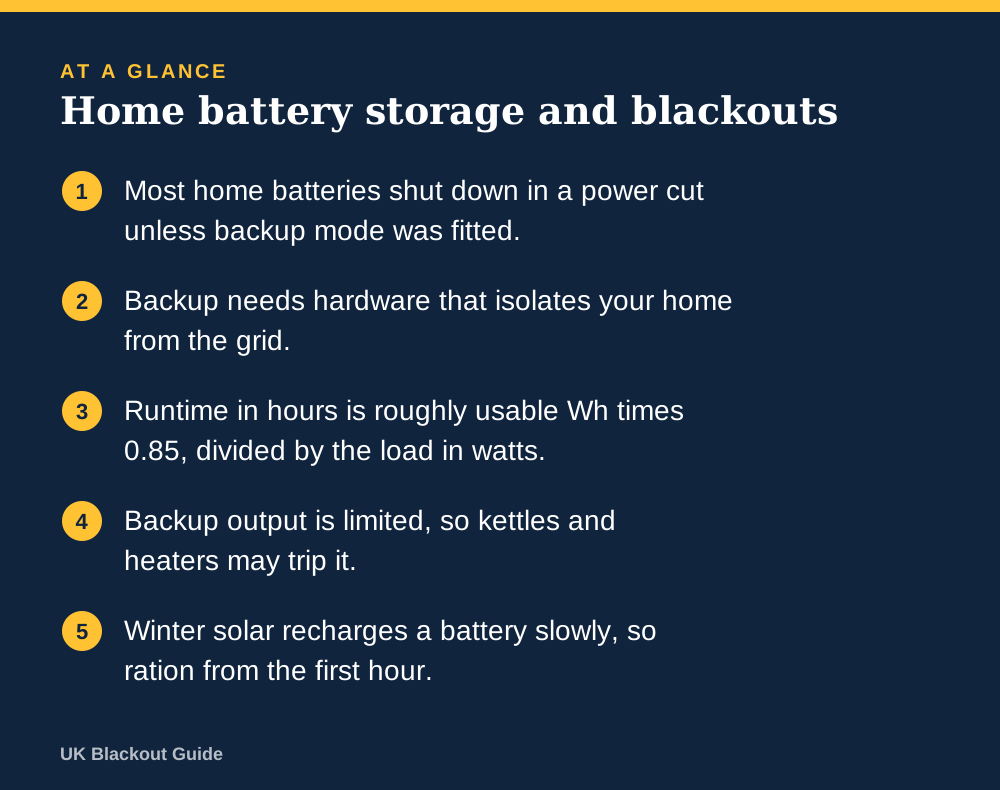
- Most home batteries shut down in a power cut unless backup mode was fitted.
- Backup needs hardware that isolates your home from the grid.
- Runtime in hours is roughly usable Wh times 0.85, divided by the load in watts.
- Backup output is limited, so kettles and heaters may trip it.
- Winter solar recharges a battery slowly, so ration from the first hour.
Why most home batteries stop when the grid does
A wall-mounted battery feels like it should be the answer to a blackout. In most UK homes it is not, at least not as installed. A standard system is tied to the grid and is designed to shut down the moment the mains fails.
The reason is safety. If your battery or panels kept pushing electricity into the street cables during a fault, an engineer working on a line they believed was dead could be killed. So the inverter watches the grid and stops when it disappears. The same rule explains why rooftop solar goes dark in a power cut even at midday in June.
The Be Ready campaign makes the same point: most home solar shuts off in a power cut unless the system has battery backup able to run independently of the grid.
What a backup-capable system has that others lack
To work in a blackout, a system has to do two things at once: cut your home off from the grid, and then supply power on its own. Installers call this island mode, backup mode or emergency power supply (EPS).
It normally takes extra hardware. That may be a backup gateway that isolates the whole house automatically, a changeover switch you turn by hand, or a single dedicated backup socket next to the inverter. Some batteries can have it added later. Others cannot, whatever the brochure implies.
Any work on this must be done by a qualified electrician, and your installer is the right first call. It is the same principle as the rule against plugging a generator into a house socket: nothing should be able to feed power back into the network.
How to check what you already own
If you have a battery and are not sure, there are three quick checks. Look at your handover paperwork for the words backup, EPS, island or gateway. Look near the inverter for a socket or switch labelled EPS or backup. Then ask the installer one direct question: if the mains fails, which circuits in my house stay live, and for how long.
The honest test is a short, deliberate one. With your installer's agreement, switch off the main switch at the consumer unit for a few minutes in daylight and see what still works. Doing this once on a calm afternoon beats finding out at 6pm in a storm. If you are unsure which switch is which, start with how to turn off your electricity, gas and water.
How long a backed-up battery will last
Use the same sum as for a portable power station: runtime in hours is roughly the battery's usable watt-hours, times 0.85 for conversion losses, divided by the load in watts. A 5 kWh battery is 5,000 Wh, so you have about 4,250 Wh to spend.
| What you run | Typical load | Runtime from 5 kWh |
|---|---|---|
| Router and two LED lamps | about 30 W | around 140 hours |
| Add a fridge-freezer | about 90 W | around 47 hours |
| Add gas boiler controls and pump | about 215 W | around 20 hours |
| A 2,000 W fan heater alone | 2,000 W | about 2 hours |
Those figures assume the battery was full when the power went. Many systems are set to drain to a low level every evening to save money, which is exactly when a winter cut is likely to start. If your system has a backup reserve setting, keeping 20 to 30 per cent held back through the winter is a sensible trade.
The limits that catch people out
Capacity is only half the story. In backup mode the inverter can deliver a limited amount of power at once, shown in kW on the data sheet. Switch on a 3,000 W kettle while the fridge compressor is starting and a small backup output may trip. Electric showers, ovens and immersion heaters are usually out of reach.
Some systems back up only selected circuits, so the lights may work while the kitchen sockets do not. There can also be a pause of a few seconds at changeover, enough to restart a router or a desktop PC. A small UPS battery backup bridges that gap for anything that must not drop.
Gas central heating is a good use of backup power because a gas boiler needs electricity only for its controls and pump, around 100 to 150 W.
Recharging from solar in a long outage
With backup mode and solar panels, the battery can refill while the grid is down, though whether solar can run a whole house off grid depends heavily on the season. In summer that can keep a careful household going day after day. In winter, be realistic. A single 100 W portable panel often makes only 30 to 80 Wh on a dull winter day, against 300 to 400 Wh on a clear summer one, and a roof array follows the same seasonal swing at a larger scale.
So in a winter outage, treat the battery as a fixed store with small top-ups. Run the fridge-freezer, lighting, phone charging and the boiler controls, and leave everything else off. That discipline is the basis of off-grid power for weeks.
If you do not have a home battery
A home battery with backup is a large installed project, and only one of the backup power options worth comparing. It makes most sense if you were fitting solar or a battery anyway and can add the backup function at the design stage, when the extra cost is smallest.
For blackout cover alone, portable kit does the essential jobs for far less. The government's Be Ready advice asks households to manage for three days, and a torch, a radio and a charged power bank are on its list. A mid-sized unit from our list of the best portable power stations will run a router, lamps and phone charging. The larger power stations can carry a fridge-freezer through a rota cut of about three hours.
Checklist
Home battery storage and blackouts
- Find your handover paperwork and look for backup, EPS or island mode
- Ask your installer which circuits stay live in a cut
- Check the backup output rating in kW
- Set a winter backup reserve if your app allows it
- Test with the main switch off for a few minutes in daylight
- Write down which sockets work in backup mode
- Keep a torch and power bank ready anyway
Common questions
Will my solar panels charge the battery during a power cut?
Only if the system has a backup or island mode. Without it, both the panels and the battery shut down until the mains returns.
Can backup mode be added to an existing battery?
Sometimes. It depends on the inverter and battery model and usually needs extra hardware fitted by a qualified electrician. Ask your original installer first.
Is a home battery better than a generator for blackouts?
It is silent, automatic and has no fumes, but it holds a fixed amount of energy. A generator runs for as long as you have fuel, and must only ever be used outdoors because of carbon monoxide.
Does a home battery help in a planned rota cut?
Yes, if it has backup. Rota cuts are expected to last about three hours at a time, which is well within the range of a charged battery running essentials.
Reviewed against these sources on 18 November 2026. If official advice has changed since, follow the official advice.
General information only. This page is not professional, safety, medical, legal or financial advice, and it is not official guidance. No national blackout has been forecast or announced, and nothing here suggests one is expected. We are independent and have no connection to the government or any energy company. Anything involving electricity, gas, fuel or food safety should be checked with a qualified professional or the relevant official body before you act on it. Always check the official sources linked on this page. Full disclaimer
Keep reading
 Question
Are power stations safe to use indoors in a power cut?
Battery power stations are safe to use indoors because they burn no fuel and give off no fumes. The sensible rules for charging, placing and storing one.
Read: Are power stations safe to use indoors in a Buying guide
Best car inverters for power cuts
Car inverters for power cuts: six units from Amazon UK listings that run a laptop, router or lamp from your car's 12V socket, with the limits explained.
Read: Best car inverters for power cuts Buying guide
Best generators for power cuts
Petrol inverter generators for UK power cuts, from 1,200 W to 5,500 W, chosen from Amazon UK listings, with the carbon monoxide and wiring rules.
Read: Best generators for power cuts Buying guide
Best jump starters for emergencies that also charge phones
Jump starters for emergencies that also charge phones: seven packs from Amazon UK listings with a power bank and torch, sized by engine, for blackouts.
Read: Best jump starters for emergencies that also