On this page
In a power cut, a 200W to 300W inverter in the car's 12V socket will run a laptop charger, a router or a lamp, but not a kettle, heater or fridge. Choose a pure sine wave model for sensitive electronics or medical chargers. Run the engine outdoors only, never in a garage.
- Your car is a backup battery you already own. An inverter gives it a mains socket.
- A 12V socket can only supply a small load, usually a laptop or less.
- Pure sine wave output is kinder to sensitive electronics.
- Run the engine outdoors only, never in a garage.
- Phones charge more efficiently from a USB car charger than through an inverter.
A car inverter turns the 12V supply from your car into 240V mains, so an ordinary three-pin plug works in the passenger seat. In a power cut that means a laptop, a broadband router or a mains-only charger can keep going for a while. It is one of the cheaper routes covered in our comparison of backup power options.
The limits matter more than the features. A car's 12V socket is fused for a small current, so think laptops and lamps, not kettles. Our guide to using your car as backup power explains how long you can draw power before the engine needs to run.
If all you want is a charged phone, skip the inverter. A USB car charger wastes less energy, as charging a phone from your car explains.
Our picks for a power cut, at a glance


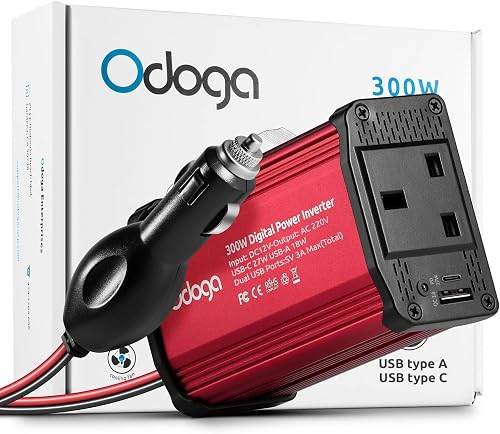


BESTEK 300W Pure Sine Wave Inverter
★ 4.4 from 995 buyers · About £60 when checked 18 November 2026The listing states pure sine wave output at 300W, plus a 30W USB-C port and a quick-charge USB port. Pure sine wave is the closest match to household mains, which suits the laptop power bricks and router adapters you are most likely to plug in during a cut. It averages 4.4 from about 995 buyer ratings and costs around £60.
- Pure sine wave stated
- USB-C and USB-A ports alongside the mains socket
- The dearest of the small inverters here
- 300W is the ceiling, and a car socket may supply less
300W Pure Sine Wave Car Inverter
★ 4.3 from 452 buyers · About £40 when checked 18 November 2026This listing states pure sine wave output at 300W for around £40, noticeably less than the branded equivalent, which makes it an affordable standby for a mains-only charger in a power cut. It averages 4.3 from about 450 buyer ratings. The title gives little other detail, so read the product page for the ports and cable type.
- Pure sine wave at a lower price
- Reasonable number of ratings
- Sparse listing title, no brand named
- Check how it connects to the car
BESTEK 200W Inverter with 4 USB Ports
★ 4.2 from 1,100 buyers · About £40 when checked 18 November 2026The listing describes three-pin sockets and four USB ports, so a household's phones and tablets can charge together from the car while the house is dark. At 200W it stays closer to what a 12V socket can realistically deliver. It averages 4.2 from about 1,100 buyer ratings at around £40.
- Four USB ports stated
- Three-pin UK sockets
- 200W rules out anything beyond a laptop and a few chargers
- Waveform not stated in the title
300W Car Power Inverter with USB-C and USB-A
★ 4.3 from 6,600 buyers · About £37 when checked 18 November 2026This 300W unit has by far the most buyer feedback in the category, averaging 4.3 from around 6,600 ratings, and sits under £40. The listing names USB-C and USB-A charging ports as well as the mains outlet, so a laptop and two phones can share the car's power in a cut. The title does not state the waveform, so assume modified sine wave unless the product page says otherwise.
- Largest number of buyer ratings
- USB-C and USB-A ports listed
- Waveform not stated in the title
- No brand named in the title, so check the seller
200W Car Inverter, 2 Sockets and 4 USB Ports
★ 4.1 from 189 buyers · About £25 when checked 18 November 2026At around £25 this is the cheapest inverter on the list, cheap enough to leave in the car for the day the power fails. The listing states two sockets, four USB ports and a cigarette lighter plug. It averages 4.1 from 189 buyer ratings, a small sample, so treat the score as a rough guide.
- Lowest price band
- Plenty of ports for the money
- Few buyer ratings so far
- Listing says 230V sockets, so check the socket type is UK three-pin
LVYUAN 1500W Power Inverter with LED Display
★ 4.0 from 740 buyers · About £42 when checked 18 November 2026The listing gives 1500W and an LED display, for around £40. A load that size cannot come through a 12V dashboard socket, so an inverter like this is normally connected straight to the battery terminals, which is a job for a longer outage and a confident owner. It averages 4.0 from about 740 buyer ratings, the lowest score here.
- Far higher stated output than socket inverters
- Display named in the listing
- Needs a direct battery connection and care with cable ratings
- Heavy loads drain a car battery quickly
- Lowest average rating on the list
How we chose
We selected these from Amazon UK listings on 18 November 2026, comparing the stated wattage, waveform and ports, the price band and the number and average of buyer ratings. None has been hands-on tested by us. Where a listing's headline wattage is more than a 12V socket can supply, we say so. Prices and availability change.
Start with what the 12V socket can supply
Most car accessory sockets are protected by a fuse of about 10 to 15 amps, which works out at very roughly 120W to 180W. Your handbook or fuse box lid gives the exact figure. A 300W inverter plugged into that socket will not deliver 300W, and a heavy load will simply blow the fuse.
That is still enough for the things that matter in a power cut. A laptop draws 45 to 65W, a router 10 to 15W and an LED lamp 5 to 10W. Our table of how many watts appliances use helps you add up your own list.
Pure sine wave or modified sine wave
Pure sine wave inverters produce a smooth output like the mains. Modified sine wave models are cheaper and produce a stepped output that most phone and laptop chargers tolerate, though some devices buzz, run warm or refuse to work.
If you want to run anything with a motor, a medical device charger or audio equipment, pay the extra for pure sine wave. For medical equipment, follow the manufacturer's and your clinician's guidance first, and read our guide to medical equipment in a power cut.
Protect the car battery and yourself
With the engine off, an inverter draws from the starter battery. A laptop for an hour is unlikely to be a problem for a healthy battery, but a whole evening may leave you unable to start. Running the engine for a while recharges it, at the cost of fuel.
Only run the engine with the car fully outdoors. Never idle a car in a garage, even with the door open. Exhaust contains carbon monoxide, which has no smell and can kill.
A portable jump starter is sensible insurance if you plan to lean on the car.
When a different product is the better buy
An inverter suits someone who already has a car on the drive and wants a low-cost way to keep a laptop alive, which is the situation in working from home during a power cut. If you live in a flat with no car nearby, or want power in the house without trailing cables, a small unit from our list of the best portable power stations is safer and quieter.
Never try to feed an inverter into your house wiring. Plug devices directly into it.
How much to spend on a car inverter for a power cut
Car inverters are cheap, and the range here runs from about £25 to £60. Under £30 buys a 200W unit with plenty of USB ports, fine for phone and tablet chargers and a lamp. Around £35 to £40 buys 300W, and at the top of that band a pure sine wave model with fewer extras. The high end, about £60, buys pure sine wave output from a named brand with USB-C built in, which is worth it if the inverter will feed a laptop, router or medical charger for hours. Paying more for a higher wattage is wasted through a 12V socket, because the socket's fuse sets the limit, not the inverter.
Common questions
Can a car inverter run a kettle?
No. A kettle draws 2,000 to 3,000W, far beyond what a 12V socket or a small inverter can supply.
Can I run a fridge from a car inverter?
Not from a socket inverter. A fridge-freezer averages 40 to 80W but needs 600W or more to start, which will blow the socket fuse.
Do I need the engine running?
Not for short, light use, but the battery will drain. Run the engine outdoors from time to time for longer sessions and never in a garage.
Will an inverter damage my laptop?
Laptop chargers usually cope with either waveform, but pure sine wave output is the safer choice for electronics.
- Be Ready campaign, UK government
- Gas Safe Register (carbon monoxide advice)
- Health and Safety Executive
Reviewed against these sources on 18 November 2026. If official advice has changed since, follow the official advice.
General information only. This page is not professional, safety, medical, legal or financial advice, and it is not official guidance. No national blackout has been forecast or announced, and nothing here suggests one is expected. We are independent and have no connection to the government or any energy company. Products are chosen from retailer listings and buyer ratings and have not been tested by us; some links earn us a commission. Anything involving electricity, gas, fuel or food safety should be checked with a qualified professional or the relevant official body before you act on it. Always check the official sources linked on this page. Full disclaimer
Keep reading
 Guide
Using your car as backup power
How to use a car to charge phones and run small devices in a power cut, what an inverter can handle, and how to avoid a flat battery or fumes.
Read: Using your car as backup power Question
Are power stations safe to use indoors in a power cut?
Battery power stations are safe to use indoors because they burn no fuel and give off no fumes. The sensible rules for charging, placing and storing one.
Read: Are power stations safe to use indoors in a Guide
Backup power for your home: every option compared
Power banks, power stations, generators, solar panels, cars and UPS units compared: what each can run in a UK power cut, for how long, and who needs which.
Read: Backup power for your home: every option Guide
Which batteries to keep at home, and how to store them
Which battery sizes and types to keep at home for power cuts, how many spares you need, and how to store alkaline, rechargeable and lithium cells safely.
Read: Which batteries to keep at home, and how to