On this page
Keep spare batteries for every torch, radio and alarm you would rely on in a power cut, which for most homes means AA and AAA plus anything unusual such as 9V, C or D cells. Store them in their packaging somewhere cool and dry, and check them every six months.
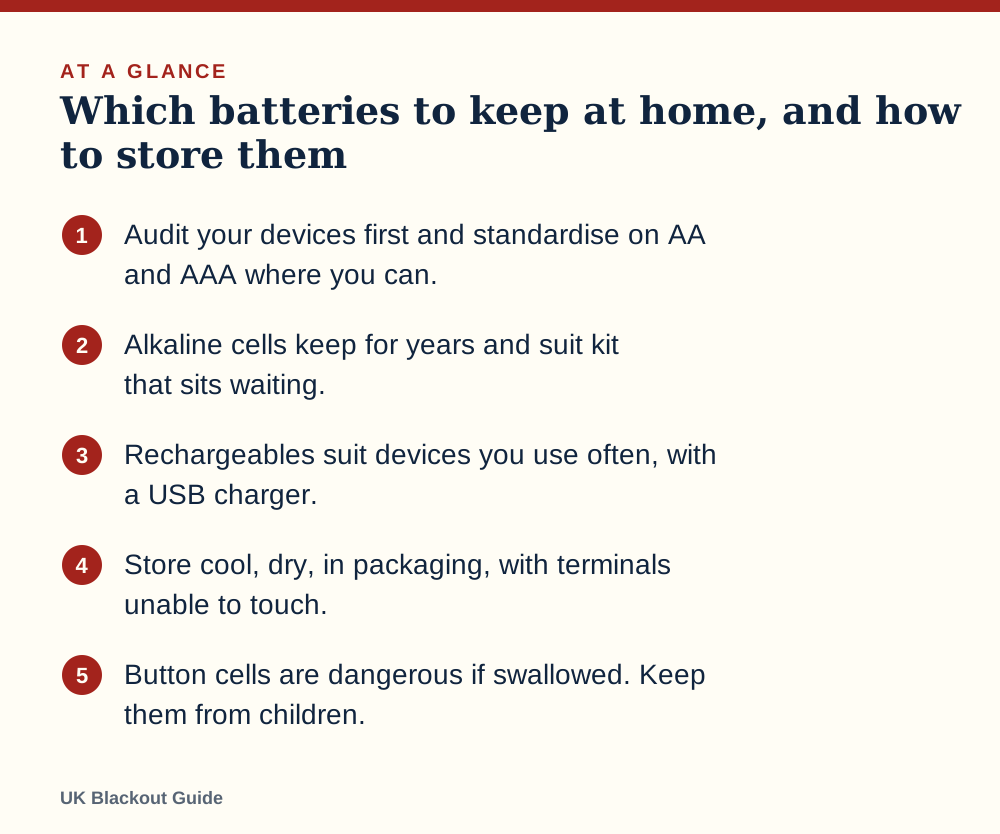
- Audit your devices first and standardise on AA and AAA where you can.
- Alkaline cells keep for years and suit kit that sits waiting.
- Rechargeables suit devices you use often, with a USB charger.
- Store cool, dry, in packaging, with terminals unable to touch.
- Button cells are dangerous if swallowed. Keep them from children.
Start with an audit of what you own
The official Be Ready kit list asks for a battery or wind-up torch with spare batteries and a battery or wind-up FM radio. So the right batteries to stock are whichever ones those devices take. Buying a bulk pack of AAs is no help if your best lantern needs three D cells.
Walk round the house and open the battery compartment of everything you would use in a cut: torches, head torches, lanterns, the radio, smoke and carbon monoxide alarms, thermometers, a doorbell, clocks, children's night lights. Write down the size and how many each takes. Most households find three or four sizes cover everything.
If the list is long, simplify it. When you next replace a torch or lantern, choose one that takes AA or AAA so that one stock of spares serves the whole house. Our lists of torches for power cuts note the battery type for each pick.
The sizes you are likely to need
| Size | Commonly found in |
|---|---|
| AA | Torches, radios, lanterns, clocks, toys |
| AAA | Head torches, small torches, remote controls, thermometers |
| C and D | Larger lanterns, big torches, some older radios |
| 9V (PP3) | Many smoke and carbon monoxide alarms |
| Button and coin cells | Key fobs, scales, small thermometers, some alarms |
Check alarms carefully. Some have a sealed battery designed to last the life of the unit and cannot be changed, while others need a fresh cell when they start to chirp. See whether smoke alarms work in a power cut for the different kinds.
Alkaline, lithium or rechargeable
Alkaline batteries are the standard disposable kind. They are inexpensive, sold everywhere and hold their charge for years on the shelf, which makes them a good fit for emergency kit that sits unused. Their weakness is leaking when left in a device for a long time, especially once flat.
Lithium disposables (sold in AA and AAA sizes, not to be confused with rechargeable lithium-ion) cost more but are lighter, cope better with cold and keep even longer in storage. They are worth considering for a torch kept in the car or an unheated shed.
Rechargeable NiMH batteries can be reused hundreds of times and suit anything you use regularly. Look for low self-discharge types, often labelled as pre-charged or ready to use, because ordinary rechargeables go flat in storage. They run at a slightly lower voltage than alkalines, which a few devices dislike.
Rechargeables raise an obvious question in a power cut: how to recharge them. A charger that runs from USB can be powered by a power bank, a power station or a car. Our list of rechargeable batteries and chargers focuses on USB-powered sets.
How many spares to hold
A workable rule is two full sets of spares for every device you would depend on, beyond the set already inside it. For a lantern taking three AAs, that is six spare AAs. Add them up across your audit and round up to the nearest pack.
Runtimes vary enormously between devices and brightness settings, so check the figures in each manual. Modern LED lights are frugal, and a lantern on a low setting can run for many evenings on one set, as we explain in how long LED lanterns last. A radio used for news bulletins a few times a day uses very little.
A mixed approach works well: rechargeables in the things you use weekly, and a reserve of alkalines still in their packaging for the emergency box. Our batteries worth stocking for emergencies list is organised by size.
Storing batteries so they last
- Cool and dry. A cupboard indoors at room temperature is ideal. Avoid lofts, sunny windowsills and damp garages. There is no need to keep them in the fridge.
- In the original packaging. This stops the terminals touching each other or metal objects. Loose batteries in a drawer with keys or coins can short-circuit and heat up. 9V batteries are the most prone to this because both terminals are on one end.
- Do not mix. Never mix old and new batteries, or different types, in one device. The stronger cells force the weaker ones and leaks follow.
- Take batteries out of stored devices. If a torch lives in the emergency box for months, store its batteries beside it, not in it, or check it regularly.
- Date them. Write the purchase month on the pack and use the oldest first.
If a battery has leaked, wear gloves, remove it, and clean the contacts with a cotton bud. Leaked material is an irritant, so keep it off your skin and away from your eyes.
Safety with button cells and lithium-ion
Button and coin batteries can cause severe internal burns if swallowed. Keep spares locked away from children, check battery compartments are secure, and if you think a child has swallowed one, go to A&E or call 999 at once.
Rechargeable lithium-ion batteries, the kind inside power banks, phones and some torches, need different care. Charge them on a hard surface, not on a bed or sofa, use the correct charger, and stop using any that are swollen, damaged or hot. Power banks also lose charge slowly in storage: see how long a power bank keeps its charge. More on reducing fire risk is in our guide to fire safety during a power cut.
Never put batteries of any kind in the household bin, where they can cause fires in bin lorries. Shops that sell batteries in quantity have collection points, and council recycling centres take them.
Make checking them a habit
Be Ready advises checking your kit every six months. For batteries, that means looking at dates, testing each torch and the radio for a few seconds, topping up rechargeables and power banks, and pressing the test button on every alarm. Our guide to the six-monthly emergency kit check gives a routine that takes about twenty minutes.
A wind-up or solar radio reduces how many batteries you need to think about. Our guide to emergency radios compares the power options.
Checklist
Which batteries to keep at home, and how to store them
- List every torch, lantern, radio and alarm with its battery size
- Hold two spare sets for each device you depend on
- Keep spares in original packaging, cool and dry
- Own a USB-powered charger if you use rechargeables
- Lock button cells away from children
- Write the purchase date on each pack
- Test devices and alarms every six months
- Recycle dead batteries at a collection point
Common questions
Do batteries last longer in the fridge?
There is no need with modern alkaline batteries, and condensation can do harm. A cool, dry cupboard is best.
Can I use rechargeable batteries in a smoke alarm?
Follow the alarm maker's instructions. Most specify a particular disposable type, and rechargeables can give misleading low-battery behaviour.
Are cheap own-brand batteries good enough?
For low-drain devices such as radios and LED torches, own-brand alkalines from a reputable shop are usually fine. Avoid unbranded cells from unknown sellers.
How do I know if a stored battery is still good?
Check the best-before date, look for any leakage or swelling, and test it in the device. An inexpensive battery tester gives a quick reading.
Reviewed against these sources on 18 November 2026. If official advice has changed since, follow the official advice.
General information only. This page is not professional, safety, medical, legal or financial advice, and it is not official guidance. No national blackout has been forecast or announced, and nothing here suggests one is expected. We are independent and have no connection to the government or any energy company. Anything involving electricity, gas, fuel or food safety should be checked with a qualified professional or the relevant official body before you act on it. Always check the official sources linked on this page. Full disclaimer
Keep reading
 Buying guide
Best rechargeable batteries for emergency torches and radios
Rechargeable batteries for emergency torches and radios: AA sets from Amazon UK with USB chargers you can run from a power bank or car in a power cut.
Read: Best rechargeable batteries for emergency Question
Are power stations safe to use indoors in a power cut?
Battery power stations are safe to use indoors because they burn no fuel and give off no fumes. The sensible rules for charging, placing and storing one.
Read: Are power stations safe to use indoors in a Buying guide
Best car inverters for power cuts
Car inverters for power cuts: six units from Amazon UK listings that run a laptop, router or lamp from your car's 12V socket, with the limits explained.
Read: Best car inverters for power cuts Buying guide
Best generators for power cuts
Petrol inverter generators for UK power cuts, from 1,200 W to 5,500 W, chosen from Amazon UK listings, with the carbon monoxide and wiring rules.
Read: Best generators for power cuts