On this page
The right emergency radio for a UK household receives FM, runs on power you can replace or generate yourself, and is simple enough to use in the dark. A basic FM and DAB portable on AA batteries, or a wind-up set with USB charging, does the job. Extra features matter far less than fresh batteries and a tested station.
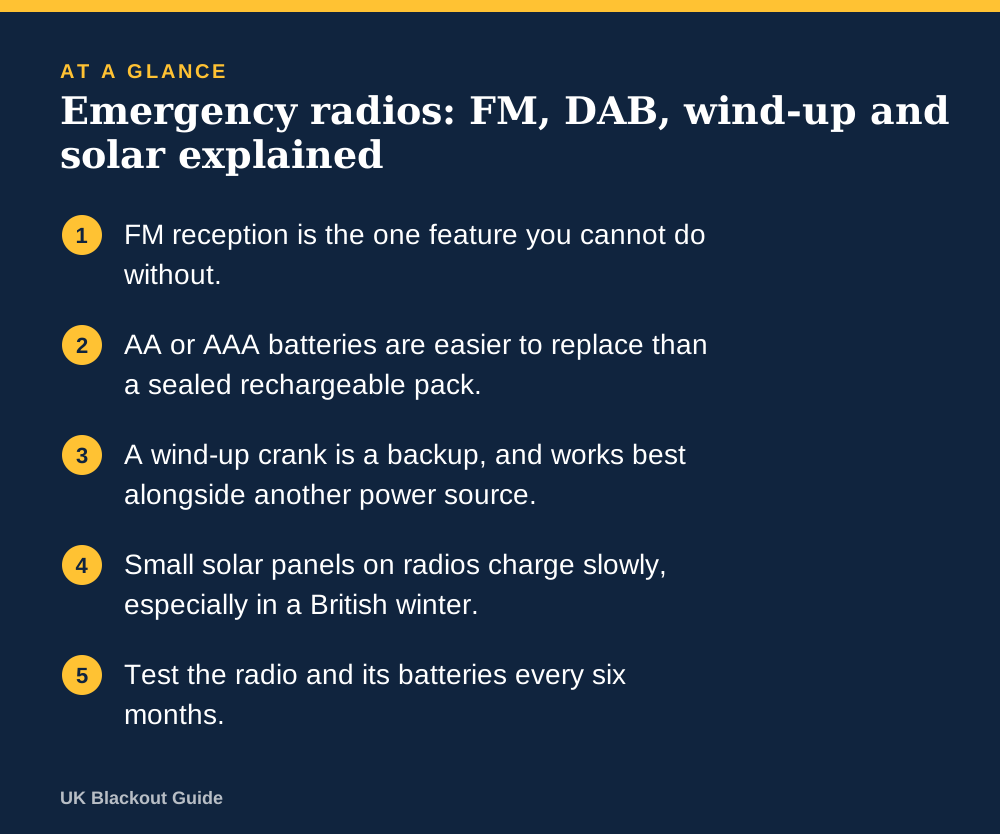
- FM reception is the one feature you cannot do without.
- AA or AAA batteries are easier to replace than a sealed rechargeable pack.
- A wind-up crank is a backup, and works best alongside another power source.
- Small solar panels on radios charge slowly, especially in a British winter.
- Test the radio and its batteries every six months.
Start with the bands it can receive
FM is the priority. The official Be Ready kit list asks for a battery or wind-up FM radio, and the BBC's published emergency plan is built around FM transmitters with generator backup. Any radio you buy for a power cut should have it.
DAB is worth having as well, though whether DAB works in a power cut depends on transmitters outside your control. It gives you more stations and tunes by name, which is easier for anyone who dislikes fiddling with a dial. The official advice during a cut is to try both FM and digital, so a set with both gives you two chances.
Some radios add medium wave, long wave or short wave. These can be interesting, but they should not decide your purchase. Do not buy a radio that has DAB and no FM.
How it is powered matters more than how it sounds
There are four ways an emergency radio gets its power, and the better sets combine two or three of them.
- Replaceable batteries (AA, AAA, C or D). The most dependable option. When they run out you fit new ones in seconds, and a small portable can run for many hours on one set.
- Built-in rechargeable battery. Convenient if you remember to top it up. It can be recharged from a power bank during a cut.
- Hand crank. Makes power from nothing but effort. You get minutes of listening per minute of winding, so it suits bulletins more than background listening.
- Solar panel. A trickle. Helpful on a sunny windowsill over a day, slow on a dull December afternoon.
If you want one simple answer, buy a radio that takes ordinary batteries and keep a spare set of batteries taped to it.
When a wind-up radio is the better choice
A wind-up radio makes sense if you know you are unlikely to rotate spare batteries, if it will live in a car or grab bag for years, or as a second radio for a relative. It will always produce some sound, whatever state the cupboard is in.
The weak point, and the reason people ask whether wind-up radios really work, is the internal battery, which ages even when unused. Charge it by USB every few months so the crank is topping up a healthy cell instead of reviving a flat one.
Many wind-up radios include a USB output for charging a phone. Treat it as a last resort. The battery inside is small, and cranking a modern phone back to life takes a very long time. A proper power bank is the tool for that job.
Features that help and features you can ignore
Worth paying a little more for:
- A headphone socket, which saves battery and lets one person listen at night.
- A backlit display or clear dial markings.
- Station presets, so anyone in the house can find the news with one button.
- A carry handle or strap and a casing that will survive being dropped.
Usually not worth the money: sirens, flashing beacons, reading lamps that drain the battery, and very large claimed charging capacities. A torch built into a radio is fine as a spare, but it means the two things you need most share one battery. Keep a separate torch.
Size is a real trade-off. A pocket radio is easy to store but has a small speaker and short aerial. A slightly larger set is easier to hear across a room and often pulls in a weak signal better.
One radio or two
One working radio per household is enough to meet the official advice. A second earns its place if people in the home may be in different places, for example an upstairs bedroom for someone unwell, or if you want one that stays in the kit and one in daily use.
There is a lot to be said for using your emergency radio in ordinary life. A battery radio that lives on the kitchen windowsill gets its batteries changed and its stations known.
Keeping it ready
Tune it now. Find your stations, save them as presets, and keep a note of the radio frequencies worth writing down in case the presets are lost when batteries are changed.
Store alkaline batteries next to the radio instead of inside it if it will sit unused for a long time, because old cells can leak and ruin the contacts, one of the storage points in which batteries to keep at home.
Then add it to your routine check. Be Ready suggests looking over your kit every six months, and our six-monthly kit check gives you a list to work through.
Show everyone in the house how to switch the radio on and find the news. A child who knows which button to press is a real help.
The radio is one line on the full emergency kit list, and one of the cheapest to tick off.
Common questions
Do I need a special emergency radio?
No. Any portable radio that receives FM and runs on batteries meets the official advice. Sets sold as emergency radios mainly add a crank and a solar panel.
How long do batteries last in a portable radio?
It varies widely by model and volume, from several hours to several days of bulletins. Check the maker's figure and keep at least one spare set.
Can I use rechargeable AA batteries in a radio?
Usually yes. They hold slightly lower voltage, so a battery indicator may read low early. Keep some alkalines as well for long storage.
Is a radio app on my phone enough?
Not on its own. Radio apps need mobile data or wifi, which may not be there in a long or wide outage.
Reviewed against these sources on 18 November 2026. If official advice has changed since, follow the official advice.
General information only. This page is not professional, safety, medical, legal or financial advice, and it is not official guidance. No national blackout has been forecast or announced, and nothing here suggests one is expected. We are independent and have no connection to the government or any energy company. Always check the official sources linked on this page. Full disclaimer
Keep reading
 Guide
How to get news in a blackout
How to get reliable news in a UK blackout when the internet and mobile networks struggle: battery radio first, then your phone, your car and your street.
Read: How to get news in a blackout Guide
Radio stations and frequencies to write down now
FM frequencies vary by area, so find yours now. A ten-minute method for finding, testing and writing down the radio stations to use in a UK power cut.
Read: Radio stations and frequencies to write down Buying guide
Best battery radios for power cuts and blackouts
Battery radios for power cuts and blackouts, chosen from Amazon UK listings on AA battery power, FM and DAB bands, simple controls and buyer ratings.
Read: Best battery radios for power cuts and Buying guide
Best emergency radios for a blackout (wind-up and solar)
Wind-up and solar emergency radios for a UK blackout, picked from Amazon UK listings on FM reception, charging without mains, battery size and ratings.
Read: Best emergency radios for a blackout