On this page
Yes, wind-up radios work, and a battery or wind-up FM radio is on the official Be Ready kit list. Winding the crank charges a small internal battery, giving a few minutes of listening for each minute of effort. That suits news bulletins well. For longer listening, charge the radio by USB beforehand and treat the crank as the backup.
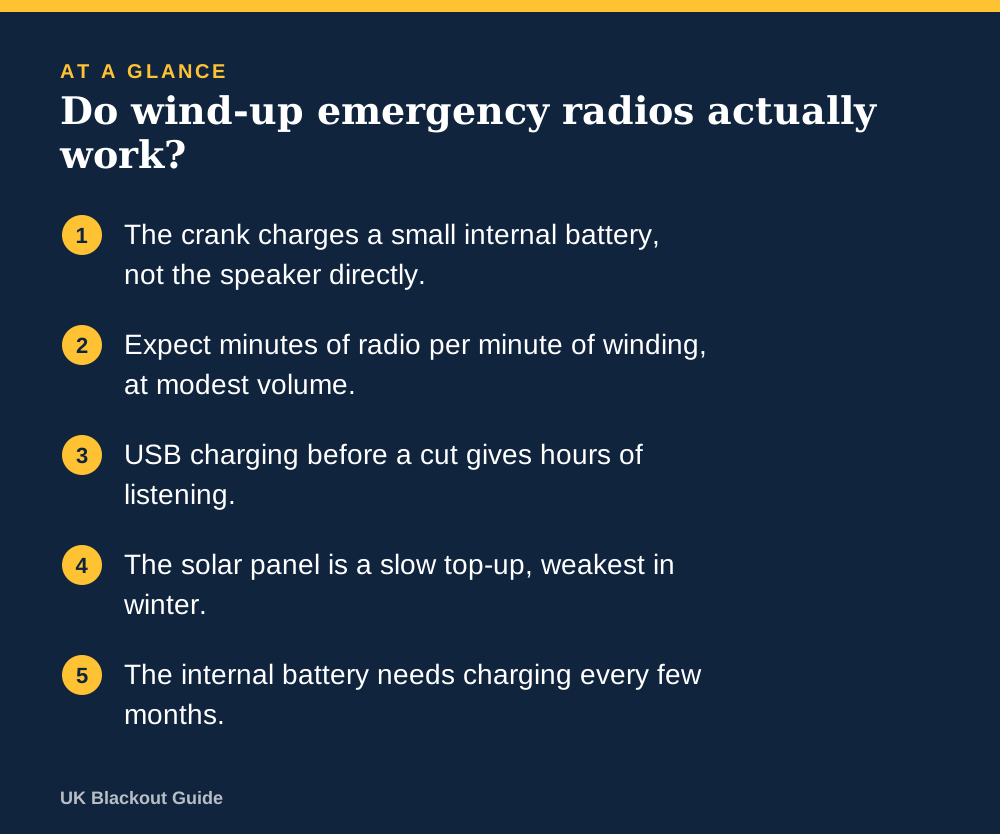
- The crank charges a small internal battery, not the speaker directly.
- Expect minutes of radio per minute of winding, at modest volume.
- USB charging before a cut gives hours of listening.
- The solar panel is a slow top-up, weakest in winter.
- The internal battery needs charging every few months.
What happens when you turn the handle
Inside a wind-up radio is a small generator connected to a rechargeable battery. Turning the crank puts a little charge into that battery, and the radio runs from it. You are not powering the speaker directly, so the sound does not stop the moment you stop winding.
The amount of energy involved is small. A minute of steady cranking typically buys a few minutes of listening at low to moderate volume, and makers' claims vary, so read the figure for the model you are considering. That is plenty for the news on the hour. It is hard work if you want the radio on all evening.
FM uses the least power. Volume, a built-in torch and DAB (on models that have it) all shorten the time you get.
The other ways of powering one
Nearly all current models can also be charged by USB, and that is how they are best used. A full charge from the mains before a storm, or from a power bank during a cut, gives hours of listening without touching the handle.
Most have a small solar panel on top. On a bright windowsill over a full day it adds useful charge. On a dull winter day the gain is slight, for the same reasons covered in whether solar power banks work. Some models also accept AAA or AA batteries, which gives you a third option and is well worth having.
Where they fall short
The usual disappointment comes from a radio left in a drawer for three years. The internal battery slowly discharges and ages, and a deeply flat cell takes a lot of cranking before it holds anything. Charge the radio fully every few months, and add it to your six-monthly kit check.
Cheap cranks can be flimsy. Wind at a steady pace and do not force the handle. Small speakers and short aerials are the other compromises, so test reception in the room you would use and move towards a window if the signal is weak.
Phone charging from the USB output is best treated as a last resort. The radio's battery is far smaller than a phone's, and winding enough for a meaningful top-up takes a long time.
Wind-up or ordinary batteries
A wind-up radio is the right choice for a kit that will sit untouched, a car, or a relative who will not rotate spare batteries. A simple portable on AA cells is easier for daily use and for long listening. Plenty of households keep one of each, since neither costs much.
Whichever you pick, tune it to your stations now. Our emergency radio guide compares the two types in more detail.
Common questions
How long do I need to wind for?
A minute or two of steady winding is usually enough for a short news bulletin. Check the maker's figure for your model.
Can a wind-up radio be overwound?
The crank will not overcharge the battery, but forcing or spinning it very fast can damage the gears. Keep a steady pace.
Do wind-up radios get DAB?
Some do. DAB uses more power than FM, so you will get less listening per minute of winding.
Reviewed against these sources on 18 November 2026. If official advice has changed since, follow the official advice.
General information only. This page is not professional, safety, medical, legal or financial advice, and it is not official guidance. No national blackout has been forecast or announced, and nothing here suggests one is expected. We are independent and have no connection to the government or any energy company. Always check the official sources linked on this page. Full disclaimer
Keep reading
 Buying guide
Best emergency radios for a blackout (wind-up and solar)
Wind-up and solar emergency radios for a UK blackout, picked from Amazon UK listings on FM reception, charging without mains, battery size and ratings.
Read: Best emergency radios for a blackout Guide
Emergency radios: FM, DAB, wind-up and solar explained
What to look for in an emergency radio for UK power cuts: FM and DAB, battery, wind-up and solar power, useful features, and how to keep it ready to use.
Read: Emergency radios: FM, DAB, wind-up and solar Guide
How to get news in a blackout
How to get reliable news in a UK blackout when the internet and mobile networks struggle: battery radio first, then your phone, your car and your street.
Read: How to get news in a blackout Guide
Radio stations and frequencies to write down now
FM frequencies vary by area, so find yours now. A ten-minute method for finding, testing and writing down the radio stations to use in a UK power cut.
Read: Radio stations and frequencies to write down