On this page
A battery or wind-up radio is the most dependable way to get news in a blackout, because broadcast radio does not rely on your broadband, your mains supply or the mobile network near you. Use your phone as a second source while signal lasts, and call 105 for local fault updates. Set the radio up now, not in the dark.
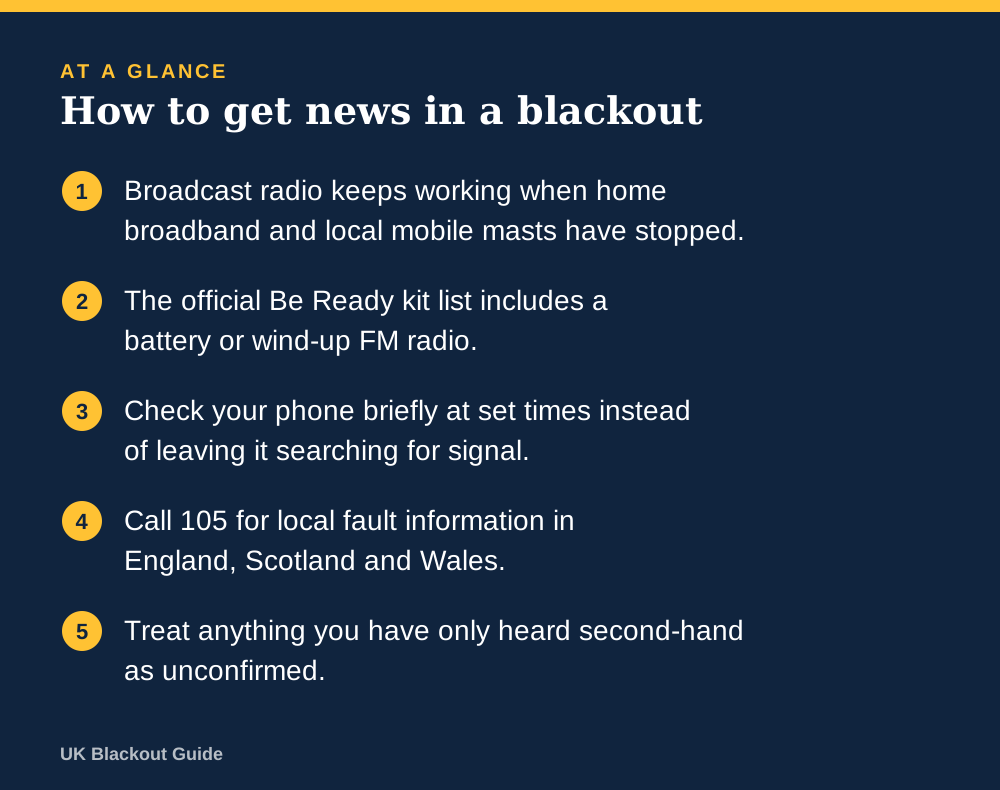
- Broadcast radio keeps working when home broadband and local mobile masts have stopped.
- The official Be Ready kit list includes a battery or wind-up FM radio.
- Check your phone briefly at set times instead of leaving it searching for signal.
- Call 105 for local fault information in England, Scotland and Wales.
- Treat anything you have only heard second-hand as unconfirmed.
Radio keeps going when other sources stop
Most of the ways you normally get news depend on mains electricity somewhere close to you. Your television needs it. Your broadband router needs it. The mobile mast that serves your street needs it too, and official advice is only that mobile networks may work temporarily in some areas on backup power.
Broadcast radio is different. One transmitter on a hill can cover a very large area, and the only power you have to supply is a couple of batteries at your end. That is why the government's Be Ready kit list includes a battery or wind-up FM radio, and why its power cut advice says to try both FM and digital.
The BBC has also described, in its emergency broadcasting plan, how it would keep broadcasting on FM from an emergency studio, using generator-backed transmitters with supplies for at least three days.
What each news source needs in order to work
| Source | What it depends on | In a long, wide cut |
|---|---|---|
| Battery or wind-up radio | Your batteries and a powered transmitter | The most likely to keep working |
| Car radio | Your car's 12 V battery | Works, with care over the battery |
| Mobile data | Phone charge and a powered mast | May work for a while, then fade |
| Home wifi | Router power and the provider's network | Off unless you have backup power |
| Television | Mains power | Off |
| Neighbours | Nothing | Always there, not always accurate |
In a short local fault most of this never matters. Your phone will probably keep its signal and your network operator's website will tell you what has happened. The table matters when a cut is wide enough or long enough that the backup batteries in the networks start to run down.
Set the radio up before you need it
A radio still sealed in its box is not much use at 9pm in the dark. Put batteries in it this week, find your BBC local station and a national BBC station on FM, and write the numbers on a label stuck to the back, using our list of radio frequencies to write down.
If you are unsure which station to listen to in an emergency, start with local radio, which earns its place because it carries the detail national news leaves out: which areas are off, where help is being offered, which roads are shut. In the Lancaster power cut of December 2015, when a flooded substation cut power to about 61,000 properties, a local station kept broadcasting on a generator while mobile and internet services failed.
There are two sensible kinds of radio to own, and plenty of households keep one of each.
A battery set is the simplest to use. A wind-up radio covers you if the spare batteries have run out or were never bought.
Use your phone in short, planned bursts
While there is signal, your phone is still the quickest way to see your network operator's fault map and messages from family. The risk is that you drain it by refreshing news feeds for an hour.
Pick set times, for example on the hour, to switch off flight mode, check one or two trusted sources, send your messages and switch back. A phone that spends the gaps in flight mode lasts far longer than one left hunting for a weak mast, which is the basis of making a phone battery last through an outage.
Text-based pages load on a weak signal where video will not. A text message will often get through when a call or an app does not, so keep messages short and plain.
Where local fault information comes from
For the cut itself, the people who know most are your network operator, the company that owns the cables in your area, and reporting a power cut is how you reach them. Call 105 free from England, Scotland or Wales, or 03457 643643 in Northern Ireland. You will usually hear a recorded update for your postcode before you speak to anyone.
If the house is silent and you need a second radio, a car radio works in a blackout too. It runs from the car's own battery, so a few minutes at the top of the hour is a reasonable habit, short enough not to flatten it. Never run the engine inside a garage.
Sorting facts from rumour
Rumours spread fast when official news is slow. Treat anything that reaches you third-hand as unconfirmed until you hear it from a broadcaster, your network operator or the emergency services.
Be wary of anyone who phones or knocks claiming to be from your electricity company and asking for payment or bank details to reconnect you, one of the common scams that appear during power cuts. Network operators do not charge to restore a fault.
Once you know something reliable, pass it on, particularly to older neighbours who may have no working radio or phone. A two-minute conversation over the fence is often the only news some people on your street will get.
Checklist
How to get news in a blackout
- Radio with batteries fitted and tested
- Local and national FM frequencies written on the radio
- Spare batteries stored next to the radio
- 105 written on your contact list
- Power bank charged
- Agreed times to check phones
Common questions
Will the BBC still broadcast in a national blackout?
The BBC has described plans to keep broadcasting on FM radio from an emergency studio, using generator-backed transmitters with supplies for at least three days.
Is a phone app as good as a radio?
Only while your phone has charge and a working mast or wifi. Radio apps use mobile data, so they stop when the network does. A real radio does not.
Should I leave the radio on all the time?
No. Listen to the news bulletins, usually on the hour, then switch off to save batteries.
Does my supplier's app show power cuts?
Your supplier sells you energy but does not fix faults. Fault maps come from your network operator, which you can find through powercut105.com.
Reviewed against these sources on 18 November 2026. If official advice has changed since, follow the official advice.
General information only. This page is not professional, safety, medical, legal or financial advice, and it is not official guidance. No national blackout has been forecast or announced, and nothing here suggests one is expected. We are independent and have no connection to the government or any energy company. Always check the official sources linked on this page. Full disclaimer
Keep reading
 Guide
Emergency radios: FM, DAB, wind-up and solar explained
What to look for in an emergency radio for UK power cuts: FM and DAB, battery, wind-up and solar power, useful features, and how to keep it ready to use.
Read: Emergency radios: FM, DAB, wind-up and solar Guide
Radio stations and frequencies to write down now
FM frequencies vary by area, so find yours now. A ten-minute method for finding, testing and writing down the radio stations to use in a UK power cut.
Read: Radio stations and frequencies to write down Buying guide
Best battery radios for power cuts and blackouts
Battery radios for power cuts and blackouts, chosen from Amazon UK listings on AA battery power, FM and DAB bands, simple controls and buyer ratings.
Read: Best battery radios for power cuts and Buying guide
Best emergency radios for a blackout (wind-up and solar)
Wind-up and solar emergency radios for a UK blackout, picked from Amazon UK listings on FM reception, charging without mains, battery size and ratings.
Read: Best emergency radios for a blackout