On this page
Scams linked to power cuts tend to take three forms: fake messages about compensation or refunds, bogus callers at the door posing as engineers, and pressure selling of overpriced or useless kit. Your network operator will never ask for bank details to restore power or pay compensation by text link. If in doubt, hang up or close the door and call 105 yourself.
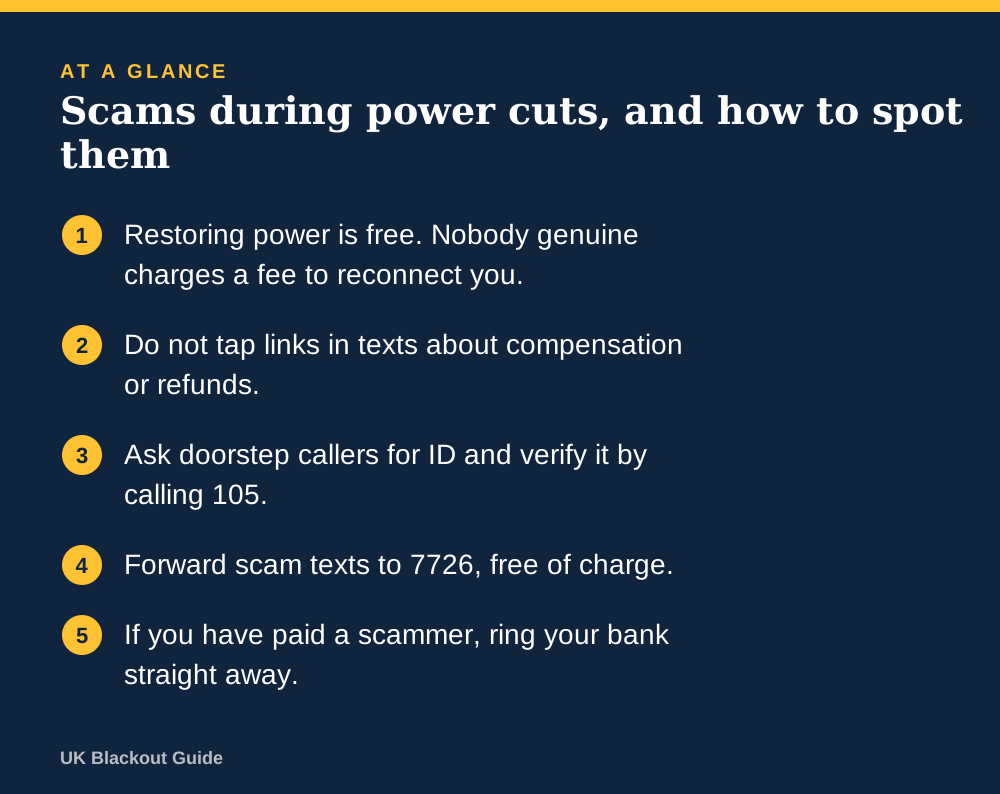
- Restoring power is free. Nobody genuine charges a fee to reconnect you.
- Do not tap links in texts about compensation or refunds.
- Ask doorstep callers for ID and verify it by calling 105.
- Forward scam texts to 7726, free of charge.
- If you have paid a scammer, ring your bank straight away.
Why power cuts attract fraudsters
A scam works best when the victim is worried, in a hurry and unable to check. A power cut delivers all three. You are waiting for news, your broadband may be off, and a message that seems to come from the electricity company feels expected.
News coverage can be used the same way. Coverage of blackouts rose after the government's Be Ready campaign launched on 22 October 2026. Be Ready is general preparedness advice, not a forecast, and no national blackout is planned or predicted, so a message claiming otherwise deserves suspicion. We have not seen official figures on how common these scams are. The patterns below are standard fraud methods applied to a power cut. If the headlines have left you uneasy, the plain answer to whether the UK is going to have a blackout is a calmer place to start than any text message.
Fake compensation and refund messages
A typical approach is a text, email or call saying you are owed money for a recent power cut, trading on the fact that you can get compensation for a power cut in some cases, with a link to "claim" it. The link leads to a copy of a real company's website that asks for your card or bank login.
Compensation for long power cuts does exist, under Ofgem's Guaranteed Standards, and it comes from your network operator. But the genuine process does not start with an unexpected link asking for card details.
If a message might be real, do not use the link or number in it. Go to powercut105.com, find your operator, and contact them through the details shown there.
Bogus engineers and doorstep callers
Faults are fixed on the network: in substations, cables and overhead lines. Engineers seldom need to enter a home, and when they do they carry identification and will wait while you check it.
Be cautious of anyone who says they must come in immediately to "check your meter" or "test your fuse box" because of the cut, or who asks for payment to reconnect you. Reconnection after a network fault is never charged at the door.
Keep the chain on. Ask for the ID card, shut the door, and call 105 (free in England, Scotland and Wales) or 03457 643643 in Northern Ireland to confirm. If you are on the Priority Services Register, some companies let you set a password that genuine callers must give. This matters most for older relatives living alone, and it helps to rehearse the routine with them.
Phone calls that ask you to move money or install something
A caller may claim to be from your energy supplier, your bank or "the grid", and say your account will be cut off, or your payment failed because of the outage. They then ask you to pay by card over the phone, move money to a "safe account", or install an app so they can "fix" your smart meter.
None of this is real. Your supplier does not control faults, your smart meter is not repaired by remote-access software, and no bank asks you to move money to keep it safe. Put the phone down, wait a few minutes, and ring the company on the number printed on your bill or bank card.
Knowing who to call in a power cut helps here, because it separates the supplier from the network operator.
Overpriced products and inflated claims
Not every bad deal is fraud. Be sceptical of adverts for "government approved" emergency kits, miracle generators that need no fuel, and power banks with capacities that are not physically plausible for their size, all regulars on any list of what not to buy for power cuts.
There is no government-approved kit, whatever the listing for a ready-made emergency kit may claim. Be Ready publishes a list of items, most of which you already own or can buy cheaply from ordinary shops, and you can build your kit at your own pace.
When you do buy power cut essentials, stick to established UK retailers, pay by card for the protection it gives, and be sceptical of countdown timers and "only 3 left" banners.
How to check, and how to report
One habit defeats nearly all of these: never act on contact details supplied by the person contacting you. Find the number yourself, from a bill, a bank card or powercut105.com.
- Scam texts: forward them free to 7726, which reports them to your mobile network.
- Suspicious emails: forward to report@phishing.gov.uk, run by the National Cyber Security Centre.
- If you have lost money or given details: ring your bank immediately using the number on your card, then report it to Action Fraud (England, Wales and Northern Ireland) or to Police Scotland on 101.
- If someone is at your door and you feel unsafe: call 999.
Good account security limits the damage if a scammer does get a password, which is the point of cyber security basics for households.
Common questions
Will my electricity company text me during a power cut?
Network operators do send genuine updates, especially if you reported the fault or are on the Priority Services Register. Genuine updates give information. They do not ask for bank details or payment.
Is it a scam if someone offers to register me for the Priority Services Register for a fee?
Yes. The register is free. You can join through your supplier, your network operator or thepsr.co.uk.
Do I need to pay to find out my load block letter?
No. It is free at powercut105.com and is printed on some bills.
Someone called about my smart meter after a power cut. Is that genuine?
Treat it as suspect. Hang up and ring your supplier on the number printed on your bill.
- National Cyber Security Centre
- Ofgem
- Power Cut 105
- The Priority Services Register
- Be Ready campaign, UK government
Reviewed against these sources on 18 November 2026. If official advice has changed since, follow the official advice.
General information only. This page is not professional, safety, medical, legal or financial advice, and it is not official guidance. No national blackout has been forecast or announced, and nothing here suggests one is expected. We are independent and have no connection to the government or any energy company. Always check the official sources linked on this page. Full disclaimer
Keep reading
 Buying guide
Best cash boxes for emergency cash at home
Lockable cash boxes for keeping emergency notes and coins ready at home for when card payments fail in a power cut. Eight Amazon UK listings compared.
Read: Best cash boxes for emergency cash at home Buying guide
Best fireproof document bags for emergency paperwork
Fire-resistant document bags for emergency paperwork: keep passports, policies, contacts and cash ready to grab. Seven Amazon UK listings compared.
Read: Best fireproof document bags for emergency Buying guide
Best multi-tools for home emergencies
Multi-tools for home emergencies: pliers, screwdrivers and a tin opener for the small jobs a power cut throws up. Seven Amazon UK listings compared.
Read: Best multi-tools for home emergencies Question
Do smart locks work in a power cut?
Most smart locks run on batteries and still lock and unlock in a power cut, but remote app control stops. What keeps working and how to avoid a lockout.
Read: Do smart locks work in a power cut?