On this page
Yes, in most cases. The majority of home smart locks run on their own batteries, so the keypad, fob, fingerprint reader or Bluetooth unlock keeps working when the mains is off. What you lose is remote control through the app, because that depends on your Wi-Fi router. Always keep a physical key or other backup.
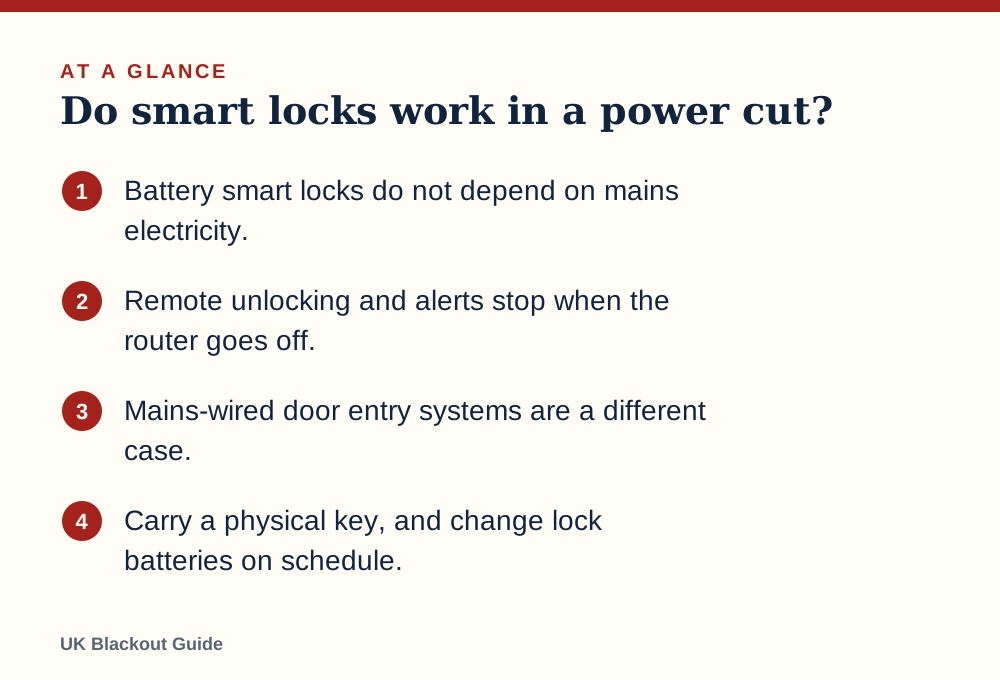
- Battery smart locks do not depend on mains electricity.
- Remote unlocking and alerts stop when the router goes off.
- Mains-wired door entry systems are a different case.
- Carry a physical key, and change lock batteries on schedule.
Why most smart locks carry on
A typical smart lock fitted to a house door is powered by AA batteries or a rechargeable pack inside the unit. It has no connection to the mains, so a power cut makes no difference to the motor that turns the bolt.
Anything that talks directly to the lock keeps working too. That includes a keypad code, a fingerprint, a key fob or card, and Bluetooth unlocking from a phone held near the door. Check your own model's manual, as designs differ.
What stops working
Features that travel over the internet stop when your router loses power, unless you have a way of keeping Wi-Fi on in a power cut. You cannot unlock the door remotely for a visitor, you get no notifications, and auto-unlock features that rely on Wi-Fi or a plug-in bridge may not trigger.
Some locks use a small bridge or hub plugged into a socket near the door. That goes off with the mains. A mini UPS on the router and bridge brings remote features back for a few hours.
Your phone matters as well. If it is your only way in and its battery is flat, you are locked out, power cut or not.
Mains-powered door entry is different
Blocks of flats and some houses use mains-powered systems: magnetic locks, electric strikes or communal intercoms. These are designed to behave in a set way when power fails. Some release so that people can get out, and others stay locked and rely on a key or a backup battery, which matters for home security in a blackout.
If you live in a block, coping with a power cut in a flat starts with asking the managing agent how the main door behaves and whether fobs still work. It is worth knowing before a dark evening.
How to avoid being locked out
The real risk with a battery lock is the lock's own batteries running down, which has nothing to do with the grid. Most locks warn you for weeks through the app or with a beep. Do not ignore it.
- Keep a physical key with you, and a spare with a neighbour or relative you trust.
- Replace lock batteries on a fixed date each year, and keep a spare set indoors with the other batteries worth stocking for emergencies.
- Learn your lock's emergency power method. Many have contacts or a USB port on the outside for a temporary boost.
- Set a keypad code for each adult so nobody depends on a phone alone.
Locks are one part of a connected house, and what happens to a smart home in a power cut differs for heating, cameras, bulbs and hubs.
Common questions
Will a smart lock unlock itself when the power goes off?
A battery-powered smart lock stays in whatever state it was in. It does not release because the mains has failed.
Can I get out if my smart lock fails?
Locks fitted to house doors have a manual thumb turn or handle on the inside, so you can always open the door from indoors. Check that yours does.
How long do smart lock batteries last?
It varies by model and use. Follow the maker's guidance and act on the first low-battery warning.
Reviewed against these sources on 18 November 2026. If official advice has changed since, follow the official advice.
General information only. This page is not professional, safety, medical, legal or financial advice, and it is not official guidance. No national blackout has been forecast or announced, and nothing here suggests one is expected. We are independent and have no connection to the government or any energy company. Always check the official sources linked on this page. Full disclaimer
Keep reading
 Buying guide
Best cash boxes for emergency cash at home
Lockable cash boxes for keeping emergency notes and coins ready at home for when card payments fail in a power cut. Eight Amazon UK listings compared.
Read: Best cash boxes for emergency cash at home Buying guide
Best fireproof document bags for emergency paperwork
Fire-resistant document bags for emergency paperwork: keep passports, policies, contacts and cash ready to grab. Seven Amazon UK listings compared.
Read: Best fireproof document bags for emergency Buying guide
Best multi-tools for home emergencies
Multi-tools for home emergencies: pliers, screwdrivers and a tin opener for the small jobs a power cut throws up. Seven Amazon UK listings compared.
Read: Best multi-tools for home emergencies Guide
Cash in an emergency: how much to keep and where
Why cash belongs in a UK power cut kit, how to work out a sensible amount for three days, which notes and coins to hold and where to keep them at home.
Read: Cash in an emergency: how much to keep and